From Feeling Beauty to Capturing ‘Living Pictures’

I had always thought to myself sitting in a theater as the lights slowly fade out making way for the picture on the screen to come alive – “this is just brilliant!” I never knew why, but somehow I liked the idea of the lights slowly and pleasantly fading out, rather than getting switched off/on abruptly. This was and obviously still is being used in most cinemas around the world. Why am I writing about this here?

Because of Richard Seymour. The co-founder of Seymourpowell – A ‘global design & innovation company’.

I chanced upon his TED talk here and was reminded of this incredibly subtle and  pleasurable sensation of ‘warmth’, a feeling of ‘wow’ whenever I see the lights getting off slowly. And that’s exactly what he starts his TED talk with: BMW car designed in such a way that whenever the door is closed, as opposed to the lights getting on/off abruptly, it takes exactly 6 secs for the lights to get off…slowly. Exactly 6 seconds. Each time. And he goes about to deconstruct the fundamental set of feelings/responses it evokes and makes his main point. He brilliantly sums it all when he finally says ‘Form IS function’ and that, a new lens with which design has to be viewed is asking if a design is ‘emotionally functional’. This video along with these 2 key takeouts were incredibly insightful to me and set me thinking about so many brilliant things that we see, experience, feel, smell, taste etc that strike ‘that’ chord of rapport with us instantly and evoke responses and reactions that could sometimes be difficult to rationalise or codify.

On the same tangent, I discovered that there is a fast developing, parallel school of thought evolving in the world of design, something that taps into frontiers of neuroscience, behavioral economics, cognitive psychology and anthropology, neuro-marketing and neuro-linguistic programing. This is called as ‘Persuasive Design’. Though the concept of ‘emotionally functional’ design and ‘persuasive design’ can sometimes mean different things and can potentially go about serving different purposes, for me, it is clear that they all speak about very similar things: Of design speaking to our sub-conscious and making ‘that’ impact, evoking ‘that’ response/reaction in just micro seconds long before we even ask ourselves ‘why’.

A very recent example of a refreshing design is Lytro – a camera that introduces a paradigm shift in the way we look at photography.

Even for a moment, if we were to forget the fact that this magical camera enables re-focusing of photos after they have been shot, at a fundamental level, the very shape and design of this piece of optical machinery seems suddenly so commonsensical, so inuitive, and somehow evokes a ‘this-is-how-a-camera-is-supposed-to-be’ kind of response. While there is no doubt about the sheer brilliance and mastery of optics that must have gone into the conceptualisation and development of this game changing technology of ‘light field optics’, I am sure that the work that must have gone into the design/form of this piece of ‘optical magical cuboid’ could nothing be short of genius. A persuasive design example? I bet it is. Is it an example where ‘form Is the function’? I bet it is. Is it emotionally functional? Hell it is!

As cliched an example as it has become over time, Apple usually score high on these design ethos. Hence it is so refreshing to see, for a change, a horse from a different stable all set to rock the derby in the race to engage, delight and win over consumers. And perhaps also redefine an entire market on its way?

Warby Parker and its cool pair of glasses at $95

Delivering Happiness

It was this amazing book that introduced me to the zappy world of zappos.com a long time ago. What interested me was their ingenuity and ‘courage’ to make something as counter-intuitive (at first look) as selling footwear through the Internet happen. I mean, the very model of shoe buying starts with you going over to the store to try out footwear for yourself and see if it fits your size, shape, style etc. Right? So how on earth do you think you could replace this ‘last mile’ experience at the shoe store and go about selling shoes through the Internet like selling books or airline tickets? Tony Hsieh and his team at Zappos did it and did so through a journey of spirited entrepreneurship, passion, innovation and a purpose. Zappos didn’t just sell shoes, it did so with incredible profitability that Amazon had to think of acquiring zappos. And but out, they did for nearly 1 Billion USD. Despite this acquisition, Zappos still operates seeped in its own unique culture, cult and legend that’s been written about in a number of books.

Another retail concept that is extremely dependent upon the consumer trying out stuff physically and in person before making a purchase is the optical store. Just as trying out shoes is essential before making a purchase, trying out spectacles in person is ofcourse mandatory. The shape of the frame, the color, the weight and ofcourse the style need to be tried out before making the purchase. Added to this is the complication of the lens – the choice in them, the brands in them, the technical intricacies and finally the actual vision correction. So do you think we can replace all this fuss at the actual optical store with an e-commerce channel? Sounds almost heretical, isn’t it?

WarbyParker (WP) does it. It sells cool, stylish, high quality prescription glasses at just 95 $! Read here on how they do it. Profiled in Springwise, Bloomberg Businessweek, IncFastcompany etc, the startup called Warby Parker (nearly 2 years ago) was founded by 4 Wharton grads,  ”with a rebellious spirit and a lofty objective: to create boutique-quality, classically crafted eyewear at a revolutionary price point”.WP’s website is clearly designed with a meticulous attention to detail, consumer requirements, their typical concerns and their worst nightmares when it comes to chosing the right pair of glasses. At WP, the whole experience of choosing and ordering a pair of specs is so streamlined and smooth, it just feels almost as a no brainer like buying an airticket albeit for your long awaited dream vacation! It asks for some basic attributes like, shape of your face (and also helps you out of you are unsure!), color preference and goes about populating your screen with it’s recommended models. And not just that, once you chose a likely frame, it gives you an option to upload your image or take your picture with your webcam so that it can overlay that with the frame that you have chosen! Not very convinced, just click on any other pair, you would see yourself wearing those glasses in a few secs!

There are so many noteworthy facets about WP including a cool way of using infographics to share its ‘annual report’,  it’s home try-on program, its do good initiative etc that it is hardly surprising to see its copy cats spawned up in a very short span of time! And now WP is ranked among the top 10 most innovative companies of 2012 by Fastcompany.

My take outs:

What is common between Zappos and WP is:

– These companies tried the nearly impossible to start with.

-They were willing to question the obvious with an incredible amount of attention to detail to customer service. They understood (and continuously seek to understand) their consumers and their pinch points while making the purchase.

-Zappos seeks to address the primary customer concerns (in buying a pair) by offering some innovative features as : Free shipping both ways, A 365-day return policy and a A 24/7 call centre

-On similar lines, WP service model has features like 5 pairs, 5 days and 100% free

-And lastly they have a purpose that is beyond just profits and dividends.

Any other examples where we have seen a disruption of the traditional model by an e-retail concept?

Of trucks, specs and monopolies

Buri nazar wale, tera mooh kala

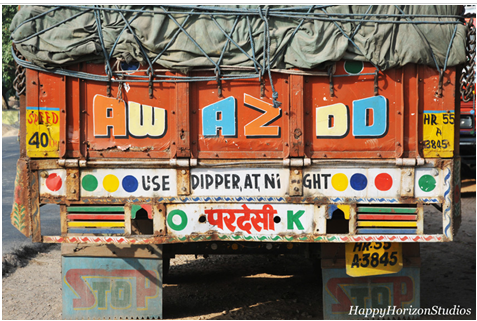
Sounds familiar? It losely means:you with the evil eye, may your face turn black. Does this remind you of anything? I guess for Indians the question should be how many such phrases do you remember?

HORN OK PLEASE/AWAZDO/HUM DO HAMARE DO/and most common ‘JAI HIND’

I am sure that the list could be endless with a gazillion kinds of messages having tones that are quirky, humourous, funny, cunning, spiteful, romantic, ambitious, fanatic, patriotic and sometimes absolutely ‘WTF kinds’! And I am talking about the messages that are painted on the back of trucks in India

See here, for a good detailing of some history behind some of the most popular write ups on the back of trucks. A infotainment indeed.

Besides my realisation of the obvious ‘service’ that they do to the roads by lighting up moods, igniting conversations and sometimes even helping drivers stay awake, what was interesting for me is the phenomenal reach and the audience that each truck (or even an autorickshaw in a city) has in India.

It is in this context that I felt a creative to be hitting on the ‘desi cool’ theme.

Brand Titan Eye+ (clock here for a larger view of the picture below)

Though the creative is interesting and has a real ‘desi cool’ ethic, I am not sure how impactful or even relevant that would be for the kind of consumers that Titan Eye + wants to speak to (why? that’s a different post altogether). Unless this is part of a larger 360 campaign that spans across all relevant touch points, I am sceptical about its success (of this single medium) in delivering results as claimed above.

While reading about trucks in India, another interesting thing that I came across is this new ‘genre’ of monoploy game that the popularity of trucks has spawned.

Truckopoly, as the game is called as per the designer Shantanu Suman, is adapted and designed on the basis of the truck industry of India. The objective of the game is to become the wealthiest truck owner through buying, renting and selling property and goods across the country. The game involves various rules that have to be followed by the truck drivers while transporting goods from one city to another. The challenge is to stay on the top while incurring losses in the form of fines and penalties.

A cool idea that can be translated to the digital realm and marketed as the desi farmville’s of the world. Has there been any popular online Indian game that has captured the imagination of kids and adults alike in the new milieu? Good ideas, seeded through the right channels with decent funding and some innovative marketing is all that it could take to make it big. Hmm.. some food for thought there?