The Worst Hotel In The World

In a very small (80 page) book called The Dip, one of Seth Godin’s contentions is that whatever we chose to do (in life and for a living) it is imperative to be THE BEST in it – THE BEST in your world, THE BEST in your market, THE BEST for your consumer, THE BEST for a specific need etc. Else, he says, there is little reason to stick to doing/pursuing/selling something and one is better off quitting the very pursuit.

It’s interesting how one specific budget hotel in Amsterdam exemplifies itself as a proof of concept for Seth’s point on being ‘THE BEST’ in the world. Enter the Hans Brinker Budget Hotel in Amsterdam.

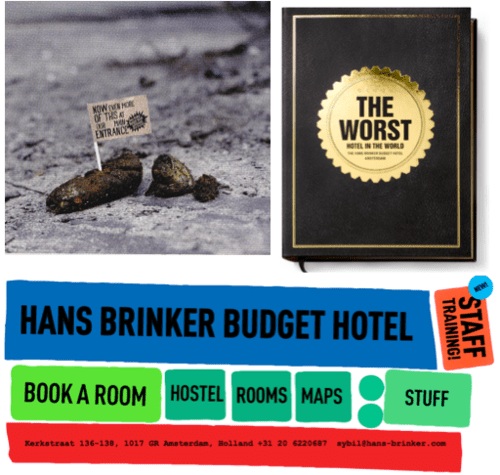
What is so special about this place? It is obviously cheap, arguably seedy, apparently run down and potentially awful. And this is all expected regular fare from most backpackers or a super cheap budget hotel that your thrifty friend recommends from his travels or some sort of a ‘hostel’ that you get compelled to chose in the last moment devoid of budget/options or time. What sets this hotel apart from the others is that it actually prides itself at being The Worst Hotel In The World!

Conceived by KesselsKramer (their website itself is an eccentric, dynamically changing themed concept, and I am yet to get a grip over how ‘it works’ and how it ‘makes sense’),  an Amsterdam/London based agency led by Erik Kessels, the campaign is almost a case study of sorts. Purportedly with a brief to create buzz and thereby make a ‘branded noise’ to reach out to the young backpackers who are typically much too aware of the multitude of options to chose from when it comes to travel, accommodation, food, drinks and fun, it looks like a very well conceptualized campaign, and an extremely courageous one at that.

The following is what particularly interested me:

  • The Channels: It is indeed an Integrated Brand Communications campaign having different legs to it: Wacky Posters, Direct Marketing, ‘OOH’ (miniature promotional flags placed in Dog Poops around the city!), Digital (the website has a tastefully cheap look to it), a dedicated Youtube channel and an actual hardcover Book dedicated to the hotel (presumably as a PR leg)
  • The Execution: Across all those channels, it speaks in a very consistent tone: making a ‘serious joke’ of itself, playing onto your worst backpackers nightmares, promising absolutely nothing but the worst and highlighting its price point

Even more interesting are the results: 

  • It has become the most talked about hotel in the world in terms of the buzz (offline and online) that it generated
  • And ever since the campaign went live, it is said that the rooms have always been fully booked (a 42% increase in occupancy)
  • And the book has gone out and become a live case study of building a strong brand!

Go ahead, take time and browse through its website, and search for some of its communication material (by simply searching for the ‘Worst Hotel In the World’) and I am sure you would have some interesting bits to reflect upon.

A month ago when I blogged about how some brands have turned around a ‘hate-worthy’ attribute about themselves as a virtue, I had little clue about this case – an extremely unique, devastatingly dark in humor, decidedly cheap and funnily scary example of how a brand has actually gone ahead and touted itself as THE WORST IN THE WORLD.

And succeeded at it!

Pillars of Digital Influence and what it means for G+

As per the recently released report by the Altimeter group, there are 3 pillars of Digital Influence –  Reach, Relevance and Resonance.

(Image Source: Altimeter)

While it’s hugely instructive as a framework, what interests me is that can potentially explain many trends that we see play out in the digital arena today. Let’s take Google +.

Google+ does a great job at building strong foundations given its legacy and thereby straddles 2 of the 3 pillars of Digital Influence:

  • Reach:  G+ rides on a phenomenal user base that Google has built through Gmail
  • Relevance: given that most web journeys start with a search and given the dominant market share that google has in this domain, G+ can naturally syndicate itself through these multiple touch points and hence thereby have the ability to target with relevance (eg: highly targeted ads etc)

That said, there is a critical pillar that G+ is yet to figure out – Resonance. Why?

My hypothesis as follows

First let’s consider 2 obvious facts about social networks and how they scale:

Social Networks Scale with participation: It is known that the worth of a social network increases exponentially with the growth in the user base. In other words, the more friends of mine I see on a particular social network, there are greater chances that I buy into it. In fact that’s precisely why I ‘graduated’ from orkut to facebook a few years ago.

Social Networks scale with time: Secondly, the more time I spend on a social networking site, the more valuable it becomes for me, simply because over the years I would have built a network of friends, interests, groups etc. that I am interested in.

As a corollary to this – given that garnering a critical mass user base becomes the holy grail of any social networking site, it gets all the more elusive progressively for the newer social networking sites  as users find themselves within very high exit barriers.

So what does it mean in the context of Facebook Vs Google+?

Inertia: As facebook users, while I, along with millions of others have built our own social networks over the years and have started creating our own digital footprints, Google+ now asks me for my willingness, time, effort and patience to painstakingly recreate a similar network on Google+! Does this offer any scale for me as a user? Hardly.

The Proposition: Even in terms of its core proposition, G+ offers me a very similar value as a social network as that being offered by facebook and doesn’t offer me anything differentiated (like say Linkedin). Does that entice me as a user? Hardly – unless I want to review it as a techie.

With all the recent news about Google+ over hauling its design of the interface and arguably even doing a great job at that, it doesn’t seem to be moving the needle in the right direction for G+.

It is here, I guess Pinterest has done an extremely smart thing – it offered a new platform for content creation and sharing and not necessarily a new social network. It just rides on the social networking footprint of facebook and focuses on what it does best – pinning!

And that could partly explain why Facebook finds Instagram as a very attractive acquisition – as it sees it more as an opportunity to acquire the ‘most valuable’ user base (most Instagram users are naturally content creators and not mere spectators or joiners) than as an acquisition of a photo-editing and sharing software.

It is really interesting and extremely instructive to see how Mark Z and his aides are mapping out Facebook as a Social By Design edifice strongly predicated on the 3 pillars of Digital Influence. Result: an enhanced social experience for users and value for marketers.