Targeted Sampling

OK. For almost 3 weeks in a row, I have been raving about a single topic – sampling. Couldn’t help it, as I seem to be (inadvertently) running into very interesting examples from around the world and across categories. Latest case in point, an interesting execution of ‘targeted sampling’.

Reports suggest that every year nearly 1 Billion USD is sunk into food sampling alone. So with ROI measures becoming ‘make or break’ metrics for most marketing initiatives, it is imperative that sampling also follows suit. Therefore an interesting challenge in sampling is:  how do you reach out and cater exclusively to your target. For eg, for an ‘adults only’ products (like Alcohol, Cigarettes, X rated stuff etc), how do you ensure that the recipients of the free samples are almost only adults? Solutions indeed come from the most unexpected quarters. This time it is the category of, believe it or not… pudding!

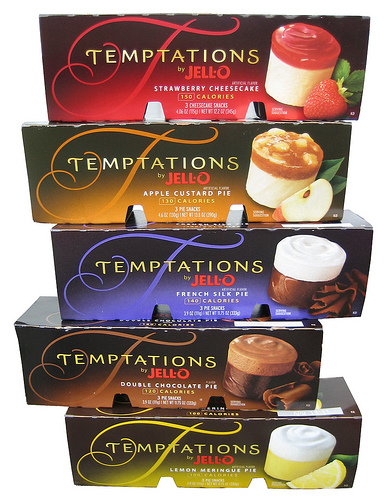
The story goes that Kraft has launched its line extension of Jell-O ‘just for adults’, under the name Temptations. What separates it from the regular Jell-O variants is that it is low in calories (the copy actually says “150 well behaved calories or less”) and available in 6 different flavors like Lemon Meringue Pie, Apple Custard Pie, French Silk Pie, Double Chocolate Pie,  Raspberry Cheesecake, Strawberry Cheesecake.

Now, line extension to a target group that is not your regular base can be challenging. So how did Kraft try to pique the interest of ‘adults’ regarding a product that they had only known as kids?

Well, certainly a well executed TVC was very much in their arsenal.

While the TVC arguably does a good job at making ‘adults’ (and I would bet, more kids than adults) sit up and take note; and in a number of instances peaks their curiosity just enough to merit a purchase, how do you take this to the next level at the last mile ‘the point of purchase’? Sampling, of course.

Now if Jell-O Temptations were to execute unrestricted sampling, they would be faced with a very real challenge – kids. So how would you execute sampling targeted exclusively to adults? Kraft tied up with Intel (agency: CP+B) to roll out a set of ‘first of its kind’ vending machines that dispense free Jell-O’s almost only to adults. And if you are a kid, you’d get the following message 🙂

Essentially the camera in the vending machine scans the user’s face and calculates the distance between the user’s eyes, ears and nose to categorize him/her as a kid or an adult. While this approach might not be 100% fool proof in all cases, it is certainly a remarkable marketing initiative – for a number of good reasons.  The following video shows the interaction in more detail.

While being positively hilariously and deliberately tongue in cheek in its approach, I have a feeling that Jell-O successfully crosses the chasm and cements that bond with their new target group.

Extending to new target groups can indeed be challenging, interesting and sometimes frustrating. Reminds me of Lego’s recent bid to woo girls, AXE recent foray into deos for her and the brilliant examples of Harley Davidson’s targeting of women bikers. But more about these cases in a later post.

Do you know of any interesting instances of brands extending to the “other 50%”?
Sampling Experiences

One of the topics of my previous post was sampling. While there could be a good number of campaigns out there that understandably do a go job at sampling ‘products’, how do you execute sampling of services and experiences? I wondered.

And then I discovered Hunger Delivery

There are campaigns for NGOs that have tried to tug at your heartstrings in order to make a point and evoke your empathy (and in some cases, sympathy). But what if you are made to actually experience the cause that an organization is fighting for? In other words what if you are inadvertently compelled to sample the experience? And what if the experience is ‘hunger’? The Food Bank Foundation tied up with 2 pizzerias in Paraguay and executed the following campaign.

It could require guts to execute something like this (in fact it could almost be impossible to be executed in a number of markets given the expected temperament and potential consumer backlash characteristic of these markets). The results shown in the above video notwithstanding, I am not sure if this campaign has actually offended or ended up alienating any of their consumers. But a noteworthy campaign by any standards! Hats off to the Pizzerias that have offered to be part of this campaign even if it was for one single day. (Agency: TBWA/Oniria)

Interestingly, I also learnt that there exists a near parallel for this campaign in Spain, albeit for a TV Show.

Alcatraz Delivery

Alcatraz is an American TV series; a thriller based on the namesake Alcatraz Prison, from where all the prisoners and guards had mysteriously disappeared in 1963. The execution apparently was to make people sample the prison experience without them having to leave their homes. See the case study video here.

Alcratz reportedly was a success on its opening, given the buzz it has managed to generate with this campaign. (Agency: Leo Burnett Iberia).

Again a gutsy attempt, but I have mixed feelings about this as it almost inflicts an unpleasant experience upon unsuspecting ‘viewers’ and doesn’t make up for it (as the Hunger Delivery example did). May be it succeeds at planting an intriguing thought in your mind, but I somehow get a feeling that it appears to have tried a little too hard at it.

What do you think?

Any other ‘sampling of experience’ examples that you know of?

Wash Your Bill + Space For Rent

Sampling and Coupons.

Let’s start with ‘sampling’ – the initiative through which marketers offer consumers an opportunity to try out their product/service for free or for a nominal charge, so that they get a first hand experience and thereby form an opinion about the offering. The philosophy? Trying IS believing. TrendWatching.com calls this TRYVERTISING. Everyone of us have at some point or other been offered free samples or a chance to try out something for free. But how many of those do we remember? How many of those experiences have left an impression on us and carved a niche for themselves in our mind?

As with all other marketing executions, the key challenge for sampling is to stand out as a memorable message delivered through a touch point that is innovative, relevant and remarkable (as in ‘Remarkable’ = Anything that is worth making a remark about). Though it sounds like an obvious statement to make, identifying and executing sampling through touch points that are relevant (to the target consumer) can become an uphill task as we descend down the ‘ladder of involvement’. In other words, while a bedroom furniture store’s idea of offering customers nap for free, may not sound like a ingenuous mattress sampling idea, I would think that it requires a good deal of ingenuity to think of innovative, distinct and relevant sampling avenues for low involvement product categories.

Take for example, the category of Dish Washing Sponges. How do you introduce them to a new demographic like the Youth? How do you deal with the challenge of being ‘innovative’ and ‘remarkable’ when you speak about something as boring/avoidable as Dish Washing to a segment of consumers who are as ‘challenging’ as the Youth? 3M’s Scotch Brite did it in Brazil. The Wash Your Bill Campaign. See the video for all details.

A fun way of reaching out to a new demographic, through touch points and instances that are remarkable  and innovative. It has all elements to be sticky. Surprises you, delights you, compels you to share the experience, and makes you speak about it. The following screen shot says it all about the potential of this.

A great example of sampling executed in a cool way!

Now let’s get to ‘coupons’.

How do you make coupons sound serious? Like serious money? By making it sound as a real business deal, so that the consumers have a ‘real’ stake in the equation. IKEA is known to be ‘Out of the Box’ when it comes to its marketing. Recently, in Australia it has come up with, what I think is a fantastic campaign called ‘Space for Rent’. Executed by 303Lowe, this campaign spans the entire 360 spectrum of touch points to reach out and target the consumers that are willing to ‘rent out some space for IKEA’.

Hang on..did I say consumers renting out space for IKEA and getting paid in return? Indeed. Watch the video here.

What I loved is the sheer genius of the solution. It smartly repurposes the whole question and turns it around into an almost irresistible offer. Kudos to the team behind it!

Another innovative ‘couponing’ example is the recent emart’s 3D QR code campaign to generate traffic during the non peak hours in Seoul. See the video here.

What I liked about this campaign is that it almost creates a sense of urgency, owing to the 60 mins time window of 12-1PM when the Sun just about helps you get a QR code out of those strategically placed installations. And thereby spurs you and entices you to take action.

Nice finds for the week.

And you thought ‘sampling’ and ‘coupons’ were dirty cheap words?

Technology: Catching up with Human Behavior

What is the most expensive piece of real estate in the world?

Many know that it is – arguably – the white space on the Google home page. Obviously it was a user interface design principle laid out by the founders of Google to keep its interface as clean and simple as possible. We know that it is user centered design at work. The fonts, colors, sizes, layout and design of every single element on every single page of Google are known to be ideated, brainstormed, prototyped, tested, validated, fine tuned and refined before finally dishing it out to the end user. The objective: to facilitate the user’s interaction and her journey of finishing the task at hand without drawing unnecessary attention to itself.

  • That’s what has made Facebook dramatically redesign its interface – The Timeline
  • That’s what makes Twitter roll out changes/improvements in its interface on a continuous basis
  • That’s what makes Apple.com to be consistently ranked as the Best Designed Website in the world
  • That’s what stokes the passion flames in Mac fanatics and equally…
  • That’s what is creating great levels of anticipation for the next iteration of Microsoft Windows as it is slated to be a game changing redesign of its UI to what is called as the Metro interface.

That’s all good and inspiring. But if we take a step back and ask ourselves why is this so pertinent to the current world order, the answer could be simple. Information.

Simplistically put, computers, web portals, websites, web browsers and Operating Systems are nothing but our interfaces for information consumption, data processing and finally content creation. Given that the information that is becoming available online is growing by leaps and bounds by every passing second, it is but natural that user interface design takes utmost precedence. The goal: Facilitate information consumption to be as intuitive as possible.

What further complicates the access and consumption of this boundless information is this word called ‘social’. Given that information is increasingly taking social attributes and contexts of time and space (almost in real time) the complexity of information retrieval has seemingly multiplied over night. Hence the goal now is not just to make information consumption as intuitive as possible, but also as instinctive as possible.

For e.g. if you want to search for restaurants in a new town, you naturally Google for it, pick some names from the search results, read their reviews on Yelp and then choose one that looks promising for your needs and budget. Of course search engines are now dishing out the search results in such a way that all these activities can be collapsed to one single search action. That could be intuitive design at work.

Now comes the interesting part. What if you know of a friend who lives in that town or who had visited that town recently? Naturally you would give her a buzz and take her recommendations and bingo your search is complete! It is instinctive of us to seek out references/ advice / suggestions to many things that we search for from the people that we know and trust. That’s how we fundamentally seek out information.

Sounds very natural isn’t it? Only, our online search experience has been antithetical to this very social attribute that we humans are instinctively used to. Not any more, the guys at Microsoft seem to say. See the video here.

In what looks like a paradigm shift in search, Bing has announced today that it is soon going to make search socially relevant to you like never before. Read the full story on this post on Bing’s blog.

This has many interesting ramifications.

  1. Everyone is now a key influencer: If I like Nikon on my Facebook page, a friend of mine searching for this brand on Bing could potentially get to know of my affiliation to this brand and can thereby start a conversation with me. And given that I already ‘like’ Nikon, chances that I would recommend this brand to her are high.
  2. Marketing on Facebook can now become even more challenging (and expensive): Facebook ‘Likes’ can become much more valuable than they are now and could even be monetized a la AdWords
  3. Online Privacy: Online privacy is slated to become even more complex and interesting as Social Networks evolve into these bigger entities
  4. Trust, Connection and Attention as the core assets of ‘connection economy’ can be radially redefined (for good or for worse)
  5. Mashup: This could open up very interesting possibilities of mashing up info from geo tagged sources, social networks, along with conventional web pages to make search results even more relevant and contextual in terms of time, space and connections.
Facebook is known to quote often that “Technology is now catching up with human behavior”. And today they seemed to have proven this again with Microsoft.
I Like!

Stories, Grommets and Epipheos

This is the latest in the series of cartoons by Hugh MacLeod as featured on his blog GapingVoid. While I totally agree with his point on how conversations change when the markets change, I want to add further to it or take the liberty of phrasing it in a slightly different way by saying “all evolutions in marketing are evolutions of stories, the narratives, or chronicles”.

KONY has been phenomenally viral. It is a story well told.

Charity Water tugs at your heart. It is a story well told.

Innocent makes you look at smoothie in a new light. It is a story well told.

Stories simplify, humanize and lend emotion to messages about products, services and causes and thereby make them unique and authentic for us. When a brand tells me its story, it plants its idea in my mind and thereby becomes more potent. When I know the story, I suddenly begin to care. That’s why more and more videos in Kickstarter are about a ‘story’, that’s why people go to ‘About Us’ page in most sites/blogs that they visit, that’s why you might find yourself intently reading the story of a restaurant as printed on the first page of its menu even before you get to the appetizers section, that’s why you might even relish and appreciate the coffee at your local coffee store. That’s why Facebook brand pages with a well designed timeline tend to come across as more interesting and humane narratives.

As a marketer I find this to be one of the most inspiring tenets of the practice. When I realize that it is all about story telling, things suddenly seem to take newer shapes of significance and bring newer things into perspective. It then begets questions from a consumer standpoint and demands for a spiel that a consumer can care about.  That I can relate and relate to as I share it with my friends. Branding as Story telling isn’t to be confused with some smartly concocted campaign ideas or executions. It is much more than that and encompasses all the elements of the mix and binds them to a unique, authentic core.

I am definitely not an expert at this but there are tons of resources available that offer help on the science and art behind branding as story telling. That said, let me highlight 3 interesting trends that are panning out in the realm of story telling in various realms.

1. Luxury brands are showing greater proclivity to adopt story telling strategies: Some examples: Vitra – the maker of master piece furniture is turning to story telling – read the story here. Read an account of Lady Dior Saga in this post on Luxury Story Telling.  And finally, the Chanel No5 film – need I say more!

2. Story telling at a personal branding level: For starters, I could argue that most brands in high involvement categories that you buy today, you do so with a conscious, painstaking thought and consideration on what story it could tell of you. As an other example read a trend briefing here regarding the shift from brands telling a story to brands helping consumers tell ‘status-yielding’ stories about themselves to other consumers.

3. Content consumption as story telling: Visual story telling is fast becoming a new standard in content curation and consumption. ‘Infographics’ are redefining this field rapidly. In fact it is said that over the past 2 years, infographic search volumes have increased by over 800%. There is even a site full of ‘visual summaries’ of this year’s SxSW event!

Obviously, story telling is no more about just making films, writing screenplays or devising plots. It is much much than that and the following 3 examples are a testimony to it:

Daily Grommet: This innovative site uses the art of story telling to sell a product a day. A new product is featured every day in a video with a story and an account on why this product has made the cut on this carefully curated video blog.

Epipheo: There is this ‘story telling studio’ that helps people/companies/brands tell stories about their new ideas, products or even technologies with what they call as ‘epipheos’. I would strongly urge you to see its video on Siri here and you would know why Epiheo has clients like Google, Facebook, etc.

And finally there is Get Storied that is all about teaching entrepreneurs how to tell their story. Never before was story telling so critical a part of pitching as business plans, revenue models and risk mitigation strategies had been for VCs and investors by budding entrepreneurs. Story telling is THE thing in pitching now.

Now, that begets the question – what is your story?

The Worst Hotel In The World

In a very small (80 page) book called The Dip, one of Seth Godin’s contentions is that whatever we chose to do (in life and for a living) it is imperative to be THE BEST in it – THE BEST in your world, THE BEST in your market, THE BEST for your consumer, THE BEST for a specific need etc. Else, he says, there is little reason to stick to doing/pursuing/selling something and one is better off quitting the very pursuit.

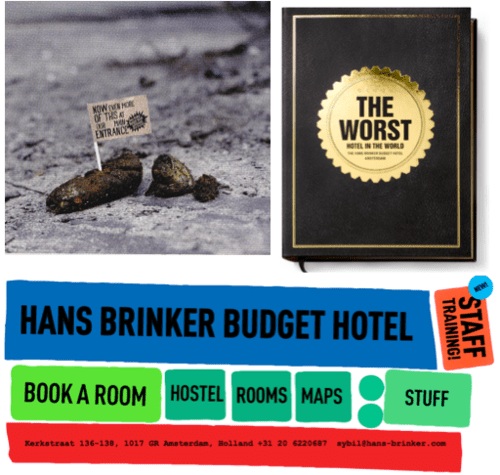
It’s interesting how one specific budget hotel in Amsterdam exemplifies itself as a proof of concept for Seth’s point on being ‘THE BEST’ in the world. Enter the Hans Brinker Budget Hotel in Amsterdam.

What is so special about this place? It is obviously cheap, arguably seedy, apparently run down and potentially awful. And this is all expected regular fare from most backpackers or a super cheap budget hotel that your thrifty friend recommends from his travels or some sort of a ‘hostel’ that you get compelled to chose in the last moment devoid of budget/options or time. What sets this hotel apart from the others is that it actually prides itself at being The Worst Hotel In The World!

Conceived by KesselsKramer (their website itself is an eccentric, dynamically changing themed concept, and I am yet to get a grip over how ‘it works’ and how it ‘makes sense’),  an Amsterdam/London based agency led by Erik Kessels, the campaign is almost a case study of sorts. Purportedly with a brief to create buzz and thereby make a ‘branded noise’ to reach out to the young backpackers who are typically much too aware of the multitude of options to chose from when it comes to travel, accommodation, food, drinks and fun, it looks like a very well conceptualized campaign, and an extremely courageous one at that.

The following is what particularly interested me:

  • The Channels: It is indeed an Integrated Brand Communications campaign having different legs to it: Wacky Posters, Direct Marketing, ‘OOH’ (miniature promotional flags placed in Dog Poops around the city!), Digital (the website has a tastefully cheap look to it), a dedicated Youtube channel and an actual hardcover Book dedicated to the hotel (presumably as a PR leg)
  • The Execution: Across all those channels, it speaks in a very consistent tone: making a ‘serious joke’ of itself, playing onto your worst backpackers nightmares, promising absolutely nothing but the worst and highlighting its price point

Even more interesting are the results: 

  • It has become the most talked about hotel in the world in terms of the buzz (offline and online) that it generated
  • And ever since the campaign went live, it is said that the rooms have always been fully booked (a 42% increase in occupancy)
  • And the book has gone out and become a live case study of building a strong brand!

Go ahead, take time and browse through its website, and search for some of its communication material (by simply searching for the ‘Worst Hotel In the World’) and I am sure you would have some interesting bits to reflect upon.

A month ago when I blogged about how some brands have turned around a ‘hate-worthy’ attribute about themselves as a virtue, I had little clue about this case – an extremely unique, devastatingly dark in humor, decidedly cheap and funnily scary example of how a brand has actually gone ahead and touted itself as THE WORST IN THE WORLD.

And succeeded at it!

Pillars of Digital Influence and what it means for G+

As per the recently released report by the Altimeter group, there are 3 pillars of Digital Influence –  Reach, Relevance and Resonance.

(Image Source: Altimeter)

While it’s hugely instructive as a framework, what interests me is that can potentially explain many trends that we see play out in the digital arena today. Let’s take Google +.

Google+ does a great job at building strong foundations given its legacy and thereby straddles 2 of the 3 pillars of Digital Influence:

  • Reach:  G+ rides on a phenomenal user base that Google has built through Gmail
  • Relevance: given that most web journeys start with a search and given the dominant market share that google has in this domain, G+ can naturally syndicate itself through these multiple touch points and hence thereby have the ability to target with relevance (eg: highly targeted ads etc)

That said, there is a critical pillar that G+ is yet to figure out – Resonance. Why?

My hypothesis as follows

First let’s consider 2 obvious facts about social networks and how they scale:

Social Networks Scale with participation: It is known that the worth of a social network increases exponentially with the growth in the user base. In other words, the more friends of mine I see on a particular social network, there are greater chances that I buy into it. In fact that’s precisely why I ‘graduated’ from orkut to facebook a few years ago.

Social Networks scale with time: Secondly, the more time I spend on a social networking site, the more valuable it becomes for me, simply because over the years I would have built a network of friends, interests, groups etc. that I am interested in.

As a corollary to this – given that garnering a critical mass user base becomes the holy grail of any social networking site, it gets all the more elusive progressively for the newer social networking sites  as users find themselves within very high exit barriers.

So what does it mean in the context of Facebook Vs Google+?

Inertia: As facebook users, while I, along with millions of others have built our own social networks over the years and have started creating our own digital footprints, Google+ now asks me for my willingness, time, effort and patience to painstakingly recreate a similar network on Google+! Does this offer any scale for me as a user? Hardly.

The Proposition: Even in terms of its core proposition, G+ offers me a very similar value as a social network as that being offered by facebook and doesn’t offer me anything differentiated (like say Linkedin). Does that entice me as a user? Hardly – unless I want to review it as a techie.

With all the recent news about Google+ over hauling its design of the interface and arguably even doing a great job at that, it doesn’t seem to be moving the needle in the right direction for G+.

It is here, I guess Pinterest has done an extremely smart thing – it offered a new platform for content creation and sharing and not necessarily a new social network. It just rides on the social networking footprint of facebook and focuses on what it does best – pinning!

And that could partly explain why Facebook finds Instagram as a very attractive acquisition – as it sees it more as an opportunity to acquire the ‘most valuable’ user base (most Instagram users are naturally content creators and not mere spectators or joiners) than as an acquisition of a photo-editing and sharing software.

It is really interesting and extremely instructive to see how Mark Z and his aides are mapping out Facebook as a Social By Design edifice strongly predicated on the 3 pillars of Digital Influence. Result: an enhanced social experience for users and value for marketers.

Social Dissonance – Blasphemy or Opportunity?

Unlike.

I am sure that most people who use Facebook must have felt a pressing need for a  an ‘unlike’ button at least once so far. There are a lot of irritatingly clichéd, painfully faked, ostentatiously humane kind of shares, messages, pics and videos out there so much so that you would sometimes cringe at even a hint of such posts. Give me an ‘unlike’ button or better still ‘hate’ button – you might yearn, at such times!

The bad news obviously is that Facebook bans even the usage of the words ‘hate’ or ‘unlike’ in the Apps and hence developers are told that it is a strict ‘NO GO’, evidently in the spirit of fostering more inclusive communities, curating  conversations and triggering engagements that are more positive in nature.The good news however is that very recently, a new kind of App has come into the ‘Social AppSphere’ that kind of comes close to this ‘dislike’ / ‘hate’ kind of intent. Records say that it became so controversially popular that it had got more than 10,000 users in just 36 hrs.  Enter EnemyGraph.

Created by a Dean Terry and his Grad Student Bradley Griffith (at University of Texas at Dallas), EnemyGraph essentially is a Facebook App that lets you identify, create and share your enemies list with your friends online. I have to admit that when I first heard of it I wasn’t very impressed by the idea. It smacked of something that’s trying hard to be innovative by deliberately trying to think different. But before pursuing the story further on the WWW, I froze in my heels and tried to argue with myself to see if there is something more to it.

Let’s get back to the basics – What are communities? and how are communities built? Wikipedia defines a community as a group of people that share common values and are bound by ‘social cohesion’. Now these vibes of cohesion or a shared set of values/beliefs are nothing but those that are created out of very strong affiliations – affiliations that are overwhelmingly positive or negative in sentiment.

So any strong sentiment that is overwhelmingly positive or negative in nature turns out to be a potential binding force for bringing together groups of people as strong communities. This very insight must have triggered this ingenuous attempt to foster and leverage upon the seeds of social dissonance planted in the social media landscape.

At a very simplistic level, assume that you like Justin Bieber, but one of your friends lists him as an “enemy.” EnemyGraph will send you a “dissonance report,” pointing out the difference and offering it up for conversation. What is actually happening here? Dissonance always tends to capture people’s attention. So when I know that something that I like, is hated by my friend (or vice-versa) it  makes me pause for a while (even in the occasional social media ‘rush hour madness’) and compels me to reflect upon this new equation, this new conversational dynamic and makes a participant out of me. Isn’t that cool?

Sadly the founders themselves feel that this could soon be seen as a blasphemy by Facebook as it could go against their social media philosophy, and hence fear that it could soon be shut down by Mark Z and his aides.

I, for one believe that there is a phenomenal opportunity in the idea – as a consumer and more importantly as a marketer. Interesting co-incidence that my previous blog post was about brands that have sought to create a distinctive and (in some cases like Marmite) an almost irresistible kind of proposition by using a HATRED related angle.

Let’s take Marmite as an example.To take their positioning that you either love it or hate it, to the next level, it could potentially have ‘fans’ (or let’s’ say active participants of a community) who declare their authentic affiliations towards the brand on their Facebook page. Tons would love/like it (as the pouring online evidence shows). Many could even hate it (as the brand communications boldly state). Just imagine. If there were to be an EnemyGraph kind of platform that helps the brand to capture these strong dual affiliations online, wouldn’t that be a very powerful source that truly reinforces its fundamental brand truth and thereby its iconic appeal?

From Marmite’s part, agreed that it requires a meticulously careful management of this love/hate relationship as it pans out in real time online and a very mature capability of curating content around that community in the over all interest of the brand.  Agreed that it could be a leap of faith for the brand (as things can very rapidly go downhill online if mismanaged). But we are speaking about a brand as iconic as Marmite, a brand that has literally taken a leap of faith nearly 3 decades ago and amazingly embraced the magical possibilities of a proposition like “You either love it or hate it”. Aren’t we 🙂

Lasltly, to sign off and to quote Dean Terry..

“You learn a lot about people by what they dislike.This app opens the door to wondering if there’s a way to draw people together against something that in turn results in positive social change, or at least brings [people] together in new ways.”

And yes, do check out the EnemyGraph site, it even has a “Trending List of Enemies”. And guess who is in the top 5 list? Internet Explorer – the browser that you loved to hate!

Marmite, Mouthwash and Microsoft

Marmite and Listerine are often quoted as common examples for a peculiar kind of reason – HATE.

These are classic examples of brands that have spun a hatred related angle into a brand positive. Just as a very quick recap, for the uninitiated.

Marmite – An English brand is essentially a Yeast Extract commonly used as bread spread (and many others) and is known for a very.. let’s say peculiar kind of taste – that has nearly polarized the world into 2 camps: People who love it and people who hate it. Through the decades it has established itself as a truly iconic brand based on just this simple ‘brand truth’ – you either hate it or love it. In fact it goes the extra mile in communicating to us that people who hate it do indeed find it repulsive to the highest degree.

Listerine – on the other hand was originally known for its very ‘non inviting’ medicinal kind of taste. When competitors began to launch mouthwash known for its ‘good taste’, Listerine smartly (and courageously) stuck to its ground and attributed its ‘virtues’ to its taste – that people hate twice a day.

Through the years, these brands have leveraged upon this ‘HQ’ (Hatred Quotient) and spun it into an incredibly positive sounding/ stimulating discourse about themselves.

(Source for the classic Listerine Ad)

Spurred by these very interesting examples of brands using ‘hatred’ as a nearly irresistible proposition, I tried to search around and see if there are any other similar examples. After about a few unsuccessful days of online crawling for ads/ brands/ campaigns high in HQ, I was almost about to give up when I stumbled into this.

The browser that you have loved to hate campaign by Microsoft.

Essentially this was a campaign for the launch of the ‘newest’ browser from Microsoft – IE9. See the cheeky/ballsy video here. In a nutshell, the campaign idea seems to be predicated on what is meant to be an honest disclosure from Microsoft. “We gave you a crappy product – you obviously hated it – we listened to you – we now confess our bluff – and hence we present to you a newer version of the browser that you had loved to hate”

See the official tumblr page here. Some highlights of the campaign as seen through the tumblr page:

  • The site reflects the new penchant that Microsoft seems to be developing for self mockery
  • But again (just seconds after you buy into the mockery confession), Microsoft tries to get into a more serious discourse on ‘comebacks’ with some seemingly unrelated examples of how comebacks come in many shapes and sizes (by speaking about moustaches, birds, false perceptions of reality, bikes that are hard to ride etc!!!)
  • The 2nd page has a list of all reviews of the IE9 from different sources while the 3rd page is a pin board of different tweets extolling the IE9

Now taking a step back and pulling all these 3M’s (Marmite, Mouthwash, Microsoft) together, I guess, these brands/executions are more different than not from each other. Fundamentally the reason they jumped into the ‘HQ’ bandwagon is for very different purposes.

Marmite –the story goes, that these 2 creatives (Flintham and McLeod) from DDB London didn’t actually set out to think of any new slogan. In fact it just struck to them as a fundamental brand truth as that’s how Flintham and McLeod saw the brand ; While Flintham loved the spread, McLeod hated it and thus was born a powerful idea that was then presented to the client, who in turn courageously embraced all its possibilities. The rest, as they say, is history. In essence, You either love it or hate it – has been the fundamental brand truth and thereby the core positioning that it had and still has in the minds of the consumers.

Listerine, as mentioned above, got into the hatred related discourse only in response to a competitive onslaught. Over the years, Listerine has been launched in various flavors most of which are more inviting and non medicinal in taste as opposed to the original Listerine. Naturally it is no more using this erstwhile campaign around the taste that people hate twice a day, as this was originally meant to be a tactical response and not much of a strategic initiative from the part of the brand.

Microsoft IE9, I guess, is a tricky case. It is neither a strategic move (obviously) and nor is it a tactical initiative. I guess it has been envisaged as a stand alone campaign to create awareness about the new browser – presumably by trying to ‘cut through the clutter’. In simple words, Microsoft, I guess wanted to gate crash into your chrome/firefox browser experience by entertaining you with a video of self mockery and reminding you that it is the browser you loved to hate, hoping that you would find it funny and thereby pass it over to your friends. As a result of the ensuing viral phenomenon it expects that it could count upon a good number of downloads and hopefully some converts along the way. Period.

The browser you loved to hate campaign reminded me of the Domino’s Pizza campaign aired 2 years ago. But what differentiates both is that the Domino’s campaign was not a self mockery exercise for fun, it had elements of communicating a serious, critical, introspective and an honest look that they had cast upon their own products, talked with the consumers and thereby made what they call as a ‘PIZZA TURN AROUND’.

On the contrary, the IE9 campaign puts its own authenticity into question, especially when you become aware that the IE8 was launched in 2010 with pretty much similar fanfare and positioned as a browser that enables you to browse with confidence. And just after an year it comes out and tells you that it’s actually a browser that you could potentially have hated. Wow! from selling ‘confidence’ to seeding ‘hatred’ – that was quite a journey!

Are there any other brands that have sought to ride upon the HATRED bandwagon?

Power of Imagination. Unleashed

It’s funny – I just realized a recent happening in the world of brands that has, in a queer way, connected my previous 2 blog posts.

Speaking about Apple and Minimalism, I have posted designer Wonchan Lee’s much acclaimed minimalistic posters that are inspired from Pixar’s famous characters.

You would see that in each of these posters, Wonchan Lee has sought to, and incredibly succeeded at, bringing out  the personality of each character by using almost only the eyes, and leaves no doubt about who these characters are (to someone who is familiar with these movies – Up, Wall-E, The Incredibles, Monsters Inc, Monsters Inc (Sully), Toy Story, Ratatouille and Finding Nemo – in that order). His website says that each of these posters come in Synthetic Matt finish and an A3 size comes for 25$. Given the pull factor that these minimalist posters could have, as they challenge the viewer and plays with his/her imagination, I am sure these would have many takers – potentially also spawning fakes!

Cut to my previous post on brands that use the inherent limitations/constraints of their ‘system’ to create a commonly identifiable set of shared experiences among the user base and thereby make ‘tribes’ of them. One of the examples that I wrote about was Lego – a brand that was literally built by its famous and consistent ‘Lego bricks’. My argument was, given that each of these bricks are functionally similar to each other (for over decades!), they come with very similar set of capabilities and constraints for any given user across the world. Thereby any interesting possibility that can be realized out of these bricks tends to be limited only by the user’s imagination and subsequently spurs the other members of the tribe as an inspiration or a challenge. If you stop for a moment and reflect upon these dynamics, it would be evident that Lego is also speaking (in a focussed way) to an adult (as a potential consumer), an adult who loves to exercise his creative/exploratory capabilities to his/her ‘playful fullness’; an adult who is imaginative and yes fun loving.

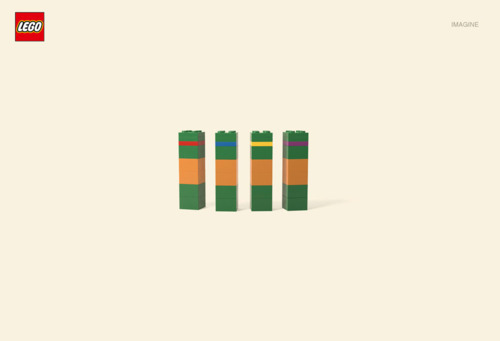
Probably it is along these lines that Lego has commissioned the following line of Print Ads with the help of an agency named Jung von Matt.

(Source)

Essentially, these are minimalistic interpretations of popular cartoon-characters. Can you guess who’s who? I loved their simplicity and the power of imagination that is evoked by these executions. Squarely hits at the bulls eye of their ‘adults’ target group and seeks an undivided quantum of their attention by means of this ‘Guess-Who’ kind of dialogue/challenge that they are playfully throwing at them.

Being, not super comic-savvy, I set out to Google around and tried to build parallels with the actual cartoon characters referenced in these executions. Following is what I could knit together as an exercise for myself.

(Cartoon referenced: South Park)

(Cartoon referenced: Uncle Scrooge and the nephews: Huey, Dewey, and Louie)

(Cartoon referenced: The Simpsons) – this is my 2nd favourite!

(Cartoon referenced: Asterix, Obelix and Dogmatix)

(Cartoon referenced: Teenage Mutant Ninja Turtles) – this is my 1st favourite!

(Cartoon referenced: Bert and Ernie)

I should say that I am very inspired by this upcoming trend in brand communications that seeks to engage the consumer, grab an undivided pie of their attention (even if it is for a sliver of a moment) and evoke their imagination so that they discover something by themselves and thereby are entertained.

That is the power of imagination. Unleashed.