Making And Breaking Memory Structures

Quick Read: Generating awareness or influencing consideration, driving distinctiveness or establishing differentiation, the key is to effectively leverage memory structures.

Distinctiveness is said to be the key in driving penetration and hence growth. But what sort of distinctiveness is most effective? 

In other words, when a brand is launched/re-launched, how do you strike that elsuive balance –  between being rooted in the current to drive enough familiarity, yet bring in an element of newness to drive differentiation along a chosen set of dimensions to drive favorability. 

The key lies in memory structures. 

As this insightful paper says, while driving distinctiveness for a brand, a key consideration is how much of your mix should reflect the existing perceptions of your brand locked in consumers’ “memory structure”, and how much should break with this.

And why are memory structures important?

This is because, as per Phil Barden in Decoded, we are known to first process any new stimulus from a brand (advertising, packaging, activation) “implicitly”. This is a subconscious reaction based on our intuition & past experiences locked in our memory structures. And that’s where most of the heavy lifting is said to happen before the rational mind kicks in for decision making.
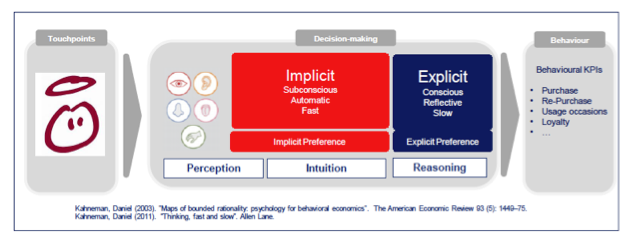
Blog Decision Making(Implict and Explicit processing of stimulus, Source)

So it must come as no surprise that some of the smartest techniques in creating awareness for new brands are those that do a great job at playing with our existing memory structures.

Two recent, notable (and slightly non traditional) examples.

Dumb Starbucks Coffee

Dumb Starbucks Coffee(The Dumb Starbucks Coffee store in LA. Source)

No it’s not a joke. This has been an actual store with everything from the signage, menu, the cup sizes, right till the music CDs sold by the cahsier looking exactly like that in a Starbucks Store, albeit with one small modifier – the word ‘DUMB’ as a prefix.

And why DUMB? Parody law. 

As this awesome FAQ reads: “Although we are a fully functioning coffee shop, for legal reasons Dumb Starbusks needs to be categorized as a work of parody art. So, in the eyes of the law, our “coffee shop” is actually an art gallery and the “coffee” you’re buying is considered the art. But that’s for our lawyers to worry about. All you need to do is enjoy our delicious coffee!”

Rated as one of smartest Guerrilla Marketing stunt by Comedy Central to generate buzz around their new show, this attempt created a social media sensation in just 2 days before it faced a ‘notice of closure’.

Despite being a shortlived ‘experiment’/art installation (or whatever we chose to call it), by playing smartly on our existing memory structures “Dumb Starbucks” proved itself to be an ingenuous idea from a venture that wanted a big bang for a small budget.

And boy did they get it!

CitizenM Hotels

Can you create awareness by challenging our existing memory structures of a category?

A new campaign from CitizenM hotels shows how. See the ad here

I liked how it evokes all the memories that we have of conventional hotels untill it just shatters them, thereby piquing our interest levels in the brand. In fact – depending upon the viewer’s context –  I would argue that it does a briliant job at more than just generating awareness.

All managed by neatly piggy backing on our existing memory structures of a category.

(H/T to L Bhat for the CitizenM film, and to Robert for this riff on Dumb Starbucks. Featured Image: source)

Ideas And Their Six Degrees Of Separation

Quick Read: Ideas, like people, could be said to have their own “6 Degrees of Separation” i.e., any idea in the world can potentially be related to another idea in the world with a maximum of 6 connections. And if this hypothesis is right, it can have major implications on marketing. 

What are you thinking right now? This comic by Richard McGuire appeared in 1990.

Richard McGuire(What Are You Thinking Right Now, Richard McGuire. Source)

While it is a wonderful comic and a fun reflection on how we think, for me it is a brilliant work that manages to encapsulate within the confines of a comic panel – the interconnectedness of our thoughts and ideas.

Speaking of which, just as this theory that any two people in the world can be connected to each other with a maximum of 6 steps, my hypothesis is that:

Any two ideas in the world can be related to each other in less than or equal to 6 degrees of separation. 

In other words, if you think of each idea as a node, I contend that you could potentially connect any two nodes in the “idea universe” with a maximum of 6 connections.

(One way of proving this could be as a corollary of the 6 Degrees of People Separation and mixing it with the notion that ideas make a man. And voila! You can have even a far right capitalist ideology being related to a far left communist ideology within 6 degrees of separation.)

people-exchanging-ideas-26061929(Ideas and connections, stock image)

Why is this fascinating? If the hypothesis is proven right, it can potentially have two major implications on how ideas can be sold.

Implication #1: 

Let’s take Recommendation Engines, the intelligence behind “If you like this, you might also like these” kind of recommendations that you see on Amazon

A good recommendation engine – in search, videos, online shopping, travel etc.,  has far reaching implications in delivering more relevant content to users, thereby driving sales and growing retention within the platform. In fact, as per many accounts, some companies have even gone so far as to realign their business objectives in light of recommender-driven demand, such as Netflix, Amazon, Microsoft, Disney and Apple.

Now, what if we abstract this concept of “six degrees of ideas’ separation” into an iterative, machine learning algorithm that can build up, in real time, a user’s idea map – i.e., a construct that maps out the interconnectedness of user’s ideas?

We can then perhaps use it as the back bone of a more powerful recommendation engine.

So instead of dishing out nearly hard coded, precedent based recommendations – with imperfect results –  what if the smart logic embedded in the recommendation engine can rapidly learn, iterate and replicate my idea map resulting in recommendations that almost feel like – mind reading?

That’s when I might be able to see breathtakingly personalised assortment of search results, advertisements, content and retail options appear in front of me almost at the speed (and diversity) of my thought.

Implication #2: 

Given that any of my existing ideas can potentially be connected to other ideas – and thereby products – out there, having an insight about my idea map can potentially help you sell me a new product/service. How?

By carefully structuring your sales pitch in a way that takes me gently through the different related nodes from my existing ‘idea state’ to a new ‘idea state’ that could probably help me better relate to your product.

Easier said than done, I am sure. But the outcomes here could be as thrilling as they could be scary – a signpost of every major scientific advancement over the last few decades.

On a related note..

If you enjoy the creative process of discovering and connecting disparate ideas into an insightful whole, check out Seenapse.

Seenapse

A creative technology start-up, Seenapse is an ‘inspiration engine’ that assists in your creative process by exposing you to non-obvious idea associations between seemingly disparate concepts. It is currently in a closed beta but you can get an invite by using the code: strandsofgenius. (source)

(Featured image source. H/T Austin Kleon for the riff on Richard McGuire and Faris Yakob on Seenapse)

—————————-

PS: This is my 100th blog post on BrandedNoise which got its 2020th subscriber today! A big thank you to all the readers out there who have been the source of my strength, inspiration and support. Looking forward to many more blog posts to come and a journey fuelled by creativity, curiosity and fun. A big thank you once again!!