The Overview Effect

Quick read: Overview Effect – a phenomenon from space travel can have some great creative parallels in the arts. 

There’s a strange phenomenon that happens to astronauts when they see Earth from space. Most astronauts describe this as a cognitive shift in awareness, a state of mental clarity or a sense of deep connection.

This state called the “overview effect,” occurs when you are flung so far away from Earth that you become totally overwhelmed and awed by the fragility and unity of life on our planet. It’s the uncanny sense of understanding the ‘big picture’ and a humbling appreciation of our infinitesimalness in comparison – all at the same time.

Recently, two creative technologists have created an oddly mesmerizing website that provides something approximating the ‘Overview Effect’ for the rest of us.

Check it out at astronaut.io

screen-shot-2017-01-30-at-5-31-47-pm
astronaut.io

Andrew Wong and James Thompson created an algorithm that picks YouTube videos fitting specific criteria: uploaded within the past week, with generic file names (IMG, MOV WMV) as titles, and zero views. And juxtaposed this seemingly endless stream of random videos against a view of our planet from low Earth orbit. (source)

The result is a fascinating glimpse at the mundane, perplexing, and oftentimes sweet events of everyday life juxtaposed against the monumental, mystical and often times sublime views of the planet earth.

The insight here could be about the possibilities that can be achieved w.r.t driving a shift in the viewers’ perspective when an object is made to interact with a meta object. E.g., what if a character in a story interacts with someone that typically exists in a dimension higher to that of the character, like the author? 

Let’s take two examples.

The Gunfighter

Think of an actor in a film as an object.

Now think of the narrator of this film. A narrator is conceptually meant to be at a degree higher in dimension or abstraction vs an actor in that film, in order for him to be able to narrate the story to us. Right?

But what if the actor in the film is made to interact with its narrator?

The result? See it for yourself here. The Gunfighter

Directed by Eric Kissack, The Gunfighter has won several awards across categories like best narrative, best short film, best comedy etc and was the official selection for various film festivals.

Old Mout Cider even commissioned him to shoot a film with the same narrative device for their ad. (see here)

The Museum’s Ghosts

This eponymous photography project by Andrés Wertheim is an experiment on similar lines.

the-museums-ghosts_andres-wertheim_munich11-adapt-1190-1
Photograph from The Museum’s Ghosts – Andrés Wertheim

The premise as stated by Andrés Wertheim is simple.

It is assumed that when people go to a museum, they carefully observe the paintings and sculptures and thoroughly read the explanatory panels.

But what if the characters portrayed in nearby paintings looked upon visitors while they aren’t paying attention, what unusual scenes would we find ?

Through double exposures made in camera, Andrés Wertheim merged in a single photoframe, both planes of the visible reality – the audience in a museum’s room and the portrayed characters on the same room’s walls – trying to create a dialogue between them.

The Museum’s Ghosts as a photography project, has also been featured in National Geographic for its creation of such surreal scenes that place art and its observers together in a new imagined dimension.

The bottomline

Whether it’s art walking off the walls to interact with the visitors of a museum, or the characters in a film being able to interact with its’ narrator, or a micro level human narrative getting juxtaposed against the macro level perspective of the planet earth, they all have one thing in common.

They are all examples of objects interacting with meta objects, compelling us to re-evaluate and reconsider our perspectives of the world within and around us – perhaps just like in the ‘Overview Effect’ as experienced by a space walker when looking back at our planet earth.

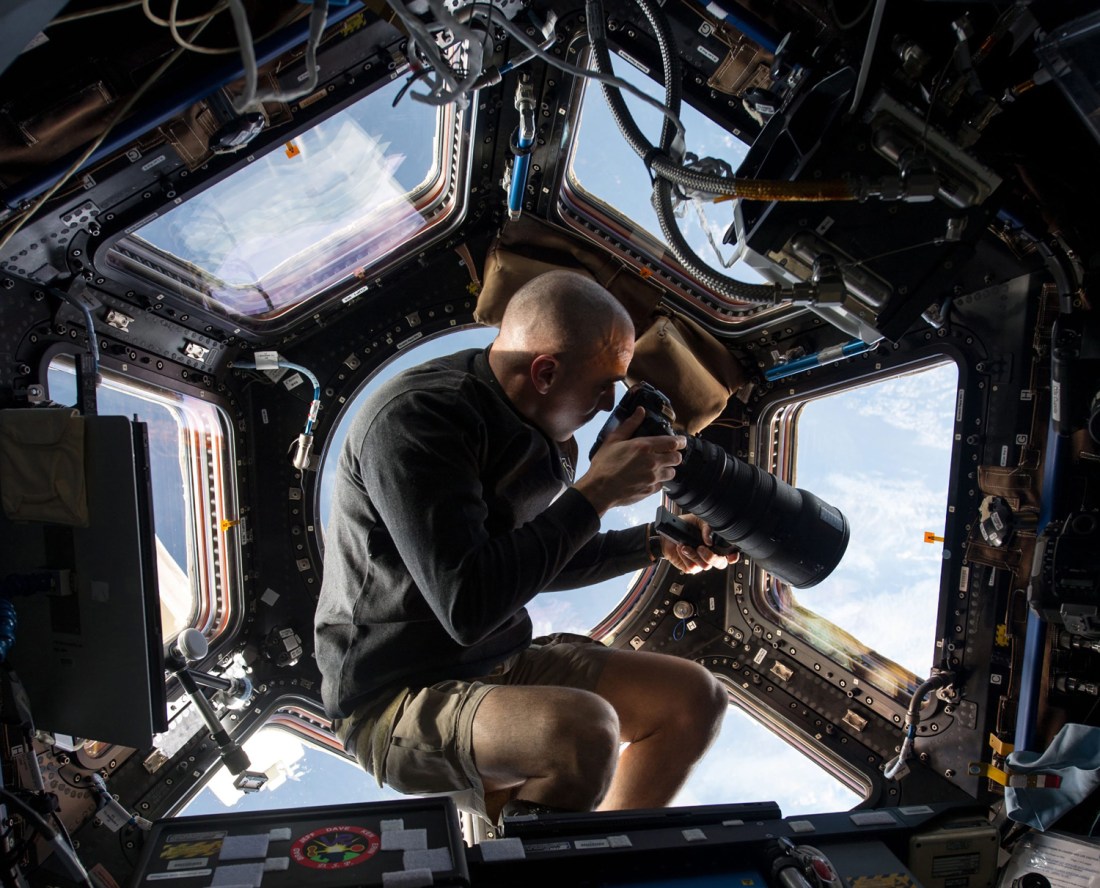
(Featured Image: Photos being shot from International Space station. Source)

Expressions and Insights

Quick Read: No matter what we do, we tend to express ourselves. And these expressions can lend themselves to interesting insights. 

A very popular class of Kenneth Goldsmith at the University of Pennsylvania is called “Uncreative Writing”.  As part of this course, students are forced to plagiarize, appropriate, and steal texts. In fact, they are said to be penalized for originality, sincerity, and creativity.

What does the course do?

As Kenneth elaborates ..

What they’ve been surreptitiously doing throughout their academic career—patchwriting, cutting-and-pasting, lifting—must now be done in the open, where they are accountable for their decisions.

Suddenly, new questions arise: What is it that I’m lifting? And why? What do my choices about what to appropriate tell me about myself? My emotions? My history? My biases and passions? The critiques turn toward formal improvement: Could I have swiped better material? Could my methods in constructing these texts have been better?

Not surprisingly, they thrive. What I’ve learned from these years in the classroom is that no matter what we do, we can’t help but express ourselves.

No matter what we do, he says (and I repeat), we cannot help but express ourselves. And this forms of expression if interpreted and analyzed could lend themselves for some valuable insights.

Let us take a few examples from the most unlikeliest of the sources of expression.

The link between crime and ink

People choose to draw stuff on their bodies because of what that specific tattoo means to them. With one of the hotbeds of tattooing being the American prisons, The Economist set about to investigate what inferences it could possibly draw about a life of crime from different types of tattoos.

mob
Source:  Robert Gumpert 


Their question: If people’s ethnicity and sex determines their tattoos, can the same be said of their types of crime?

Using data from the Florida Department of Corrections (FDOC) – a downloadable database featuring records for all the 100,000 inmates currently incarcerated in the Florida state prison system –  The Economist built a series of statistical models to predict the likelihood  of criminals committing specific crimes based on their demographic traits and choices of tattoos. (see table below)

crime-ink
Source: The Economist

For example, their  analysis had found that inmates convicted of property crimes and weapons-possession offences have the most tattoos, while sex offenders, particularly those convicted of paedophilia, tend to have the fewest. For a full commentary on this revealing analysis read the full article here.

One big insight based on this analysis is that tattoos tend to be supremely effective in predicting recidivism – the tendency of an ex convict to relapse into criminal behavior. (Of the inmates who have been re-incarcerated, 75% percent had tattoos!)

So non profits like Homeboy Industries – one of America’s largest gang rehabs – have free tattoo removal services. For, the act of removing tattoos reflects a genuine investment in ones change and thereby almost guarantees a step change in how you see yourself.

Bespoke fashion: an investment in self expression

Getting a pair of bespoke shoes is considered an epitome in luxury grooming for men.

One, because of its obscene cost. And two because it requires a considerable investment of time—typically, you fly off to Europe to get your feet measured and place the order (or the shoemaker flies in to your city), there may be two-three more visits for fittings, and then you wait anything from 9-12 months for the final shoe.

These connotations of luxury don’t still capture the essence of the bespoke fashion movement, until one begins to see it as an investment in self expression.

Bespoke, thereby, is a journey where you typically start with shirts, move to suits, and then some men take the logical next step to shoes as a final expression of their overall style and look. So next time you see someone with a bespoke suit you know where they are in their journey of self expression.

berluti-shoes
Source: Berluti, Mastery of Form

Now, given that there’s greater variety in women’s body shapes than men’s, one would expect a greater choice for women’s bespoke fashion. Interestingly it’s the other way round.

Cost is one challenge – more curves mean more measurements, more places a garment might need to be adjusted and more time getting the fit just right, making the whole process more expensive.

But the key challenge could be in being able to support for the underlying vocabulary of self expression dormant in women’s custom clothing. After all, bespoke fashion for women is an ocean of choice for personal expression that goes beyond just body fit, spanning attributes like apparel, color, fabric, style, occasion and perhaps even mood.

Now that’s one heavily under served segment in the super lucrative world of bespoke fashion –  if only one could demystify the method to the madness of the infinite variations of expressions that constitute women’s custom clothing.

Anyone that’s sartorially linguistic?

(Featured Image: Bespoke Shoes by Gieves and Hawkes)