The Wabi Sabi Edge

The Ise Grand Shrine – a Shinto Shrine – in Ise, Mie prefecture in Japan has been preserved exactly like it was around 2,000 years ago. Despite such a rich legacy, the UNESCO has refused to list the shrine in its list of historic places.

Why?
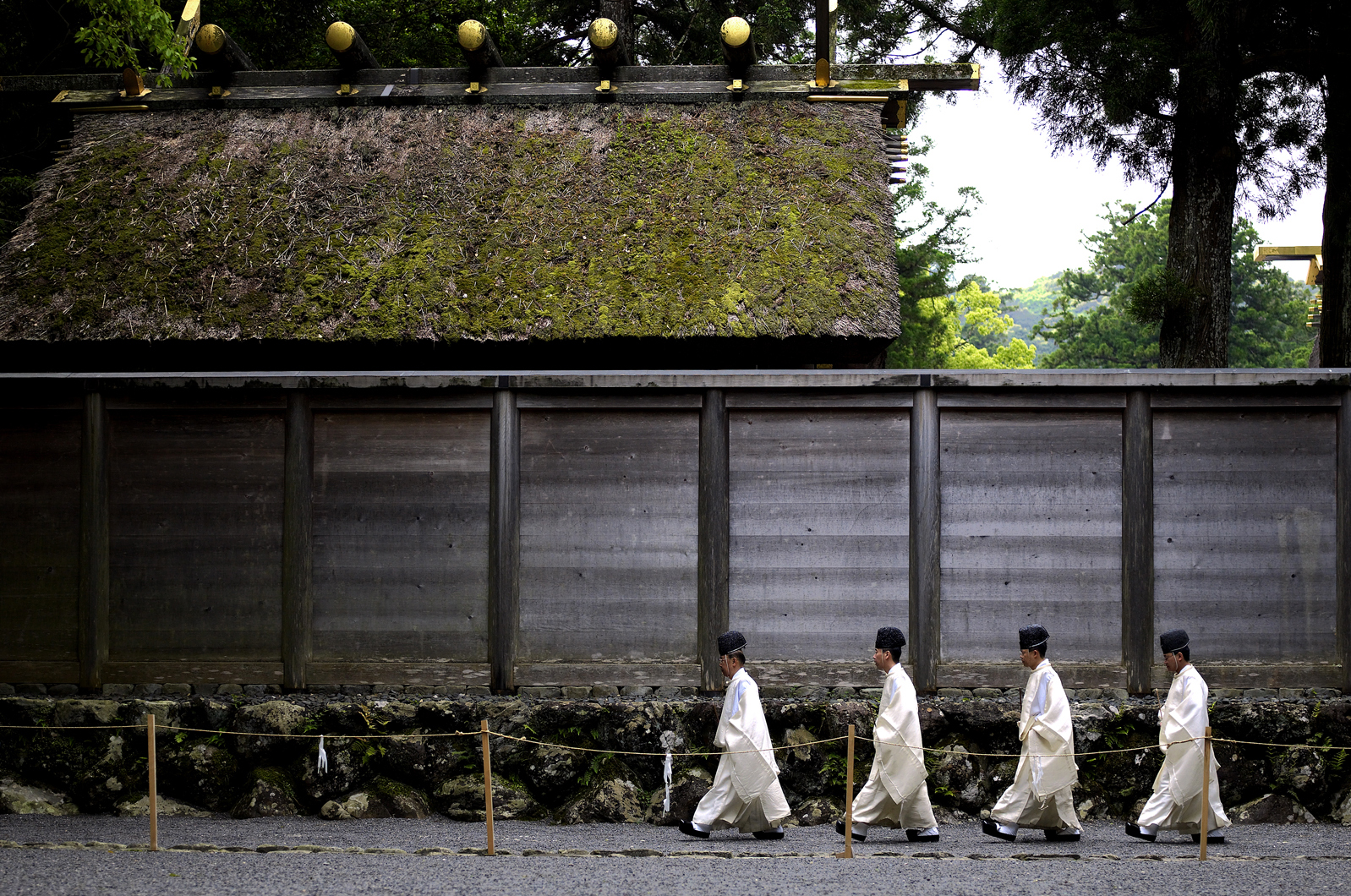
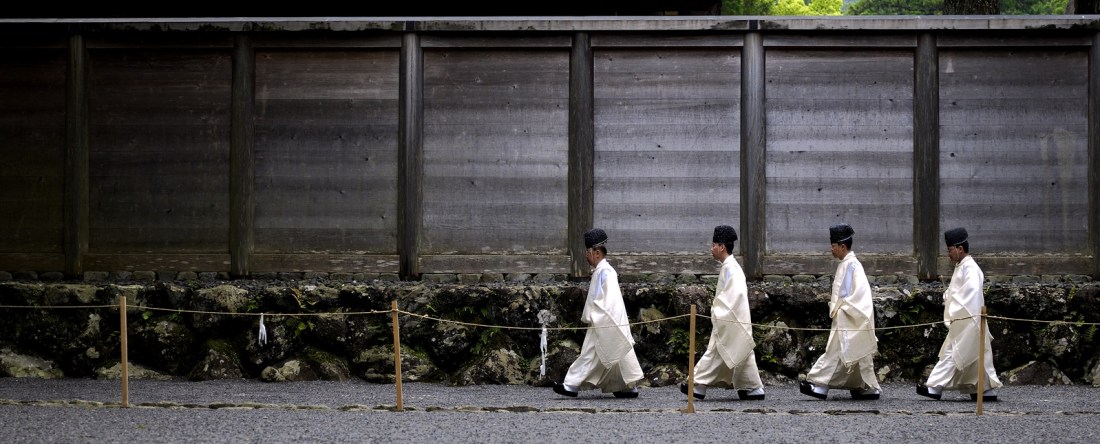
Shinto Shrine

(Shinto priests walking beside the Ise Grand Shrine, Japan. Source)

This is because the shrine is not built of a ‘permanent structure’. The ISe Grand Shrine is built of wood and hence it  gradually loses its structural integrity over years. So the Shinto priests have a solution;  every 20 years they tear down the structure and rebuild another – in an adjacent plot –  in exactly the same specifications as the original using the wood from the same forest that the original structure was built from. Result: the shrine  is  forever new,  ancient and original! The present structure, dating from 1993, is the 61st iteration to date and is scheduled for rebuilding in 2013!

A centuries old Shinto belief of death and renewal of nature and the transience  of all things called Wabi- Sabi underscores the philosophical and artistic significance of this shrine. To quote the wiki  page ….

Wabi Sabi nurtures all that is authentic by acknowledging three simple realities: nothing lasts, nothing is finished, and nothing is perfect.

Burning Man

Further to the west, in northern Nevada US is the Black Rock Desert –  an open swathe of desert land where a week long annual cultural festival called Burning Man is held every August/September. This iconic event is described as an annual experiment in community, art, radical self-expression, and radical self-reliance – a week long celebration of extreme creativity, art, spirituality and innovation. Often compared to TED for its potential to provoke, inspire, connect, indulge or just ‘let be’, Burning Man regularly attracts stalwarts like the Google founders, Eric Schmidt, Chip Conley among many many others. But what makes Burning Man stand out as an exceptional event is the fact that it is transient by nature. The whole venue, the structures and the shelters for the event are practically built from scratch and again torn to dust without leaving a trace at the end of the week!

See below the time lapse video of 2011 Burning Man to appreciate the ‘dust to dust’ cycle typical of the Burning Man.

As Business Strategy

Transience as a method, an approach or a strategy is not just  an expressionist arts style or some exotic charm of a shrine.  It also has far reaching implications on contemporary business strategy. The June 2013 edition of Harvard Business Review features an interesting article by Rita Gunther McGrath on what she calls as Transient Advantage. She argues that  in a world where competitive advantage often evaporates in less than a year, companies can’t afford to spend months at a time crafting a single long-term strategy. She introduces what she calls as The Wave of Transient Advantage and explains its ‘curve’ (below). Companies possessing this edge constantly start new strategic initiatives, build, exploit, re configure and if need be even actively disengage from an initiative as a means to reprioritise, reinvent and renew their approach to growth.
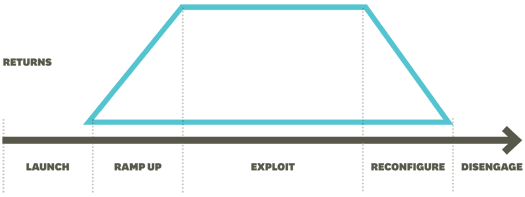
Transient Advantage

(Wave of Transient Advantage, Source)

She posits that the thinking in this field “has reached an inflection point” leading to an acknowledgment from a multitude of strategy practitioners that “Sustainable competitive advantage is now the exception, not the rule. Transient advantage is the new normal.”

The latest post in the Gaping Void newsletter by Hugh Mac­Leod pays an artistic tribute to this concept through this delightful piece of ‘office art’.
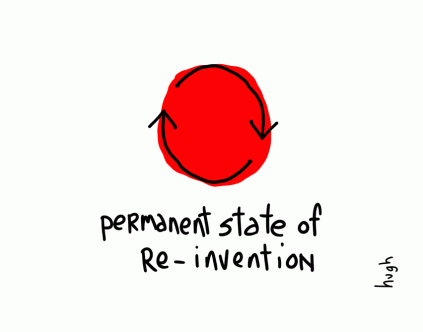
permanent_state

(You must subscribe to his newsletter, sure to make your day!)

Essentially from which ever perspective you look at it – artistic, personal, emotional, professional or even strategic, the ability to accept transience as the new normal, the ability to let go of the status quo to rethink, re-invent and renew our  approach forms the bedrock of the new competitive edge – The Wabi Sabi Edge.

The Last Of Us And The McWrap

What is common between the latest PS3 game The Last Of Us and the recent McDonald’s addition to its menu The Premium McWraps?

Stealth.

Let’s first take The Last Of Us

If you still haven’t heard of this survival horror video game, you must be hiding under an abandoned bunker in a post apocalyptic zombie infested world.

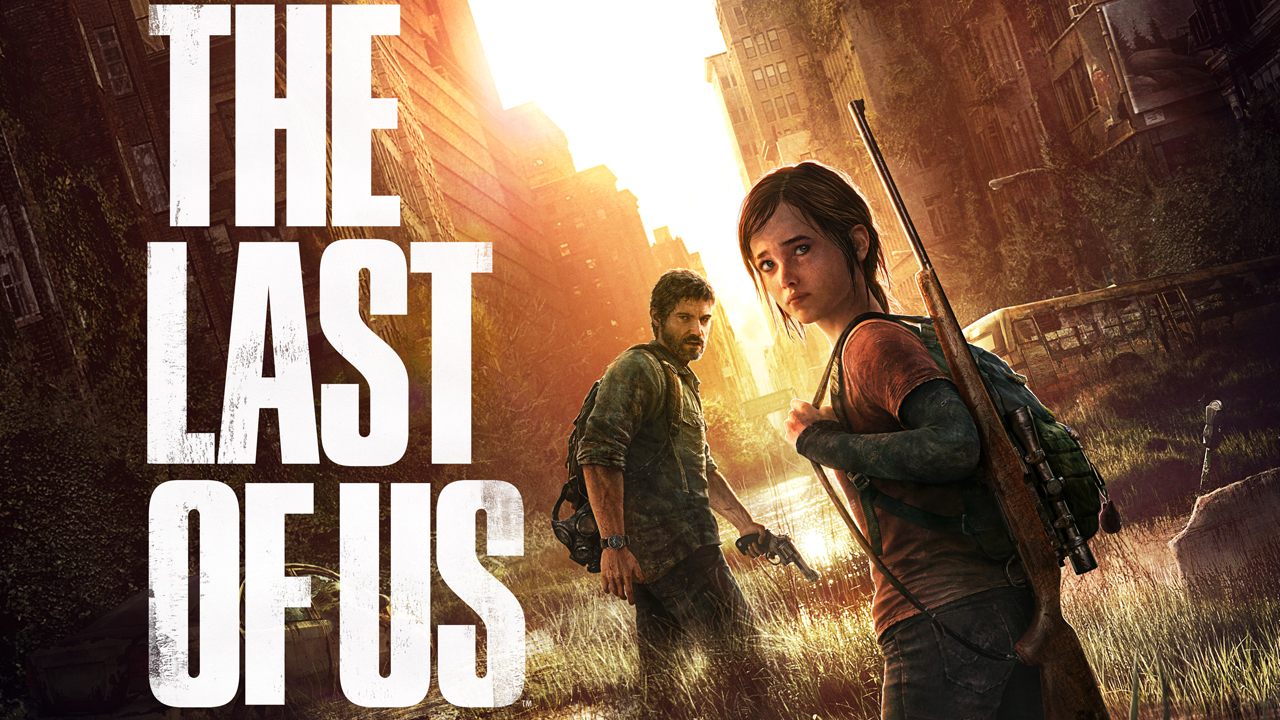
The-Last-of-Us-key-art

At least that’s how you might feel once the brilliance of this creation hits you. Declared as a masterpiece, for its choice-enabling gameplay, realistic action, emotional depth in the plot, sound design, and environments, The Last Of Us has been the biggest video game launch of 2013 so far, selling over 1.3 million units in its first week after its worldwide release on June 14, 2013  (source)

A key innovation that underpins the genius of this game’s design is its AI system called as Balance Of Power. This enables realistic combat situations and enriches stealth attack tactics to what it calls as Dynamic Stealth.

Dynamic Stealth: While Stealth is not particularly new as a gameplay tactic, the genius of Dynamic Stealth lies in how it makes the player own the consequences of his actions in real time. For example:

  • If you’re infiltrating a secured building and see two guards at the entrance,  you create a distraction, split them up, and take out one of them when he’s off in the shadows. In other stealth games, the second guard would stoically continue to be on the watch as if nothing had happened.  But with Dynamic Stealth he starts to wonder where his buddy went, gets panicky and might even call for extra cover and back up.
  • the game doesn’t pause when the player  is accessing their inventory and assembling weaponry (loading guns, crafting a molotov cocktail etc), so the player’s stealth tactics are governed by real life like rules of space and time.

Instead of  just bombarding the player with a constant stream of actions resulting in cookie clutter shoot and swear sequences, the Dynamic Stealth system lets the user set the pace of his own survival experience and make him fully own the consequences of his decisions and actions. And that for me is the big insight in interaction or use case design from The Last of Us: 

If the system is designed in such a way that it allows the user to own the consequences of his decisions and actions, they’d willingly embrace all its resulting outcomes – both positives and negatives.

Now let’s move over to The Premium McWrap

mcdonalds_mcwrap

Launched on April 1 2013 after 2 years of R&D and a blockbuster like pre-launch fan fare, the marketing mix of this newest addition to the McDonald’s menu can be summarized  as follows: (Source)

Product: The McWrap is a 10-inch, white-flour tortilla wrapped around 3 ounces of chicken (grilled or crispy), lettuce, spring greens, sliced cucumbers, tomatoes, and cheddar jack cheese topped with ranch, sweet chili, or creamy garlic dressing.

Proposition: “The Subway Buster”

Target Group: Millenials, 18-32, who are looking for healthier and tastier alternatives to their fast food.

Packaging:  The PKG design requires the customers to tear off the top half of the container. “The packaging was a very big, big idea,” says Kasey Short, director of menu innovation in the U.S. “When you unzip the product, there was more excitement.” It’s also designed to fit easily in a standard cup holder; 65% of McDonald’s customers order at the drive-through.

Price:  At $3.99, it’s four times the cost of a McChicken.

Service: Assembled in 60 seconds, the lettuce and chicken peek out of the top, suggesting farm-to-table freshness.

Ingredients:  After lot of R&D, testing and negotiations with the suppliers, McDonald’s managed to add one new ingredient to the McDonald’s arsenal: the English cucumber. That might not seem like a big change, but when the chain added sliced apples to its menu, it immediately became one of the largest buyers of apples in the country! So this addition has a huge implication on the supply chain of cucumbers around the world.

As an analyst sums it up “It’s the best piece of total marketing we’ve seen out of them in a long time. It’s convenient, healthy, fresh, good-tasting, and filling”.  While reading about these specific elements of the mix was definitely interesting, the big reveal for me came towards the end in this Businessweek article:

… the McWrap serves another stealth purpose…..customers may come into restaurants with healthy intentions but fall short of their aspirations…. With salads and now the McWrap on the menu, customers may forgive themselves a little more for showing up at McDonald’s. And if they skip the wrap at the final moment and get a Big Mac and fries instead they don’t blame the restaurant.”

Now that’s a tremendous AHA moment for me in stealth marketing – almost like a Dynamic Stealth tactic in gaming.

As they say – It’s a reality of the fast-food business that what can be ordered in a few words, served up in seconds, and consumed in minutes is often the product of years of research and testing. Because the battlefield here is not in the restaurants, it’s not in the ingredients, it’s not in the fields where the ingredients are grow, it is after all in our minds. 

No wonder then you have battlefield tactics like stealth meant to lure you not just into making a decision but also into owning it.  How’s that for some food for thought?

Nespresso – An Unsustainable Business Model?

 Single-serving coffee made at home.  That’s the category Nespresso operates in – a segment estimated to be 8 billion USD in 2012 (source).

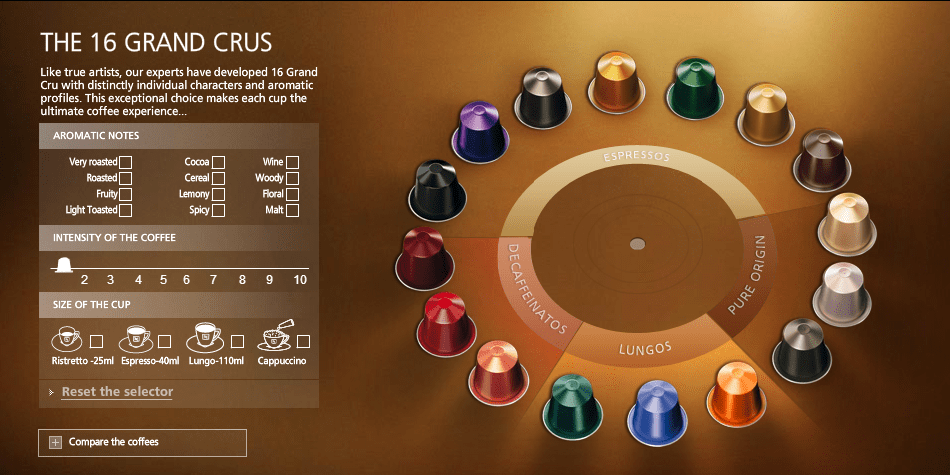
Nespresso

Some laudable facts regarding Nespresso to start with:

  •  It took 30 years for Nespresso to get to where it is now.
  • Their first patent was registered in 1976 and it was launched internationally in 1991.
  • As of 2012,  their concept (machine, capsule, service) is subject to 1,700 patents.
  • Features celebrities, such as George Clooney and John Malkovich, as brand ambassadors.
  • At 55 cents for a 4-g capsule, Nespresso coffee works out to a nerve-jangling $62 per lb. ($137 per kg). And the hefty markup doesn’t seem to bother its fans.
  • Is rumored to command gross margins at about 85%, compared with 40% to 50% for regular drip-coffee brands.
  • The company confirmed that  Nespresso is targeting to grow sales by around half a billion francs in 2013.

(sources for the above information: 1, 2, 3, 4)

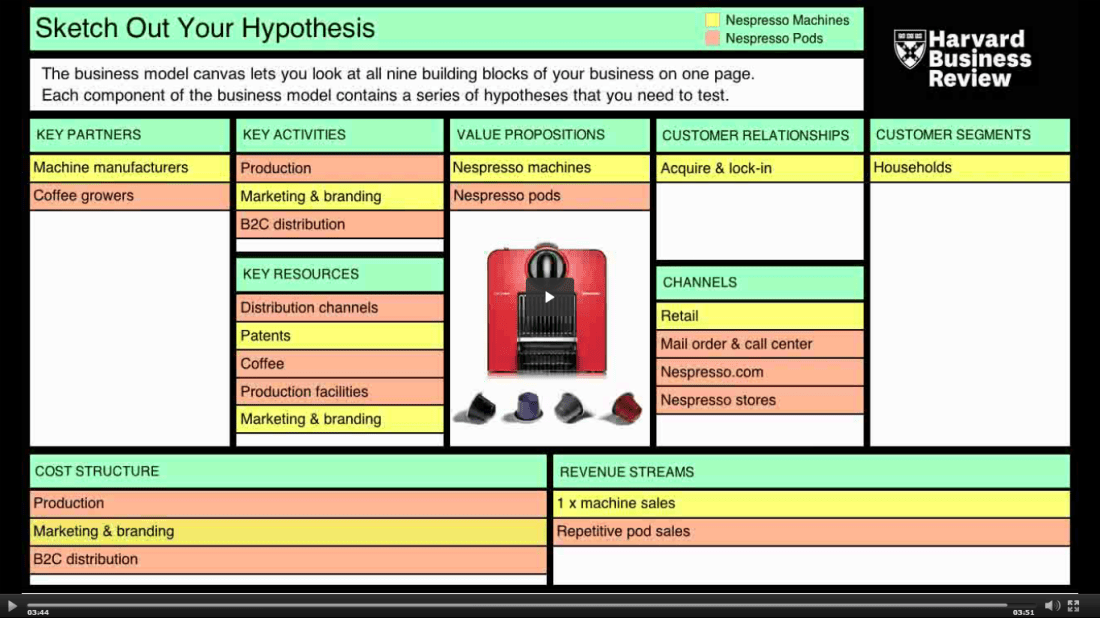
As a brand, Nespresso has been vaunted as the “Apple of coffee pods” riding high on the classic razor/razor-blade business model – otherwise called as the Vendor Lock In business model.  See an informative video here on the specifics of the Nespresso business model using the framework of Business Model Canvas.

Nespresso Business Model

Now the not so good news for Nespresso is the emergence of nearly 100 competitors around the world including 50 that claim compatibility with the Nespresso system (many of Nespresso’s patents have expired in 2012).  A more recent Reuters report on the latest threat to Nespresso from Mondelez…

Mondelez International, the world’s second-biggest coffee maker, is going head to head with larger rival Nestle by launching capsules compatible with its Nespresso system to steal a share of the premium coffee market.

The capsules will be sold under the Jacobs and Carte Noire brands in many EU markets in the second half of 2013 – the biggest challenge yet for the $4.4 billion (2.8 billion pounds) Nespresso brand that has sued many copycats.

These are just the warning bells for the company as many more brands jump onto the bandwagon of this fast growing coffee segment.

David Taylor on the brandgym blog posits that these moves can be in the larger interest of Nespresso as long as it ensures the following:

  • Benefit from market growth: Even if Nespresso’s share drops, sales can still increase if the market is growing.
  • Keep product quality up: Continue offering a better coffee experience through its select blend of coffee.
  • “Load” existing customers: Defend against the Mondelez launch by loading its existing customers with product, and so taking them out of the market.
  • Drive distribution: Drive distribution in new channels. e.g., store-within-store formats.
  • Tell a product story:  have a bit more product “sausage” to complement the emotional “sizzle”

I would however beg to disagree here, as I suspect if the current business model can be sustainable in the long term. And my argument is equally applicable to the Tassimo’s, Dolce Gusto’s, Keurig’s and Verismo’s of the world. Why?

Insight #1: Which business are the Nespresso’s of the world actually  into

These brands are not in the business of delivering convenient, barista like coffee at home. Instead they are in the business of making cup after cup of a consistent brew of coffee on demand with consistent being the operative word. Guardian reports

..while pod machines might not make great coffee, they do make a consistent cup. This is making them irresistible to high-end restaurants…. Nespresso machines can now be found in the kitchens of around 30% of the world’s 2,400 Michelin-starred restaurants. The appeal is obvious –they’re consistent, cheaper than hiring a barista and take up less space than a traditional espresso machine.

Insight #2: What can I learn from a cup of Starbucks coffee that bears my name? 

One thing I enjoy the most whenever I queue up at a Starbucks for my cuppa is eavesdropping on how different people want their coffee to be customized (a Quadriginoctuple Frappucino anyone?) and finally seeing them hold on to the cup with their name scribbled on it with an affection and warmth that comes out of familiarity and a sense of having co-created the cup coffee (by the sheer act of asking for a slightly personalized brew!)

The scribbled name on the cup just seals the deal in a magical way.  (speak about The IKEA Effect)

starbucks_cup

Now based on these 2 insights…

What if a ‘coffee pod’ sets up a unique proposition of designing a one of its kind, exclusive and a truly unique coffee blend concocted to your minutest specifications and delivered it to you as your own coffee pod  (like that cup of starbucks with your name on it) for you to be able to enjoy this very same cup of coffee day after day using the machine back home?

The benefits are obvious: enduring consumer relationships, deeper consumer insights, a treasure trove of data on how people love their coffee, a truly unique blend that only you can deliver, resulting in pods that consumers are willing to pay a premium for and finally pods that cannot be easily replicated by the “me too’s” of the world.

Speak about infusing authenticity to the  vendor lock in business model.