
Marketing Lessons From Emerging Markets

Successful marketing examples from emerging markets teach us many a lesson in getting the basics right.

Let’s take Indonesia for example. While Coke is the beverages leader globally, it is NOT so in Indonesia!

Teh Botol Sosro – The Indonesian Beverages Leader

After 80 years in Indonesia, Coke sells around 80 million cases per annum. Interestingly a local player by name Teh Botol Sosro (TBS) sells 2x that volume. Fascinatingly, TBS is not even a cola, it is a Ready To Drink Tea format and has become Indonesia’s favorite beverage in less than a decade! (source).

sosro

The reason? As per this insightful post on Occasion Based Marketing, it is two fold:

(1) TBS’s positioning is grounded in 3 local truths

  • Indonesians eat several times each day (3 square meals and 3 to 4 more snacking occasions)
  • Indonesia has a strong tea culture
  • When Indonesians eat or munch, they feel the need to drink something as well

Given these, TBS positioned itself with the simple and straight forward tagline

“Whatever the meal, Teh botol Sosro is the drink”  –  (“Apapun makanannya minumnya Teh botol Sosro”).

(2) Discipline in executing marketing strategy

Not only did TBS get the basics right w.r.t the beverages segment, it also ensured robust execution through:

  • Consistency of the brand messaging across all touch points
  • Ensuring Physical Availability i.e. solid distribution across retail and popular fast food chains like McDonalds and KFC
  • Building Mental Availability i.e, driving top of mind awareness and salience by leveraging on all media channels: ATL & BTL

TBS-Iklan-Ramadhan-01

(A Ramadan promo material for TBS,  shows the extent of its ‘Physical Availability’ – Image source)

McKinsey & Co Report On Building Brands In Emerging Markets

In many ways, each of the above principles strongly resonate with the findings of a recent McKinsey report titled “Building Brands In Emerging Markets”. Read the full article here for an elaborate report based on research conducted in nine product categories (including food and beverages, consumer electronics, and home and personal-care products) across various developed and emerging markets.

Essentially the report highlights 3 key differences between emerging and developed markets and its implications as:

  • Harnessing the power of word of mouth is invaluable, as it seems to play a disproportionate role in the decision journeys of emerging-market consumers.
  • Getting brands into a consumer’s initial consideration set is even more important in emerging markets, because that phase of the journey appears to have an out sized impact on purchase decisions.  
  • Finally, companies need to place special emphasis on what happens when products reach the shelves of retailers, because the in-store phase of the consumer decision journey tends to be longer and more important in emerging markets than in developed ones.

McKinsey Report On Emerging Markets(Exhibit Source, McKinsey Report On Emerging Markets)

While the above example and theory are inspiring and instructive in many ways, these miss out a commentary on an important characteristic of an emerging market.

How about speaking about building CATEGORY RELEVANCE first?

Emerging markets are essentially those where the categories / segments in question are under developed.  i.e., the target consumers in these markets don’t find the category/segment relevant to them – at least as yet. So if a segment itself is not seen as relevant in the market place, how crucial are word of mouth / perfect in-store experiences / or consistency in communications for a brand?

As a corollary, brands that start off by ‘setting up the dialogue on a category relevance’ can be said to be leveraging the opportunity to drive awareness of the category/segment and thereby establishing a strong salience of its branded offering in the market. If this key – setting up the context – activity is handled right by a brand, it can naturally have a solid advantage in the market place in the emerging category.  Let’s take 2 examples, one from a marketing strategy stand point and the other from a creative execution stand point.

1. Wines in India – Marketing Strategy In An Emerging Market

Wines in India is still an emerging market.  In 2012, wine (including imported varieties and sherry) only made up 0.45% of sales of 9 liter cases of alcohol in the country! (source). In other words (for various reasons) wines as an offering in India are still not seen as ‘relevant’ in the consideration set of alcoholic beverages category by most target consumers. So how do you build relevance for wines?

Sula Wines – a pioneer at the forefront of the Indian wine revolution shows by example. It embarked on a set of relevance building initiatives for the segment by going all out to promote wines domestically.For example, it holds about 1,600 wine tasting sessions a year to educate people on the finer points of enjoying a glass of wine, off late it has also been actively developing ‘wine tourism in India’ with vineyard tours and a music festivals held at its winery.

As a result the company produced 550,000 cases of wine last year and expects the number to rise by 25% in 2013. (source)

Sula Kebab Fest

(Image Source, Kebab Fest @ Sula Wines)

2. 4×4 Drives in Venezuela – Creative Executions In Emerging Markets

Venezuela has 147 motor vehicles per 1000 inhabitants. Compare this with 797 motor vehicles per 1000 that USA has (source). Motor vehicle here is defined as  automobiles, SUVs, vans, buses, commercial vehicles and freight motor road vehicles.

So how does Jeep communicate in each of these two markets?

You guessed it right! In a market like Venezuela,  Jeep focuses on setting the category context first – i.e. it’s communications are tuned towards building relevance of GETTING OUT as an activity ; and not so much on its technical specifications or competitive claims. See the following print ads by Leo Burnett developed for Venezuela. I love how Jeep manages to drive relevance of its segment without losing its tongue in cheek tone.

Jeep_Climber_ibelieveinadv   (Source, See the other ads in this series here, agency Leo Burnett)

On a related note, see how Jeep communicates in Bolivia here.  Similar theme here too –  More focus on setting up the category relevance than on proclaiming its uniqueness / superiority vs competition.

Now, as a contrast, how does Jeep communicate in the US?

It still speaks in its tongue in cheek tone, it still speaks about getting out or making the world your playground. But here, it also focuses on what makes Jeep the best in its segment by rattling off the pertinent technical specs or superiority credentials. See the following print ad from the US.

wrangler_garage(Source, Click on the ad for the enlarged version, agency BBDO)

The copy says: “Dana 44 solid axles, heavu duty Rock-Trac 4WD system, Tru-Lok fornt and rear differentails, front and rear mounted tow hooks, CD player, and seven speakers.”

On a related note, see Jeep’s print ad for Germany (another developed market) here and here.  Similar theme here too as that in the US – The focus here is on reinforcing its uniqueness and/or technical superiority vs competition and not so much on setting up the context / category relevance.

In Summary..

Whether it’s about a marketing strategy or even a creative execution,  whenever we see a success/failure of a brand in the context of an emerging market, probably the first questions to be asked could as well be:

  • Who was the first to drive the category/segment relevance in the market place? (who initiated the dialogue)
  • And How?  (is the dialogue grounded in local consumer truths?)

Once you have these answers, often times, you might not need to see the market shares for validation.

Don’t you think so?

(Featured Image –  BRIC Countries, Source)

Block By Block – A Consumption Focused Design Paradigm

It took more than a 100 years for inkjet printers to become commercially viable. The reason?

Severe interdependence of the components and underlying systems. 

For e.g., even with the slightest change in the chemistry of the ink, the composition of the resistors had to be changed, and this potentially impacted the physical layout of the circuits and so on.  The solution for this?  Modularity of design. 

Wikipedia defines modularity as ..

 the degree to which a system’s components may be separated and recombined.

Today most tools, gadgets, processes, systems, structures, designs that we interact with on a daily basis have modularity built from deep within. Right from the nuts and bolts of a system to the way it has possibly been put together on an assembly/production line, modularity is all pervasive.

In fact it is almost accepted wisdom now among designers and manufacturers that the speed at which an innovation can be commercialized is directly proportional to the speed at which the underlying design (of the system) and the process (of the assembly or integration) is standardized and modularized.

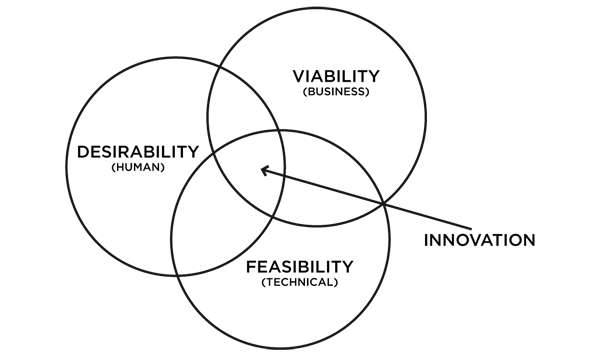
Now consider the above statement in conjunction with the following self explanatory paradigm of Design Thinking evangelized by IDEO, called the Desirability – Viability – Feasibility triad of innovation design. 

IDEO

Based on the above two, my hypothesis is the following:

While modularity in the context of production has almost proven itself to be a pre-requisite for establishing technical feasibility and – in many cases – for driving business viability of a given innovation , modularity in the context of consumption – if done right – can have far reaching implications in seeding the attributes of human desirability for the same.  

Three recent examples that seem to suggest the compelling potential for modularity in the context of consumption as a design paradigm:

(1) Phoneblok: Most of us, by now, would have seen this short video on the idea of building a phone with modular detachable blocks. This  presents the idea of Phonebloks –  hailed as a radical vision of what tech could be. The idea for me, is sheer ingenuity and insight. The possibilities  of such a consumer focused modularity in design seem to be truly empowering and liberating.

(2) NoFlo – A Flow Based Development Environment: The philosophy of Modular Programming is the default standard in most coding systems. But this modularity was mostly – for lack of a better term – limited to the realm of abstraction and ideation, since the corresponding code nevertheless lends itself as ‘strings of spaghetti’ and presents challenges for debugging compilation and logic errors.   With NoFlow as a development environment, modularity can be made more tangible and actionable in order to help inform, structure, design, test, debug and implement a complete software package.  The following is the video put together by the team for their Kickstarter campaign to raise funds (the funding was successful!).

(3) Modularity in content consumption: Unleashing the power of modularity in the domain of content consumption is in fact the name of the emerging game. Platform agnosticism is one of the many ways in which modularity lends itself in the consumption context for services like Amazon, Youtube and now Dropbox.  The latest edition of WIRED in fact features a fantastic story on  Dropbox’s radical plan for a future where “the gadgets are dumb, the features are smart, and data trumps devices.”

Dropbox

So there we have, emerging examples of modularity in the context of consumption (as opposed to only production) and how they promise to pan out in mobile, software design environments and cloud based architectures. Something for the technology powerhouses to sit up and take note? In fact in a recent interview with Forbes Clayton Christensen worries about Apple saying Modularity Always defeats Integration! 

Even in life as usual as we know it, no matter what we do from fixing a meal, concocting a cocktailassembling a piece of furniture, to laying out our Google Newsfeed, there’s always been a sense of joy, an inexplicable sense of desirability that we had for our stuff, for after all, it was our creation.  Step by step. Block by block. Isn’t it?

(Source for the featured image)

Adjacencies and Algorithms

30.56 degrees Celsius.

That’s the temperature at which fungus is normally known to thrive. Now, since fungus is the staple diet for termites, even in the scorching heat of Sub Saharan Africa, they are known to meticulously maintain this constant level of temperature within their mounds.  But how do they pull this off?

The answer for this question has been the inspiration for the design and construction of Zimbabwe’s largest commercial complex – The Eastgate Centre. Designed to be ventilated and cooled by entirely natural means, it was probably the first building in the world to use natural cooling to this level of sophistication.

During a Formula 1 race, a car sends hundreds of millions of data points to its garage for real-time analysis and feedback. So why not use this detailed and rigorous data system elsewhere, like … at children’s hospitals?

These tangents of thought are some of the several examples that stand out for the power of combining seemingly different ideas to  arrive at breakthrough concepts and revolutionary designs.  Frans Johansson calls this The Medici Effect in his insightful book by the same name – a must read for anyone fascinated by the world of creativity, innovation and ideas. This is very similar to the concept of The Adjacent Possible that Steven Johnson speaks about in his book Where Good Ideas Come From.  

Essentially it is about two things:

  1. Identifying seemingly different or intuitively unrelated ideas and
  2. Combining them together in new and unexpected ways to yield  actionable insights or practical – yet unforeseen –  solutions to existing problems.

One related concept of The Adjacent Possible is what could possibly be called as Meaningful Adjacencies.

Two very interesting ways in which the application of this concept has panned out in the recent past. One in the field of stylometry and the other in ‘commemorative design’.

(1) The Algorithm that declared “It’s J.K. Rowling” 

When The Cuckoo’s Calling – a detective story was released earlier this year, the novel has received lavish praise and the writer one Robert Galbraith was marked as someone to watch out for. But, reportedly The Sunday Times believed that Robert Galbraith was just a pen name for an author who could possibly be a bit more familiar. So on July 11, Professor Patrick Juola received an interesting mail from The Sunday Times. The task? To verify that Ms. Rowling was indeed the author of The Cuckoo’s Calling!

So what did Prof Juola – the stylometry expert do do?  He deployed a computer program called the Java Graphical Authorship Attribution Program (JGAAP) that he had designed to recognize writing styles undetectable by human readers.  He loaded the e-version of The Cuckoo’s Calling into JGAAP, along with several other texts, including The Casual Vacancy, J.K.Rowling’s post-Potter novel, set the program running and sat back to watch the fun.

Essentially, the JGAAP algorithm works by comparing the following variables in each of the book within the comparison set:

  • Word-length distribution
  • The use of common words like “the” and “of”
  • Recurring-word pairings and
  • The distribution of “character 4-grams,” or groups of four adjacent characters, words, or parts of words.

While the first two variables are more distribution and frequency related, the last two are adjacency related. Now this was an insight for me-

– that a set of adjacent words / characters / or even part of words can potentially have a unique pattern of their own so much so that they constitute a distinctive signature of their own and can thereby possibly bring out unique attributions to a specific author!

So in just 30 mins, Prof Juola’s JGAAP did confirm J.K.Rowling as the ‘suspected’ author and to his delight the conclusion was later confirmed by Rowling herself!

The interesting question that this now begets is – Should we teach literature students how to analyse texts algorithmically! Well, if an author’s literary signature is hidden deep within the recess of adjacent characters and words and if algorithms can squeeze out meaning from these adjacencies – then, I’d say Why Not?

(2) The ‘Commemorative Calculus’ Of The 9/11 Memorial

Nearly 3,000  men, women, and children were said to have been killed in the attacks of September 11, 2001, and February 26, 1993 on the Twin Towers.  In order to commemorate them, the 9/11 memorial has a very unique feature – the names of every person killed inscribed into bronze parapets surrounding the 9/11 Memorial’s twin pools.

National-9.11-Memorial-4a-Credit-Amy-Dreher

(Image Source)

As Michael Arad – an architect of the memorial puts it “(the idea of having the names of all the 3,000 men, women and childen) allows families’ and friends’ stories to be told.” He says “the river of names, without other identification (like age or title or company affiliation), was meant to convey simultaneously a sense of individual and collective loss.”

But it’s here that it gets interesting. These names on first look, would seem to be randomised in their grouping.

However on deeper inspection it becomes apparent that this grouping has been the result of some truly complex set of algorithms based on the concept of Meaninful Adjacencies – whereby each name has been meticulously mapped to each other on the basis of specifics like location, floor, company of a person and laid out in relation to other people based on relevant relationship contexts .

The result?  An intricate mapping of names that commemorates those laid to rest in a deeply compelling way by reflecting thousands of complex interpersonal relationships among them – and thereby telling a story with a real emotional impact.

193921

(Image, Source)

So there we have it – an analytical process that brings in a new twist to the adjacencies of words inherent in an author’s writings and a design paradigm that is predicated on bringing out narratives based on adjacencies of the underlying elements. 

So the next time when someone tells you that new ideas thrive at the intersection/adjacency of seemingly different concepts, tell them that it can literally be the case.

(Featured Image, Termite Mound in Namibia, Source)

The Goldfish Conundrum

The fact that Google has introduced ‘skippable pre-roll’ ads on YouTube is nothing new.  In fact nearly an year ago, it has also started to enable the same for mobile users.

skippable-youtube-ad-mobile

Three obvious things that stand out for me from these ‘skippable, pre-roll ads’ are:

(1) Permission Marketing: By placing these ads right at the beginning of the actual video and enabling the viewer full freedom to skip if necessary, YouTube has acknowledged the importance of gaining viewer permission (a.k.a a commitment of her attention span) before bombarding her with any message. This disincentives attention abuse by advertisers.  [Seth Godin must have said – I Told You So” 😉 ]

(2) Soft Wired: Understandably these ‘pre-roll ads’ are not ‘hard wired’ to the video ; meaning, YouTube can dynamically mix and match an ad to a video based on algorithms / user preferences / browsing history / relevance and advertiser criteria, with an objective to maximise advertiser revenues.  This disincentives lack of relevance of the spots to the viewer/ viewer context.

(3) The 5s litmus test: This is the most interesting implication for me. Irrespective of the length of the pre-roll ads (which typically are 15s or 30s), any ad is given a golden period of 5s within which it can either capture the attention of the viewer or fail at it (for various reasons) resulting in the ad getting skipped. This disincentives lack of the grip factor in the ad – by way of production values/ story / narrative etc. 

Not surprisingly, as a result, we now see many of these ads desperately trying to shock / awe / seduce  or lure us into seeing the full spot during the first few seconds of the roll. The fascinating thing for me however is this 5s mark that YouTube has set for itself and advertisers.  But why 5s?

Well,  as it turns out, we human beings are currently rated as a species with one of the lowest levels of attention spans. For eg., see the following table that compares the worsening of our attention spans and contrasts it with that of the Goldfish’s! (source of data)

The average attention span in 2012 8 seconds
The average attention span in 2000 12 seconds
The average attention span of a gold fish 9 seconds

Call it ADD (Attention Deficit Disorder) or Information Overload or Infobesity, it’s almost an intuitive thinking now that our attention spans are plummeting. As a result, today:

  • Movie trailers are getting insanely faster.
  • We now have movie tweasers: (A tweaser is a six-second teaser for a 20-second teaser for a two-minute teaser for a 2:32-length theatrical trailer for a feature-length movie. source)
  • Vine from twitter is capped at 6s (tweasers are hosted on vine)
  • And then we have delightful ‘marketoons’ like the one below:

130902.shortattention

(source and inspiration for this blog: Tom Fishburne)

Obviously, this only reinforces the fact that we are living in an Attention Economy – where attention has become a scarce commodity.

On a related note, you should read this amazing post titled – The Scarcest Resource You Don’t Even Know You Are Spendinghere. And do check out this though provoking video.

From the above two observations viz.,

  • We tend to be ruthless in our attention spans when it comes to consumption of entertainment /information.
  • We are given only a limited number of ‘attention bits’ to spend in our life time. …

…the insight for me here is that.,,

whilst proving ourselves to be (penny) wise in terms of how we exercise our ‘attention spans’ for certain tasks like say – media consumption, we sometimes tend to be (pound) foolish when it comes to expending this very resource for things that have far reaching implications in our lives like learning, decision making, productivity, interpersonal interaction etc.

Something for us to ponder and reflect upon?

h-armstrong-roberts-boy-leaning-head-on-hand-staring-at-lone-goldfish-in-fishbowl

(Image Source)