Know Thy Neighbor Nextdoor

Share it, Tweet It, Pin It, Like It, Stumble Upon It, Digg It and the list goes on..

Every conceivable kind of content that we consume on the internet today comes with explicit social networking markers.

Today with over 1000 Social Networking sites known to exist globally and 16 virtual communities with more than 100 million active users to date, Social Networks/ Virtual Communities have truly changed us and as also our definition of SELF(!). For most of the activities that we partake in our daily life like work, sports, hobbies, shopping, travel, dine, drive, and the list goes on, there is a virtual community / social network for each if it.

Now a social network built exclusively for local neighborhoods – called NextDoor is in the news for stepping into the elite territory of start ups.  On NextDoor.Com, each neighborhood is a closed social network where users have to verify their real name and address to gain membership. Once we are in, the idea is to be able to connect with our neighbors, strike conversations, while finding out everything from local deals, finding nearby help or even be alerted of neighborhood crime.
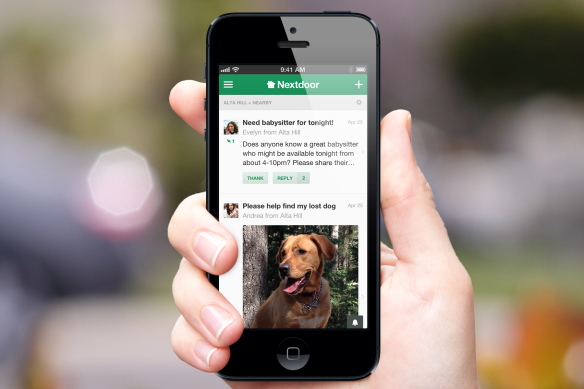
nextdoor_iphone_blog

(Image Source)

Developed on the insight that The Neighborhood has always been one of the “original social networks”, it has recently raised $60m fundraising led by John Doerr, the Kleiner Perkins Caufield Byers partner who led the IPOs of the likes of Amazon and Netscape and Tiger Global Management – prominent VC firms. (source)

This latest round of fund raising values the company at nearly $ 500 m as NextDoor.Com is slated to expand to more than the currently listed US neighborhoods on its site. Nirav Tolia, co-founder and CEO of Nextdoor, says there was already “incredible demand” abroad and goes on to say..

 “We see this whole notion of building safer and stronger communities is not an American thing at all, it is something all people share”.  

What I really like about the idea of a Neighborhood focused Social Network is the degree of relevance that can finally be attributed to the potential ads that can be placed in the network and the ways in which it can benefit all the players in the equation:

  • The Advertiser: Businesses in the locality can micro target the ‘captive’ user base in the neighborhood via their ads while also nurturing a local community of customers on an ongoing basis. The biggest opportunity here is for the SMBs.
  • The User: A user can find the most relevant offers from around her apartment rather than get bombarded by offers from across the country if not the world!
  • The Publisher: The publisher can facilitate the precious need of SMBs in the locality to micro target and reach out to their customer base in a very cost effective way, while also being able to track and optimize listings on a real time basis.

It’s almost like combining the best parts of Yelp, Craigslist, Foursquare, Path and Facebook with a liberal dash of a local flavor.  Like any other virtual community while it does come with its own privacy related nuances that need to be managed if it were to thrive across localities for the long term, one thing is nearly certain ..

We can finally get to know our neighbor. Albeit at least through the window of our screen.

PS: Two interesting things that you might want to check out:

  1.  To celebrate the ‘most neighborly holiday of the year’, Nextdoor launched just in time for this Halloween, a Treat Map to give you an insider’s guide to the best streets for treats in our neighborhood (relevant mostly to the US as of now)
  2. Funnily, Nextdoor has a page on Facebook 🙂
Soundscapes And Sonic Tapestries: Part 2/2

What do Cyborg Artists, Automobile Engineers, Game Designers and Branding Specialists have in common?

At least those featured in this blog post, that is. Surprise, surprise… all these have sound at the core of what they do!

See the part 1 of this thread here. In part 2, let me share some fascinating examples whereby sound and our ability to decode sound waves is complementing and supplementing our perceptual experience in truly astounding ways!

Sound As A Complement To Our Perceptual Experience

Sound (and its design) can be deployed in a very strategic manner to compliment our perceptual experience. Two compelling examples:

(1) Soundscaping In Product design: We know that there are armies of designers and engineers that work towards designing and developing  a car – it’s mechanics, electronics, aesthetics, thermodynamics, fluid dynamics etc. But did  you know that car companies  also employ sound experts to design the noise of a car? Read here a fascinating account of how GM makes a car sound like what a car is supposed to sound like. On that note meet Kara Gordon  – GM Noise & Vibration Performance Development Engineer who has designed the quietest Chevy.

(2) Sonic Logos In Branding/AdvertisingSonic Branding is big today. Think about the sound of ‘Intel Inside’, a call on Skype, the default ring/message tones on your phones and you’d get the idea. In fact Audi’s heart beat logo is said to be one of the most recognized sonic logos in the world today.  By the way did you know that after 14 years of using this sonic logo, BMW in March 2013, has changed it to this? This change didn’t get many fans by the way.

Sound As A Supplement To Our Perceptual Experience

Sound (and our ability to decode sound) can potentially also supplement our perceptual experience in new and interesting ways. Two examples again:

(1) Audio Games: What would happen if someone wanted to take the “video” out of video games and make users rely solely on their other senses?

At first the idea of Audio only games might sound like just another lateral marketing -isque variant (of video game formats).  But when you read about Deep Sea,  or about  Vanished you’d see that we are at the cusp of another revolution in game design and experience. These games are some of the best (if not the first) of its kind that explore the frontiers of what sound  (and our ability to decode sound) are truly capable of.

For e.g., Vanished – an iOS game as of Oct 2013 –  uses the iPhone’s internal compass and accelerometer to recreate a person’s movement. Players hold their phone in the direction they want to travel and touch the screen to walk. When in danger, they shake the phone to attack. All exploration is done with the help of audio only cues; as players move, the world “rotates” and provides different sounds.

Vanished

(iPhone Screenshot of Vanished – The Audio Game, Source)

(2) Hearing Colors: They say that you can see sound, but can you hear a color? Apparently Neil Harbisson can!  His profile on TED says this.

Artist Neil Harbisson was born completely color blind, but these days a device attached to his head turns color into audible frequencies. Instead of seeing a world in grayscale, Harbisson can hear a symphony of color — and yes, even listen to faces and paintings.

So there we have – some truly  fascinating examples from the recent past on how sound (and our ability to make sense of sound waves) is being leveraged in some truly exciting ways.

The next time you remind yourself to pause for a moment to appreciate the scenery and to ‘smell the flowers’, don’t forget that you could also take in the richness of the surrounding soundscapes in all their aural splendor.

All you need to do is incredibly simple. Listen.

(Featured image source)

Soundscapes And Sonic Tapestries: Part 1/2

See: Visualize :: Hear: (?)

Can you believe that there is officially no word in the English language that can encapsulate this? Doesn’t exactly do justice to our ability to invoke our mind’s ear to identify, create, re-create and remix sounds and thereby trigger emotions, memories and associations within us. No wonder, the aural realm remains an under exploited, and in some cases, under appreciated dimension to inform and enrich our perceptual experience. Take two of our most common habitats:

(1) Our Constructed Spaces (Architecture)  

So far the practice and purpose of architecture was anchored by the ‘eye’ and for the ‘eye’. Ears – apparently – were compelled to take a back seat and thereby had limited influence over design decisions (unless we speak about amphitheaters). Result –  offices, schools, homes, malls, restaurants and the list goes on, that are so poorly designed so much so that they actually do us more harm than any possible good! Not entirely convinced? See this TED video by Julian Treasure:

(2) Nature  

There was a time when wild soundscapes were considered just some exotic/charming artifacts of nature. But as it turns out,every habitat is believed to have its own unique sound signature – a sonic tapestry that can potentially convey an incredible amount of information about the present state and the future fate of any given place/habitat.

First a quick dose of general knowledge. A soundscape is made up of three basic sources:

  1. Geophony: these are non-biological sounds that occur in any given habitat, e.g., wind, water, waves etc.
  2. Biophony: these are sounds  generated by organisms in a given habitat at a given time and place.
  3. Anthrophony: these are sounds that we humans generate. e.g., our music, noise from machinery, automobiles etc.

So at any given point in time and place, anything that we hear is composed of these three kinds of sounds, and can be graphically represented in a Spectrogram – a graphic illustration of sound with time represented from left to right and sound frequencies represented from the bottom to the top, lowest to highest.

In an incredibly ‘earopening’ TED talk that is insightful, shocking, profound, inspiring and immensely thought provoking, Bernie Krause – a natural sounds expert –  proves that while a picture may be worth 1,000 words, a soundscape is worth 1,000 pictures. If there is one TED video that you need to see this week, let this one be the one – a must see:

In many ways these two talks could be said to be a call to action for us to resist our ‘natural’ instinct of zoning out most of the sound that reaches our ears and to start appreciating our faculty of hearing for how it can enrich our perceptual experience.

On a related note, let me submit my following hypothesis:

I started off by saying that in the English language we don’t seem to be having a word that can effortlessly fit in the following context

See: Visualize :: Hear: (?)

My guess would be that there might be some language out there (Chinese? Japanese? Korean? etc) that might have just the apt word for it. If so, my hypothesis would be that, such a country/culture must be having sonically richer traditions, must be producing relatively higher number of music prodigies and must be having general public with greater appreciation of sound and our faculty of hearing. And as an extension, I would also risk a bet that people from such a culture would also be adept at living in the now and here and appreciating everything about it.

Does your language have a word for this?

To Be Continued…

(Featured Image, Source)

Taking Over The World One Mobile At A Time

These days it is not uncommon for food to get onto Facebook / Instagram or Pinterests of the world before it gets into the mouth. 

Armed with this insight, Spoon – one of the largest restaurant chains in Costa Rica created the following campaign.

Developed by GarnierBBDO, the beauty of this campaign is that it smartly builds upon an existing habit of people.  And why Facebook? Apparently, Costa Rica has one of the highest ratios of Facebook to internet users of 95% (source).

Damn smart! I’d say.

Such campaigns can be a great inspiration for restaurants and bars seeking to drive awareness and generate talkability with minimum investment and presumably a high ROI. In fact, fast food industry today is known to be one of the most represented on Instagram with a near 100% adoption rate!

Instagram Adoption by Brands per Industry

adoption-of-instagram-by-brands-per-industryFrom left to right: cars, fast food, soft drinks, apparel, telcos, retail, personal care, beer, luxury, financial institutes, insurance, technology, oil & gas

(Instagram adoption, MillwardBrown 2012 BrandZ index, Source)

And yes, Food happens to be the  #1 category of content on Pinterest too with 57% of Pinterest users known to have interacted with food-related content during 2012. (source)

Now, let’s take one step back in the process and look at another emergent habit

Even before we tag the food in our plates on our Social Media pages, what do we do? We place our order with the waiter/bartender. However this poor waiter today vies for our attention with – surprise, surprise –  our mobile phones.  Thanks to our emergent habit of ‘checking in’ also called ‘location tagging’.

In fact, during the two year period ended in September 2012, Facebook has seen 17 billion location tagged posts including check ins (source). And to put that number into perspective, using May 2013 statistics, this would equal every single user of Facebook in the world checking in/ location tagging at least 8 times in an year over 2011 and 2012!

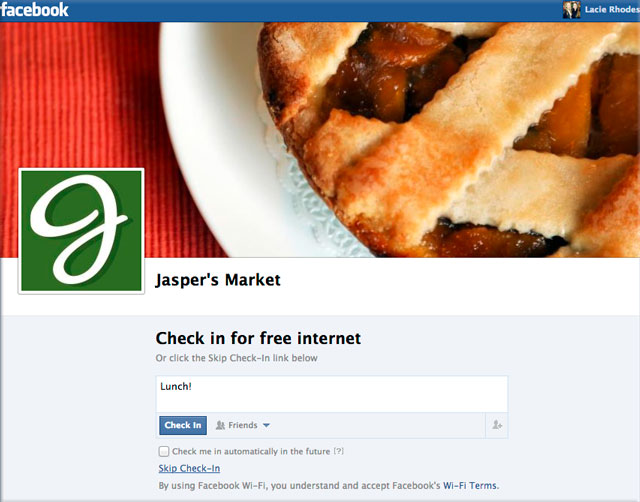
Understandably Facebook wants to make this key statistic- that of every user around the world checking in on Facebook – a reality. So after a pilot that was successfully run for over an year at over 1,000 SMEs in the US, Facebook – on October 2nd 2013 – has formalized an arrangement with CISCO. Named as ‘Facebook Wi-Fi‘ program, it converts retailers’ routers in the US into public Wi-Fi hotspots accessible to customers of the merchant establishment for free on one apparent condition. The deal? Go to the retailer’s/restaurant’s Facebook page and check in, and you have the Internet for free!

In other words, the three-step Facebook Wi-Fi system, which can be deployed by merchants running a Cisco router setup, lets people connect to a venue’s Wi-Fi, launch their browser, and click on the blue check-in button to gain unfettered access to the Internet.

Facebook WIFI

The deal for the merchant establishment?

  • Obviously each customer check in generates visibility leading to additional exposure that could pull in more customers or inspire more ‘likes’
  • While Facebook shares with the merchant an aggregate of anonymous demographic data such as age, gender, and interests on customers who sign-in to Facebook Wi-Fi, which they can potentially use for more effective targeting of their upcoming Facebook advertising campaigns

For Facebook, the Wi-Fi-with-check-in initiative is part of a broader plan to attack the local market by encouraging merchants to set up and maintain Pages on the social network and more importantly to seed – in the general public – the habit of ‘checking in’ on Facebook and thereby become the default gateway for the Internet.

Meanwhile on the other side of the world…

Chances are that you would have heard of Facebook Zero. If not, you should read this post right away. Essentially in 2010 Facebook collaborated with several mobile operators around the world and worked out an arrangement whereby the end users of these mobile networks can access  0.facebook.com – a faster and a free version of Facebook for your mobile, no matter which phone it is –  without any data charges.  People will only pay for data charges when they view photos or when they leave 0.facebook.com to browse other mobile sites. So, when they click to view a photo or browse another mobile site a notification page appears to confirm that they will be charged if they want to leave 0.facebook.com.

When this was launched in 2010, Facebook signed up 50 mobile carriers in 45 countries. The following image shows how Facebook made itself accessible on every class of phone through this initiative:

ubiquitous_mobile_facebook

How Facebook made itself accessible on every class of phone (Image source)

A smart way to drive usage of Facebook in emerging markets where the average monthly spend on mobile connectivity, which is often just voice and text, is 8-12% of the average take-home pay of a cell phone user. (source) In fact in just 10 months after its launch, Facebook Zero has become so popular in Africa that the site was said to have driven the adoption of broadband internet, just so users can have faster access to all those pictures and status updates!

Read this brilliant post on Quartz on how Facebook is conquering the world one mobile at a time.

Today, with more mobiles on earth than are people, and with smartphone penetration exponentially increasing in the emerging markets, the story has but just begun – after all there are 250 million Facebook users in Asia , more than on any other continent, and yet that’s just 6.5% of the population. In Africa, its penetration is less than 5%

And then Google launches Free Zone.

And the battle for world domination continues one mobile at a time.