
The IKEA Test

Quick Read: Well let’s just say that if IKEA had considered opening a couples’ relationship counselling centre at each of its stores, it might give the couples’ counsellors a run for their money! 

If there were to be a prep school for wannabe couples, the final test for graduation could argaubly be throwing them at the task of shopping for furniture… together.

Full discosure: Mrs and I somehow aced that test – though she derives an indescribable pleasure everytime she sees this PepperFry commercial.

No wonder then IKEA is parodied to be the #1 place where couples could realise that they actually can’t stand each other!

Probably armed with this insight, Ramani Durvasula – a California-based clinical psychologist is actually using IKEA shopping runs as a communications exercise for her couples therapy. (H/T Racked)

Ask her if IKEA is a domestic wonderland or a map of a relationship nightmare, and you are told that it could be the later. In fact, according to this WSJ report, she thinks the Ikea shopping experience is fraught with anxiety for couples, for example the kitchen models can lead to arguments about who doesn’t do the dishes and so forth.

Speaking of which, doing dishes could be a seperate thesis altogether on the perils of matrimony.

Actually make it ‘doing dishes’ + ‘trying to own the remote’ and you could have a perfect reciple for domestic disaster.

This commercial for Pril dishwashing liquid is a little undiscovered gem along those lines (though it could be accused of packing a little too many of a punch in one single ad).

(sorry non Hindi readers, wish there were sub titles)

And by the way there even seems to be a compelling case that says  – when in need of a marriage therapy, just do the dishes!

So the next time someone tells you that brands could do with some insights from ethnographic and psycho-analytical research. Tell them that the later could also be true.

[Bonus (and unrelated) Read: Nearly 3 years ago, BrandedNoise featured a post called ‘The IKEA Effect‘]

(Featured Image: Rashid and Shirley Smith got married at the IKEA in Elizabeth, N.J., in 2013. Source)

Is Sweden a Low Context Culture?

Quick Read: Differences between high context and low context cultures in branding could just be theoretical. All it takes is some brilliant marketing to blur the lines in between.

High-context culture and low-context culture are terms coined by the anthropologist Edward Hall.

Theoretically this categorisation between culutures has implications on branding and communications associated to them.

For example, according to this recent article, in a high cultural context, inherent cultural cues (e.g, symbols and emotions) add a lot of meaning to asociated marketing communications. Think of ads that reference cultures like Indian, Latin American or Middle Eastern for example and you get the picture. 

(A great ad that references Indian culture)

Low cultural contexts, by contrast, are those where there is little influence of emotions, gestures and cultural cues over the associated marketing communications.

For example – the article goes on to state – Sweden has a low cultural context. In other words, Swedish cues and metaphors are believed to contribute little meaning to any branding/communication.

But is it? 

While differences between these cultural contexts might help us to justify to ourselves the relative decibel levels of ‘cultural noise’ that gets thrown into their respective communications (e.g., narratives in films, ads etc), communications that reflect a culture are more complex and do not necesarily confine themselves to these siloed definitions.

Let’s take Sweden for example. Why is there a stereotype that Swedish metaphors add little meaning to any associated branding or advertising?

This cultural guide to Sweden encaplsulates it well when it says “Despite the generally contented natures of the Swedes, there is an underlying melancholy most often attributed to the long, dark and cold winters.” In other words, theoretically there is nothing much beyond a brooding sense of gloom to add as ‘cultural cues’ when it comes to referencing anything Swedish.

But lately, marketers seem to have used this very subdued under tone of melancholy and turned it into a state of mind (and soul) to be celebrated as uniquely Swedish!

Now that’s not exactly how a low context culture is meant to work. Right?

Volvo ‘Vintersaga’ – Embrace the Swedish melancholy

With a montage that celebrates the miserable weather conditions of Sweden aided by some spectacular photography and echoey music, Volvo recently paid a “tribute to Sweden at it’s worst” through its Vintersaga (Winter’s tale) campaign.

By capturing the country’s bleakest weather, Volvo goes on to explain that without the harsh Swedish winters it would not have become what it is today, or make the cars that it does.

Stutterheim Raincoats – ‘Swedish melancholy at its driest’

Being melancholic is an essential part of being a human being. 

…so says the philosophy page of Stutterheim’s rain coats. What for Mr. Stutterheim was initially an art project, has transformed – with a stroke of marketing genius coupled with a sharp positioning – into a line up of raincoats that are now shipped worldwide, with a price tag between $370 –  $1,400.

Stutterheim

(Source: Stutterheim’s philosophy on Melancholy and Creativity)

Apparently Swedish gloom seems to have a tremendous market demand with the brand today seeing strong growth in Europe and the U.S., with sales estimated to reach $4.8 million in 2015, up from $180,000 in 2011. (source)

After all as its philosophy goes on to say …

Through our melancholy we come up with new ways of seeing the world and new ways of being in the world. Let’s embrace Swedish melancholy. Embracing rain is a good start.

Now that’s some smart marketing that has converted something as monochromatic as Swedish melancholy into a unique (and dare I say sufficiently loud) motif of the Swedish culture.

Bonus Links: Check out this Volvo campaign that celebrates Swedish wilderness and this recent one by Grey London that celebrates Swedish….. (hold your breath & drum rolls)…. air!

Now, do you still believe Sweden is a low context culture?

Any classifications exists only as long as marketers allow it to.

Isn’t it?

(Featutured Image: Sutterheim – Swedish Melancholy At It’s Driest)

Imagination. For Selling and Unselling

Quick Read: Evoking imagination has always been a classic trick in the marketers’ book. Let’s see some recent examples where it’s been used to sell. And to unsell.

Man-eaters and the ritual of imagination

For four years, Dutch designer Daniel Disselkoen made the same journey on the same tram route to his art academy, and realised that he had stopped looking out of the window and being curious about what he might see. So he developed a simple little real-world hack called Man-eater.

Predicated around the idea that familiarity with a subject, our environment, surroundings or routine can limit discovery, Man-eater is a simple yet compelling call to action to invoke our imagination to make extra ordinary out of the ordinary.

Is at about seeing the world through a child’s eyes? 

Museum of Childhood

Museum of Childhood (yes, there indeed is a museum by that name!) says exactly the same thing in its recent campaign – wherein with a bit of imagination, the medium and the context become the key parts of it’s message. spaceman_aotw

whale_aotw

(Check out the other executions at this blog post)

Banana Bunkers that look like…um.. bananas?

It appears that it doesn’t require a hell lot of imagination to see why this particular product of GroupOn turned to be its most popular post on Facebook ever! Screen Shot 2015-04-01 at 11.28.33 PM But GroupOn’s real imaginativeness came to the forefront in what happened after the post went live.

Knowing full well of what is to come, they decided to stay ahead of the hilarity and replied each and every one of the comments on their Facebook post. Check out this snapshot of the epic comments that followed!

Now that’s some great imaginativeness to combat (and perhaps even abet) imagination!

And meanwhile else where..

Can imagination be used to ‘unsell’?

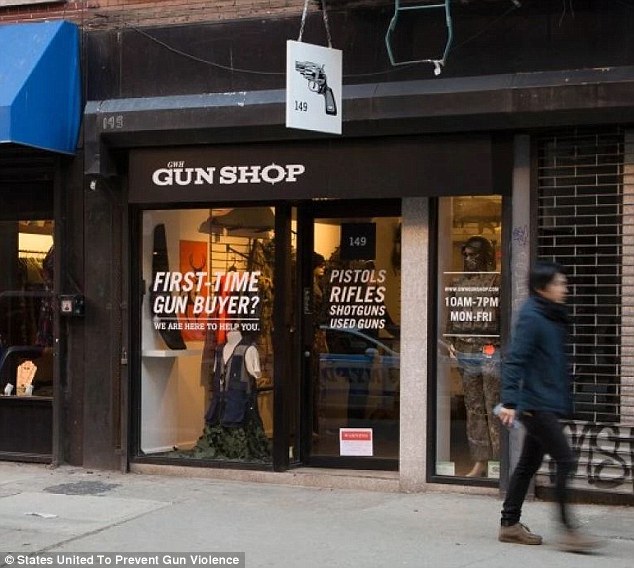
The Gun Shop‘ had recently popped up on Manhattan with a store front that read “First Time Gun Owners” in big, bold letters. The catch? Each gun in the store had been tagged with its history: from shooting a mom in Walmart to the Sandy Hook massacres. The result: imagination that just ‘unsells’!

This video captures it well.

The Gun Shop has been a pop-up demonstration created by New Yorkers Against Gun Violence – a partner of States United Against Gun Violence that seeks to make families and communities safer.

Can you think of any other examples? 

(Man-eater –  H/T Neil Perkin | Museum of Childhood – H/T L.Bhat)

Featured Image: The Gun Shop store front on Manhattan, Source