Skip to content
Riffs on technology, marketing & culture Unknown's avatar

Riffs on technology, marketing & culture

  • Home
  • About Me
  • Subscribe

Tag: Logo

Selfies As 24×7 Focus Groups

Quick Read: Nearly 2 billion pictures are being uploaded on social media each day. And this is perhaps just the beginning – for the number of uploads and their potential applications in marketing analytics and consumer research. Profiling Ditto – an innovative start up. 

Today most people carry ‘pocket cameras’ everywhere they go. And it’s been having interesting consequences.

For starters, it’s conclusively settled that the number of UFO sightings reported have dramatically gone down in the last few years.
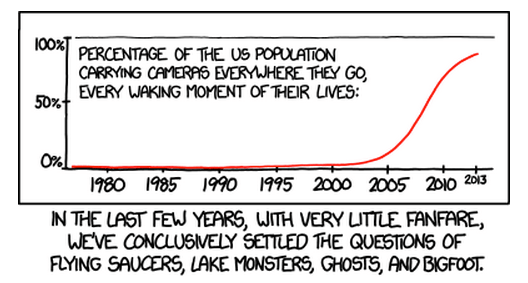
xkcd(Source: XKCD)

Plastic Surgeons are a happier bunch in recent years, unlike the Tour de France cyclists who are getting more pissed off each year with spectators stepping in front of cyclists to take selfies with them as they passed. The business of autographs has become obsolete. Wide angle lenses are getting recast in cringe inducing names like ‘wefie’ and ‘groufie’. And the list goes on.

A good part of these pics get on to social media generating about 1.8 billion uploads each day (source).  Selfiecity was a project (previously profiled on BrandedNoise) that investigated selfies uploaded from several cities around the world using a mix of theoretic, artistic and quantitative methods.

One of the findings of this project has been that only about 5% of images uploaded on the social media are actual selfies. What constitutes the other 96% of the images?

Selfiecity(Source: Selfiecity findings)

Now looking at the above finding, one thing could be clear – at least directionally.

Companies that make cars, shoes, food, beverages, clothes, etc could be missing out on a treasure trove of information by not being able to analyse and identify even the most basic patterns (like for e.g., a brand logo) from over a billion pictures being uploaded by users each day, every day.     

Ditto – started by David Rose – tries to solve this very problem. With software trained to scan for 2,500 details in each photo, Ditto analyses photos in aggregate and identifies patterns within them (source). At a fundamental level it is a logo detection engine that can be used by brands to:

  • Understand how many times a brand is seen over their competitor, aggregated by geography, gender, ethnicity and age
  • Discover how their products are used
  • Find their influencers
  • Uncover brand affinities and
  • Measure their social media ROI (as specified on Ditto’s site)

For e.g,. it found that Gatorade wasn’t just consumed during exercise, but by teens during meals.

Gatorade(Source: Ditto)

And as per this report, Ditto found that people put their Chobani yogurt in their car cupholders to eat it on the way to work. It found that beer drinking generally peaks at 11 p.m. but ice cream eating peaks at 1 a.m. It found that people are putting French’s mustard on their broccoli. And thereby has been helping brands like Kraft, Budweiser identify connections that they would never have found on their own.

In fact, you can even access a real time stream of ‘photo firehose‘ that aggregates photos in real time by categories like cars, clothing, cosmetics, food, retailers etc here.

After all, as Seth Godin says in one of his recent posts..

“The essence of a brand with social juice, of one that matters as a label, isn’t how big the logo is. No, what matters is that the buyer thinks the brand is important, and that the logo is a signifier that they’re paying for.”

For such brands, measuring market share is perhaps not the most cutting edge thing that they could with data. Measuring their consumers’ pride and enthusiasm in their products perhaps is.

So the next time we see our feed on social media, scanning it as a newsfeed of digital ethnography  is perhaps not a bad idea.

And who knows, we might find some novel use for those tons of pictures getting uploaded each second as we speak.

Bottomline: Nearly 2 billion pictures getting uploaded each day and this is just the beginning. For uploads and their applications for marketing. 

(Featured Image: cartoon by Jeff Koterba from the Omaha World-Herald)

Share this:

  • Click to email a link to a friend (Opens in new window) Email
  • Click to share on LinkedIn (Opens in new window) LinkedIn
  • Click to share on Facebook (Opens in new window) Facebook
  • Click to share on X (Opens in new window) X
  • Click to share on Tumblr (Opens in new window) Tumblr
  • Click to share on Reddit (Opens in new window) Reddit
  • More
  • Click to share on Pocket (Opens in new window) Pocket
  • Click to share on Pinterest (Opens in new window) Pinterest
  • Click to print (Opens in new window) Print
Like Loading...
Chaitanya Chunduri Branding, Consumer Behavior, Innovation, Marketing, Social Network, Software 6 Comments August 3, 2014 3 Minutes

The Uninvited Design – Agencies Beware

‘Entry Barrier’ is soon becoming an obsolete concept.

We have seen them dropping in industry after industry – music, film, publishing and even manufacturing. The businesses of Advertising and Design are no exceptions. For e.g., even a 20 year old college student can win a marquee client like coke these days. The story goes like this:

Almost everyone who knows Steve Jobs and is ‘net literate’ must have been captivated by this beautiful tribute going viral, hours after the legend passed away. Graham Fint, the Chief Creative Officer of O&M China was captivated too. So he tracked down the designer:  Jonathan Mak Long a 2nd year communications design student at Hong Kong Polytechnic University and offered him an assignment to design a poster with a deceptively simple brief –  ”Sharing a Coke”.  The result:

The poster went on to win a Grand Prix at Cannes in June 2012.

Take Johanna Basford – an illustrator and ‘ink evangelist’.

(Image Source)

This story starts in the autumn of 2010, when she set her sights on working for Starbucks and  bestowed on them the title – Dream Client. She then ‘hand penned’ Starbucks cups and posted them to their offices. Again. And Again. The string of these uninvited yet meticulously designed penned cups have finally landed her an official design assignment from Starbucks.  The story ends 18 months later when she finally adds Starbucks to her ‘Clients List’.  Read the fascinating account here.

Off late, many such instances of ‘Uninvited Design’ have become commonplace, thanks to the Internet. Apparently, it just takes a creative designer with a laptop and a couple of hours (or at most days) to spare to create ripples in the world of brands, advertising and design.

On 23rd August 2012, a quarter of a century after its last update, Microsoft has unveiled a new logo.

Evidently, it did not win too many aficionados on its unveiling. But what caught on the imagination of many people around the world was a student’s version of his redesign of the Microsoft logo. Andrew Kim is  a 21 year old designer whose ‘Uninvited Designs’ for Microsoft from his 3 day personal assignment went on to become a sensation with his concept of ‘Slate’ design and how he sees it to be applicable to the Microsoft logos.

Scroll through the full presentation here. Though I personally found his designs to be a bit ‘Apple Inspired’, these ideas have quickly gained traction online. I have a feeling that he could soon be in the news again for some good reasons.

And then there is an even more recent example of an ‘Uninvited Design’  – this time for American Airlines, from a Cyprus based designer –  Anna Kovecses. Read the story here.

And then there was Wikipedia Redesigned, and even Jeremy Lin gets an uninvited design for his logo.

While we see some graphical instances of genius coming from all around the world by way of these Uninvited Design projects, there are also graphical instances of absurdity. Don’t miss the weird history of unsolicited redesigns.

Absurdity or Genius, one thing is for sure. The entry barriers for individual creatives to stealing the thunder from established agencies have started to crumble. In a big way. Agree?

Share this:

  • Click to email a link to a friend (Opens in new window) Email
  • Click to share on LinkedIn (Opens in new window) LinkedIn
  • Click to share on Facebook (Opens in new window) Facebook
  • Click to share on X (Opens in new window) X
  • Click to share on Tumblr (Opens in new window) Tumblr
  • Click to share on Reddit (Opens in new window) Reddit
  • More
  • Click to share on Pocket (Opens in new window) Pocket
  • Click to share on Pinterest (Opens in new window) Pinterest
  • Click to print (Opens in new window) Print
Like Loading...
Chaitanya Chunduri Uncategorized Leave a comment September 2, 2012January 18, 2013 2 Minutes

100 Days of ‘Branded White’ – Experiment and Thoughts

Can a color represent a brand?

There are tons of resources out there on colors and how they influence brand identity, perception, subliminal messaging and even our day to day feelings that we experience in our lives.  In fact sites like Color in Motion and Cymbolism take this theory to a whole new level of interactive experience on color communication and color symbolism. For example, Cymbolism has a battery of questions that it has administered to thousands of people around the world on colors and their associations. The following chart aggregates this research findings:

(Image Source: UsabilityPost)

Now, that begets the question – Can a brand stand out and speak for itself despite the absence of any color? Possibly yes –  proves Andrew Miller through his 100 day project called Brand Spirit.

The thought about “capturing the essence of a subject rather than its appearance” has apparently inspired him to come up with the idea for this 100 day project. Essentially for each day for 100 days he had painted a branded object white, stripping off its visual branding elements and reducing the object to its ‘purest’ form.  The 100 day project came to an end on June 19 2012 while successfully triggering waves of discussions and debates from the online community during its course.

Each of the white ‘branded artifact’ is a fascinating commentary on product design, marketing, branding and our corresponding perceptions as consumers/users. Some of these objects are very recognizable  on account of their iconic shapes like the Tabasco and the Coke bottles here.

And there are some objects that apparently seem to be proving a point. For e.g., see the bottle below and it doesn’t take a genius to say that it is Corona.
The commentary here is obviously on this ‘branded ritual’ of sticking a wedge of lime to the bottle and how deeply it is embedded in the fabric of what Corona has come to mean to us. Mark Wilson says it the best when he says  “Corona has clearly used the beer bottle to brand the lime”.  
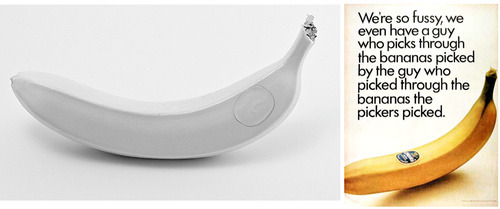
It also had an interesting reference to ‘branded commodities’ and how deeply some brand names are ingrained in our minds to refer to something as generic as fruits. Chiquita – being a major American producer and marketer of bananas, might come to be associated with this fruit for many Americans. And that’s precisely the point here.
(1967 Chiquita Vintage Print Ad: Source)
Now that’s what I call food for thought.

Share this:

  • Click to email a link to a friend (Opens in new window) Email
  • Click to share on LinkedIn (Opens in new window) LinkedIn
  • Click to share on Facebook (Opens in new window) Facebook
  • Click to share on X (Opens in new window) X
  • Click to share on Tumblr (Opens in new window) Tumblr
  • Click to share on Reddit (Opens in new window) Reddit
  • More
  • Click to share on Pocket (Opens in new window) Pocket
  • Click to share on Pinterest (Opens in new window) Pinterest
  • Click to print (Opens in new window) Print
Like Loading...
Chaitanya Chunduri Uncategorized Leave a comment June 30, 2012January 18, 2013 2 Minutes

Commoditising a legendary brand in one shot!

Imagine this, you walk into a supermarket and go ahead with your weekly or monthly purchase routine. Let’s take an example of a guy’s case. Let’s name him John and let’s make some assumptions (some bordering on generalizations, but just to make a point). Now let’s profile him.

John is a 35 year old male working as an Insurance Broker with an MNC. He is married and has 2 kids. A complete family man, he takes pride in the fact that he manages a good home, a lovely wife with 2 kids. However he knows that behind this ‘meticulous’ management, are some very regular trade offs he makes. ‘Informed decisions’ as he believes – wherein he tries to assess the ‘real worth’ of a product – be it a vacation, or his kid’s school bag, or a new shaving lotion or even a hair care product – and makes sure that he doesn’t pay more than its perceived worth. At the same time, he is not your typical coupon collector or one who jumps on discounts or sale promotions in order to shop.  He doesn’t compromise on quality while he provides for his family. He believes that money well equals commensurate value realised.

So now with this image in mind, let’s say he goes shopping for him and his family (with a grocery list from his wife and a mental list that he has made for himself and for family).

Soup: may be he picks up what his wife asked him to

Baking Powder: same as above

Cooking oil: buys an oil that purports a story of health

Shaving foam: his regular, based on habit may be

Shampoo for him: may be his regular brand ‘coz he prefers its fresh ‘after feel’

Shampoo for his kids: as per his wife’s list, or may be something that speaks about mildness with a story of how some ingredients are essential for nourishment of hair

Soap: Soaps and Shampoos tend to be the kind of category with a ridiculous levels of variety and choice. He obviously knows that a soap is a soap is a soap and is after all meant to cleanse as its basic feature. Yet given a price he pays for it, he expects it to offer ‘something more’ – may be a kind of fragrance he is used to or a fragrance he seeks, or say a story around freshness and how great it is to feel clean and fresh, or may be some story around ingredients that are known to be beneficial for skin etc

May be.. yes? Now just assume that it was you at this position at this point in time. Just think that you are shopping for a toilet soap. Would you want something that just cleanses? If so, you are better off with a cheap detergent soap..right? So wouldn’t you seek out for ‘an additional feature(s)’ from your soap? Be it a brand story that it is so good for your skin, or an natural ingredient story, or may be some imagery of how awesomely fresh it makes you feel,.. you get the drift right?

Now if I were to stand there in the store (of course not as my actual self but as a very popular company that you have always known. A company that ironically also sells soaps with masculine fragrances, ‘coz you need to smell like a man, man ) and try to sell you a soap saying that “it is nothing but a soap as in a soap which looks like a soap feels like a soap and nothing else. Not made from any special ingredient, nothing special, just a white bar of soap that, again if I may repeat, just acts like a soap.”

Would you buy it? In fact would you even stop for a moment and consider it?

Would John consider it? Would he spend his money on something that is say a dollar cheaper than the other soap, yet says it is “JUST A SOAP and nothing else”?

Congratulations to the team behind Ivory for successfully commoditising a 140+ old history, a rich story of heritage, a brand associated with apocryphal urban legends in just one shot! Congratulations for redesigning its brand elements like typeface, positioning, colors etc and thereby spending good amounts of money to do just one thing – stripping the brand off all its wonderful associations and painstakingly reminding the consumer that what they have known of Ivory as a brand of soap is in reality after all JUST A SOAP. Nothing else.

Wow!! From the company that came some truly smart campaigns, I am surprised, shocked and in fact concerned to see a live case study of how a brand of nearly 150 years history can be shot in the head – point blank!

Let me try again: “You need to buy my soap, ‘coz it is after all just that – A soap”

I’m still curious – would YOU buy it? Or is it just me?

– from a genuine fan of Old Spice Campaign (so that you don’t attribute my blog post as anti competitive)

PS: The views provided here are solely mine in my personal capacity and not related to any other person dead or alive, or any company big or small for which I might have or haven’t worked for!

Share this:

  • Click to email a link to a friend (Opens in new window) Email
  • Click to share on LinkedIn (Opens in new window) LinkedIn
  • Click to share on Facebook (Opens in new window) Facebook
  • Click to share on X (Opens in new window) X
  • Click to share on Tumblr (Opens in new window) Tumblr
  • Click to share on Reddit (Opens in new window) Reddit
  • More
  • Click to share on Pocket (Opens in new window) Pocket
  • Click to share on Pinterest (Opens in new window) Pinterest
  • Click to print (Opens in new window) Print
Like Loading...
Chaitanya Chunduri Uncategorized Leave a comment December 3, 2011January 18, 2013 4 Minutes

Featured as a ‘Recommended Blog’ by WordPress

Enter your email address

To see posts from your preferred category

Top Posts on BrandedNoise

  • Embedded Moments of Truth
    Embedded Moments of Truth
  • About Me
    About Me
Create a free website or blog at WordPress.com.
Privacy & Cookies: This site uses cookies. By continuing to use this website, you agree to their use.
To find out more, including how to control cookies, see here: Cookie Policy
  • Subscribe Subscribed
    • Riffs on technology, marketing & culture
    • Join 11,359 other subscribers
    • Already have a WordPress.com account? Log in now.
    • Riffs on technology, marketing & culture
    • Subscribe Subscribed
    • Sign up
    • Log in
    • Report this content
    • View site in Reader
    • Manage subscriptions
    • Collapse this bar
 

Loading Comments...
 

    %d