Gyotaku And The Trailer

What is common between Gyotaku and Movie Trailers?

Gyotaku Trailer

1. Both are traditionally forms of ‘advertisements’ of another art form

2. And both have evolved into specialized art forms unto themselves

Let’s start with Gyotaku

Gyotaku is the traditional Japanese art of fish printing dating back to the mid 1800s. Before you read any further, you might want to begin with this fabulous TEDEd video to get a quick introduction on this fascinating art form.

As you can see, the purpose of the early Gyotaku print was to serve as an advertisement and proof of the fisherman’s skills as reflected by the quality of his catch.  The emphasis was thereby to capture just the basic proof of the size and species of the fisherman’s “trophy fish” and to record this permanently.

Now Gyotaku has become so popular around the world that it has dedicated competitions, hobby clubs, instruction classes, museums, books, textile prints etc;  and has currently evolved to the point where the actual activity of fishing is almost besides the point.  The craft has now become a unique representational art of Japanese Culture that honors realism and story telling.

The insight for me here is that,

A good piece of Gyotaku art captures a moment in the ocean and not just a piece of dead fish.

Gyotaku2

In other words each piece of Gyotaku tells a story where:

1. The narrative often comes from what you don’t see – the negative space: A good Gyotaku composition is known to make use of the negative space within the frame and brings to life the concepts like idea, flow and freedom of movement that come with the ocean.

2. Our minds are lead into the frame and then set free : A good Gyotaku ‘hand holds’ our mind by gently leading us into the exquisite form and finish of the fish. But a great Gyotaku takes it a step further by then carefully setting our imagination ‘free’ as it allows ample space for the mind to take the fish on its journey.

Moving on to Movie Trailers

Just like Gyotaku, the movie trailer has come a long way from being a plain advertisement (of a full length movie) to becoming a genre unto itself. Today it is a thriving industry that is almost as popular as that of the movies they’re teasing, with legions of fans following, dissecting, analyzing, reviewing and rating them on a regular basis even as they are feted out at forums like The Key Art Awards and The Golden Trailer Awards (the Oscars of movie trailers).

From being just a linear montage of title cards, voice-over, a few key scenes followed by a cast run-through, movie trailers today are part art, part marketing wizardry and part awesome creativity. Result: They can tease, titillate, shock, seduce, awe, thrill or even hypnotise us via subliminal messages, imagery, and music and lull us into the cinema for the actual full length fare.

The latest edition of the WIRED magazine has an insightful feature on the Art Of The Movie Trailer. Two insights that emerge from the construct of great trailers:

1.The narrative of the trailers doesn’t necessarily come from what you see, it comes from what you hear (the negative space of trailers = music): Trailers are all about rhythm, pacing, and feeling. That’s why music plays a vital role as a key narrative device and can more often than not make or break a trailer. Mark Woollen, the man behind the trailer for The Social Network shares a secret of how he came up with its music for an evocative narrative ..

I’d had “Creep” on my iTunes for five or six years kind of kicking around before the Social Network trailer…And then when this project came along, I started to consider that song. There are a couple of qualities to it that I thought could do a lot for the trailer. It was a fantastic piece of music—the build, the message, the flavor.

And the rest as they say is history – with the trailer going on to win both The Key Art Awards and The Golden Trailer Awards for 2011 for its outstanding achievement in advertising movies. See this trailer here:

2. Our minds are lead into the plot and then condemned to a free fall: A good trailer gently leads our minds and imaginations into the centre of the plot or the tension that is eventually created in the act 2 and then sets it on a free fall. E.g., Alfred Hitchcock’s trailer for Psycho (though being a tad bit long at ~ 6 mins) very gently teases us bit by bit till almost the end before throwing us off the cliff! See the iconic trailer here: (don’t miss the last 2.5 mins at least)

The trailer for Alien is another master piece that stands out for a similar reason.

So there you have it – Gyotaku and Movie Trailers:  two art forms that have begun to become bigger than the art forms that these are based upon, two powerful examples where creativity thrives despite the underlying constraints ; or probably examples where creativity thrives due to its underlying constraints.

Blood In The Gutter – On Smart Narratives

Cleverly disguised as an easy to read comic book, Understanding Comics is a masterpiece from Scott McCloud on what makes comics as a medium – tik. Called as “…one of the most insightful books about designing graphic user interfaces ever written..” by Andy Hertzfeld, the co-creator of the Mac, Understanding Comics bares fascinating insights on time, space, art and the cosmos. A must read for anyone with a curious mind and a willingness to have some fun along the way. Go get yourself a copy if you haven’t yet and it might as well turn out to the best gift you’d have given yourself in a long time.

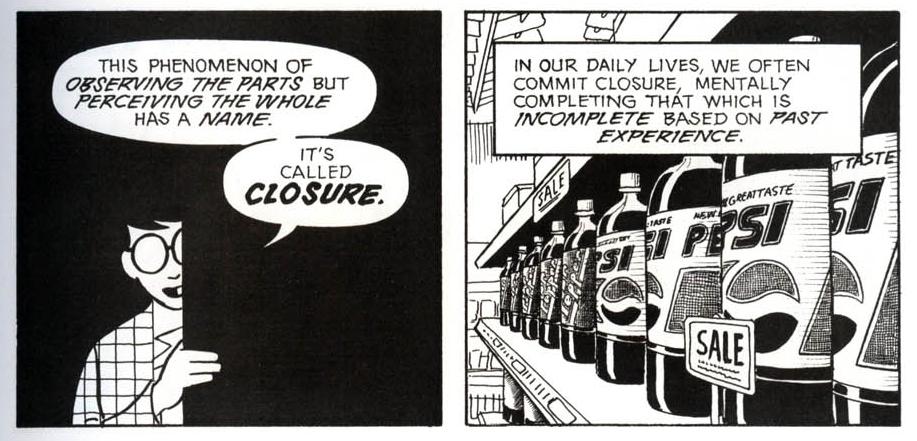
Blood In The Gutter is the name of my favorite chapter from the book where Scott explains what constitutes the magic and the mystery of comics through a concept called ‘Closure’. Following are some panels from the chapter that explain this concept in lucid detail:

Blog UC 1

Blog UC 2

Blog UC 3

(Scott McCloud (1993), “Understanding Comics”, p. 66, 68, 63)

It is closure that makes Comics an immersive medium that they are. For e.g., unlike in say radio and film, the audience for comics are compelled to participate more because they are required to perceive the gaps between panels and fill in the missing content themselves. No wonder then, artists from different media (Literature, Photography, Film etc) have experimented and adopted the techniques of ‘closure’ as a compelling narrative style in their own works. Three examples where this technique of closure has been adopted in 3 different media: literature, photography and film below:

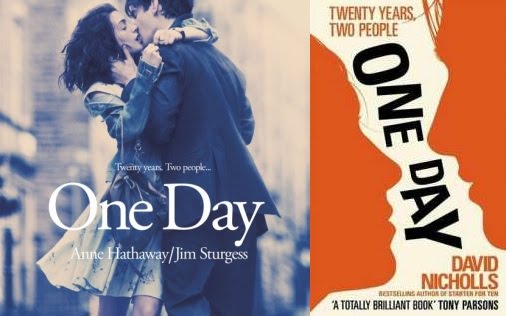
Closure in Literature: One Day

One Day is a novel by David Nicholls published in 2009. While it is essentially a ‘When Harry Met Sally‘ kind of genre, the unique feature of the book is its narrative. Each chapter covers the lives of the protagonists on exactly the same day (15 July) every year for twenty years.

One Day Movie_book

This literary technique of ‘closure’ as adopted by David Nicholls in One Day had its expected results with the book being praised as a ‘persuasive’, ‘ fast’, ‘absorbing’ and ‘smart’ and went on to be named 2010 Galaxy Book of the Year. Nicholls adapted his book into a screenplay; the feature film, also titled One Day, was released in August 2011. 

As with comics, closure –  when executed well in any media – facilitates smooth and seamless transitions in time and space and establishes a tightly symbiotic relationship between the reader’s imagination and the narrative.

Closure in Photography: The Whale Hunt

The Whale Hunt is a story telling experiment by Jonathan Harris who spent nine days living with a family of Inupiat Eskimos in Barrow, Alaska, the northernmost settlement in the United States. He documented their traditional whale hunt with a plodding sequence of 3,214 photographs, taken at five-minute intervals for seven days, and at even higher frequencies in moments of high adrenaline.  He then developed a framework for experiencing this story, allowing the viewer to rearrange the photographic elements of the story to extract multiple sub-stories focused around different people, places, topics, and other variables. (Source)

Go to the WhaleHunt page and experience the story unfold along different dimensions and see the cadence of closure engage your curiosity, senses and imagination.

The Whale Hunt

Closure in Film: I Love Your Work

Using a similar narrative style as used in The Whale Hunt, Harris now steps into a bold new territory by holding the spotlight on the world of lesbian porn.

Called as I Love Your Work, the project in Harris’ words “is an interactive documentary about the realities of those who make fantasies.It is a raw and intimate portrait of the everyday lives of nine young women who make lesbian porn.It consists of 2,202 10-second video clips, taken at five-minute intervals over 10 consecutive days.There is an interactive environment for exploring this material (around six hours of footage).”

What’s revealed through this tapestry of video clips separated by 5 min time intervals is an intimate portrait of a community opening up about topics like sex, gender politics, and their daily grind in a way that’s downright real and some times hard hitting.

I Love Your Work

Read this Fast Company article for a more detailed account of the project.

This powerful concept of closure (as it pans out in comics or in experiments like the ones shown above) seems to suggest one thing for certain. In order to engage, captivate and involve our minds and senses, the narrative of a story need not be continuous or seamless.

In fact what could work better in capturing and sustaining our attention spans can just be fragments of the story that are disjointed enough to let our imagination do the ‘connecting-the-dots’ drill and joint enough to let us feel that we are smart indeed!

Speak about the power of ‘smart narratives’.

Our perception of ‘reality’ is an act of faith, based on mere fragments.

Scott McCloud, Understanding Comics (1993)

2 Executions, 5 Years Of Life

5 Years of life. 

Gripping narratives around this same thing but contextualized against two different ends of the ‘consumer & life spectrum’.

Every year about 2 million children under the age of 5 die of infections like diarrhoea and pneumonia. A lot of these deaths can be prevented by the simple act of washing hands with soap. How do you translate this statistic and message into something real, personal and powerful? Lifebuoy‘s brilliant campaign called helpachildreach5 shows how:

(Agency: Lowe Lintas + Partners)

Over 30 percent of today’s children are obese due to physical inactivity. If action isn’t taken, one billion people will be affected less than two decades from now. Nike’s DesignedToMove campaign lands this through a shockingly powerful message.

(Agency: Wieden + Kennedy)

Two iconic brands, selling two completely different kinds of products, targeting two different sets of consumers with two different ‘need stages’ (w.r.t Maslow’s Hierarchy of Needs) but with one unmissable similarity: using ‘5 years of life’ as a frame of reference to pack a powerful punch.

The ‘contrasts’ are as compelling as the ‘similarities’ are in these hard hitting campaigns. Just couldn’t resist from juxtaposing them together for their unmissable power of story telling and sheer brilliance of executions anchored around one central tenet – 5 years of life.

(Source for header picture)

Story Telling To Spur Action

Project Re:Brief was a very interesting marketing experiment (and a sales pitch) by Google.

As part of this, Google had partnered with five of the brightest “old-school” legends from advertising to re-imagine and re-create their most iconic creative work from a half-century ago for the modern web. These include:

  • ‘Hilltop’ –  Coke
  • “Drive it like you hate it” –  Volvo
  • “I can’t believe I ate the whole thing” – Alka Seltzer
  • “We try harder” – Avis

Take time to go through this website and ‘navigate’ through the re-mastered versions of these iconic campaigns of the last century. The documentary on this project has been premiered at Cannes 2012 and went on to win accolades for its idea and execution. However, the big insight that stuck to me was what they had to say in their synopsis:

“Project Re: Brief ….. aims to shake up the ad industry and inspire new ways of thinking. While shifting formats and media platforms is one thing, as we learn from our heroes of the past, the basic tenets of human storytelling haven’t changed.” 

The evolution in formats/media notwithstanding, the fundamental tenets of human story telling are still the bedrocks of great advertising. For example, consider one of the key challenges of the current Integrated Brand Communications landscape. With brands aggressively taking on to various types of Paid, Owned and Earned media formats in the Digital/Social Media space, a big part of the challenge still remains – How can marketers use conventional media channels (Print/TV ads etc) to drive people online in order to continue the conversation further?

By just having the URL of the brand’s page or a message like “become a fan on our Facebook page” slapped at the end frame of the TV commercial? A representative statistic of the state of TV and Print ads trying to drive people online:

(2011 UK Statistic: Source)

But why on earth would I even pay attention to these ads – let alone feel motivated to memorize the keyword/URL and take time to actually visit the page? Ironically that device is often called “Call To Action”.

There are countless examples of flawed executions that attempt to drive people online through their TV/Print Ads. In most cases it’s not that the attempt wasn’t ingenious. It’s not that they lack a clear direction or an underlying strategy that seeks to unite different channels towards a central message. It’s not even that they lack the ‘innovativeness’ of the new media. I believe that it’s because such attempts seem to side step the basic tenets of human story telling. 

Why? Because, I firmly believe that ‘Powerful Communication’ – in any form- is all about the story and how its told. Especially when a piece of communication needs to make you reflect upon and react to something in a very tangible way. See the film below and notice how the ‘story’ is told. Don’t miss how dramatic it gets towards the end.

Till around 1 min 20s into the film everything seems to be ‘oh-so-sweet’ /’oh-so-cute’ , making you even ignore the whole point of this – till the moment the kid asks: “(But Hang on) Why are you even asking me that?” That’s when it begins. A spine chilling revelation, a shocking fact that makes you sit up and start paying attention. It wakes you up to your most receptive state before splashing the last frame with the URL. That’s it. It’s done.

How many of you actually considered visiting the page now?

This film (by Wieden + Kennedy) was first shown at the 8th Annual Clinton Global Initiative earlier this week and proves in a very powerful way that the classic tenets of human story telling are still as impactful if not more in making us sit up, take notice and perhaps even take action. Even if the action entails us taking the time and effort to visit a website.

By the way the website in itself is pretty cool and has its own well researched spiel to spur you into thought and action towards the end.

Any brilliant executions of Call To Action that you have come across off late?

Stories, Grommets and Epipheos

This is the latest in the series of cartoons by Hugh MacLeod as featured on his blog GapingVoid. While I totally agree with his point on how conversations change when the markets change, I want to add further to it or take the liberty of phrasing it in a slightly different way by saying “all evolutions in marketing are evolutions of stories, the narratives, or chronicles”.

KONY has been phenomenally viral. It is a story well told.

Charity Water tugs at your heart. It is a story well told.

Innocent makes you look at smoothie in a new light. It is a story well told.

Stories simplify, humanize and lend emotion to messages about products, services and causes and thereby make them unique and authentic for us. When a brand tells me its story, it plants its idea in my mind and thereby becomes more potent. When I know the story, I suddenly begin to care. That’s why more and more videos in Kickstarter are about a ‘story’, that’s why people go to ‘About Us’ page in most sites/blogs that they visit, that’s why you might find yourself intently reading the story of a restaurant as printed on the first page of its menu even before you get to the appetizers section, that’s why you might even relish and appreciate the coffee at your local coffee store. That’s why Facebook brand pages with a well designed timeline tend to come across as more interesting and humane narratives.

As a marketer I find this to be one of the most inspiring tenets of the practice. When I realize that it is all about story telling, things suddenly seem to take newer shapes of significance and bring newer things into perspective. It then begets questions from a consumer standpoint and demands for a spiel that a consumer can care about.  That I can relate and relate to as I share it with my friends. Branding as Story telling isn’t to be confused with some smartly concocted campaign ideas or executions. It is much more than that and encompasses all the elements of the mix and binds them to a unique, authentic core.

I am definitely not an expert at this but there are tons of resources available that offer help on the science and art behind branding as story telling. That said, let me highlight 3 interesting trends that are panning out in the realm of story telling in various realms.

1. Luxury brands are showing greater proclivity to adopt story telling strategies: Some examples: Vitra – the maker of master piece furniture is turning to story telling – read the story here. Read an account of Lady Dior Saga in this post on Luxury Story Telling.  And finally, the Chanel No5 film – need I say more!

2. Story telling at a personal branding level: For starters, I could argue that most brands in high involvement categories that you buy today, you do so with a conscious, painstaking thought and consideration on what story it could tell of you. As an other example read a trend briefing here regarding the shift from brands telling a story to brands helping consumers tell ‘status-yielding’ stories about themselves to other consumers.

3. Content consumption as story telling: Visual story telling is fast becoming a new standard in content curation and consumption. ‘Infographics’ are redefining this field rapidly. In fact it is said that over the past 2 years, infographic search volumes have increased by over 800%. There is even a site full of ‘visual summaries’ of this year’s SxSW event!

Obviously, story telling is no more about just making films, writing screenplays or devising plots. It is much much than that and the following 3 examples are a testimony to it:

Daily Grommet: This innovative site uses the art of story telling to sell a product a day. A new product is featured every day in a video with a story and an account on why this product has made the cut on this carefully curated video blog.

Epipheo: There is this ‘story telling studio’ that helps people/companies/brands tell stories about their new ideas, products or even technologies with what they call as ‘epipheos’. I would strongly urge you to see its video on Siri here and you would know why Epiheo has clients like Google, Facebook, etc.

And finally there is Get Storied that is all about teaching entrepreneurs how to tell their story. Never before was story telling so critical a part of pitching as business plans, revenue models and risk mitigation strategies had been for VCs and investors by budding entrepreneurs. Story telling is THE thing in pitching now.

Now, that begets the question – what is your story?