Fruit Flies, Technology and Heritage

Context: I was recently invited by Ahmedabad University Centre for Heritage Management to deliver a “curtain raiser keynote” (had to look up what that meant) at their annual research conference – The 5th International Conference on Heritage Management Education and Practice. Organized between March 15 – 17 2024, the theme of this year’s conference was “Intersections of Heritage Economics and Digital Technologies”.

When I had first received the invite, I was pretty certain that there must have been some mistake, for I had/have no authority to speak on the subject. But long story short, I took up the challenge and delivered my keynote at the Ahmedabad University CHM research conference. And to my absolute surprise, the presentation ended up receiving very positive (and very kind) feedback from the attendees. So I thought I would put it out here on brandednoise to solicit further ideas/ inputs.

So here goes my presentation. This is the direct ‘slide by slide’ rundown along with my speaker notes. Barring extremely minor tweaks (that I have incorporated to aid readability of the content as a blog post), this is my keynote – as is, in full.


Esteemed leaders – current & soon to be – from academia, research, policy and the practitioner community. It is such a privilege to be here amidst you all, precisely because I belong to none of these groups wrt the domain of “Heritage Management Education and Practice”! At best, I may call myself an observer as I seek to soak in, participate and contribute to the topic of the conference today “Intersections of Heritage Economics and Digital Technologies“.


When I thought about the rapidly growing role of Digital Technologies in Heritage Management, I naturally thought about how the technologies of AR/VR, Artificial Intelligence & advances in Cloud Computing are transforming how we interface with Heritage & Art. 

I thought I’d talk about Google’s platform where all this comes to the forefront – Google Arts & Culture. And how it uses technology to elicit user participation, engagement and drive co-creation of experiences wrt art & heritage.

But here’s the thing – that would be my “comfort zone”. 

And I thought, this is a research conference – and one of its kind at that! And what is a research conference if we don’t step beyond our comfort zone – a slight bit. That zone where we do a bit of philosophising, theorising and some crystal ball gazing, if you will? 

And that’s what I am going to do over the next few mins here. So indulge me here 🙂


My argument (or more precisely a premise) in a nutshell is as follows… 

It is clear as daylight that digital technologies have incredible value wrt heritage management & practice. 

But I’d be doing a disservice if I focus on just this aspect of technology – which is just the “tip of the iceberg” , For, if we do that we’d perhaps end up focusing on just a small subset of possibilities: i.e., digital technologies as just “techniques” to be used.


I am going to take a few more steps further and argue that Digital Technologies have an even more foundational role to play wrt the domain of heritage management. For, if you view Digital Technologies for what they truly are or what they truly can be, you could perhaps even see them as enablers of new ontological, epistemological and axiological perspectives of the domain.

So I’d say that Digital Technologies can have a lot to contribute to (even) the core philosophical foundations of heritage as a construct.

Let’s unpack that.


I’d like to start by asking a question. What is common amongst these three.

  1. A 2000 year old Japanese Shinto Shrine 
  2. The Drosophila melanogaster a.k.a the “fruit fly” 
  3. The hard disk drive

Have a think.


Let’s start with the Ise Grand Shrine – a.k.a .Ise Jingu

What can this 2000 year old Shinto shrine have to do with Heritage Management and Digital Technologies?

The Ise Grand Shrine – a Shinto Shrine – in Ise, Mie prefecture in Japan has been preserved exactly like it was around 2,000 years ago. Despite such a rich legacy, it doesn’t figure in the UNESCO world heritage list.

Why?

This is because the shrine is not built of a ‘permanent structure’. The Ise Grand Shrine is built of wood and hence it gradually loses its structural integrity over years. 

So the Shinto priests have a solution;  every 20 years they tear down the structure and rebuild another – in an adjacent plot –  in exactly the same specifications as the original using the wood from the same forest that the original structure was built from. 

Result: the shrine is forever new, ancient and original! 


The Shrine is currently in its 62nd reconstruction, the next reconstruction will be in 2033.

Despite not being on the UNESCO’s World Heritage list, the Ise Jingu Shrine is one of the highest visited Shinto shrines in the world! Now that’s saying something about Heritage Economics 🙂  

What can a 2000 year old Shinto shrine have in common with Digital Technologies?

It goes by the name “version control” / “generational cycle management”. 


The definition of Heritage is anchored around the core concept of “generations” 

  • What qualifies to be called as ‘legacy’ by a generation?
  • How does one generation view the legacies of an older generation? 
  • And what are the socio political cultural & economic imperatives that influence how a generation preserves its ‘legacy’ for its future generations?

And we can’t speak about generations without speaking about the Strauss Howe Generational TheoryWhat it essentially states is that history repeats itself and the sooner we understand the socio – political – cultural and economic contours of the same, we will be better served.

First a few building blocks of the theory:

  • Let’s take the average human life span as approx. 80-90 years. This is called a Saeculum and consists of four periods of approximately 20-22 years each. Which are (1) Childhood (2) Young Adult (3) Midlife and (4) Elder hood.
  • A generation – as we know – could be thought of as an aggregate of people born approximately every 20-22 years.
  • Each generation experiences “four turnings” every 80-90 years. They are (1) High (2) Awakening (3) Unravelling and (4) Crisis.

In essence, the cyclical nature of these “four turnings” could be stated as follows:

  • “Strong people” create “good times” (in general)
  • “Good times” create “weak people”
  • “Weak people” create “hard times”
  • “Hard times” create “strong people”
  • “Strong people” create “good times”
  • and it goes on…

Throwing all these elements into one chart gives us a view like this one about American generational cohorts – where you can see this cyclicity emerge across generations punctuated by the four turnings. And at any given point in time we have multiple generations co-inhabiting the time space. And the interplay between these generations is what leads to the socio political and economic imperatives that we grapple with as a society.

And the world around us – here and now – is this ‘laboratory’ where one can study this theory play out across generational cohorts.
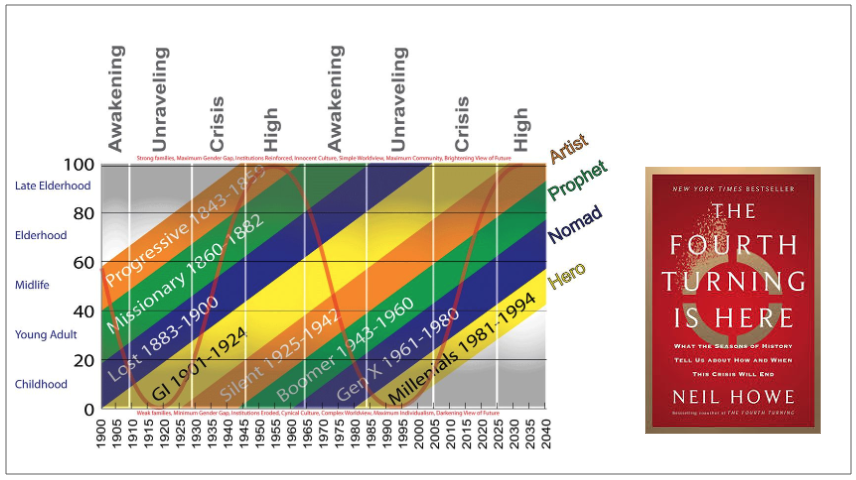

In fact in their book “The Fourth Turning is here” the authors of this theory argue that we are collectively living through the “Fourth Turning” now. The book has been called prophetic given how it seems to have ‘predicted’ way back in 1997, many of the socio political economic cultural and technological realities that we have seen ourselves grapple with over the last two decades in this millennium.

Now let’s conduct this thought experiment.

What if we were to set up a lab where we can observe these inter generational forces at play along with their fall outs? Only this time, the generational intervals are much shorter, thereby allowing us this rare opportunity to get a sweeping view across multiple generations during one single life time.

Wouldn’t we then be able to identify hypotheses, build models, test theories and perhaps even build grounded simulations around how the notions of heritage emerge, propagate and evolve over generations?


Studying species with short generational intervals is not a novel concept. Today, scientists study evolution in species with short generational intervals. This allows for direct observation of changes over many generations, which wasn’t possible in Darwin’s time.

This is Prof Thomas Hunt Morgan who was awarded the Nobel prize in medicine in 1933. His genius lies in establishing the Drosophila melanogaster as the model organism in the study of evolutionary genetics. Why? Because, the whole life cycle of the fruit fly is relatively rapid and takes only 10-12 days

Over the last century, this discovery has led to an exponential rise in research productivity across a diverse range of topics including genetics, embryonic development, learning, aging, behavior and more.


This is Prof. Clayton Christensen who has developed the theory of “Disruptive Innovation”. Reportedly..

Someone told him that disk drives were the “fruit flies” of technology: they were ideal subjects for studying innovation, because a generation in disk-drive technology was incredibly short. He saw that the companies that made fourteen-inch drives for mainframe computers had been driven out of business by companies that made eight-inch drives for mini computers, and then the companies that made the eight-inch drives were driven out of business by companies that made 5.25-inch drives for PCs. 

What was puzzling about this was that the eight-inch drives weren’t as good as the fourteen-inch drives—they had a lower capacity, and a higher cost per megabyte—and the 5.25-inch drives were inferior to the eight-inch drives. So why hadn’t the fourteen-inch-drive companies simply started producing eight-inch drives? It didn’t make sense.
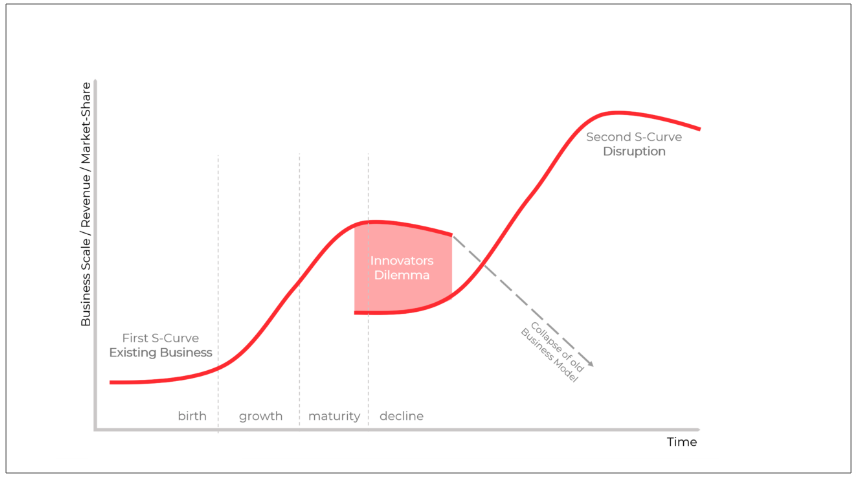

The genius of Prof. Christensen lies in studying innovations in products/categories which have incredibly short generational intervals and rapid evolutionary cycles in order to identify the organizational, economic (and sometimes even political) imperatives that could lead to an incumbent getting ‘disrupted’ by a new entrant in an industry.


In many ways, this – exercising our focus on digital technologies as our canvas – could be inevitable as they pretty much characterise the times that we live in. Students of economics would know the Kondratiev Wave which pretty much says the same thing.

This shows the pattern in the societal waves of advancement since the industrialization era. A few things that you can immediately observe, (1) every k-wave (which is characterized by the dominant technologies of its time) is shorter than its previous wave. (2) We are today living through the 6th K-wave, which could have an even shorter interval span, and finally (3) this wave (loosely estimated to be the one between 2010-2050) could probably be the one around “intelligent technologies”.

Central theme here: Technology’s shorter generational cycles and how that creates a second or a third order influence over the corresponding socio, economic, political and cultural forces at large. It’s pretty much the story of our times.

Let’s take a few examples.
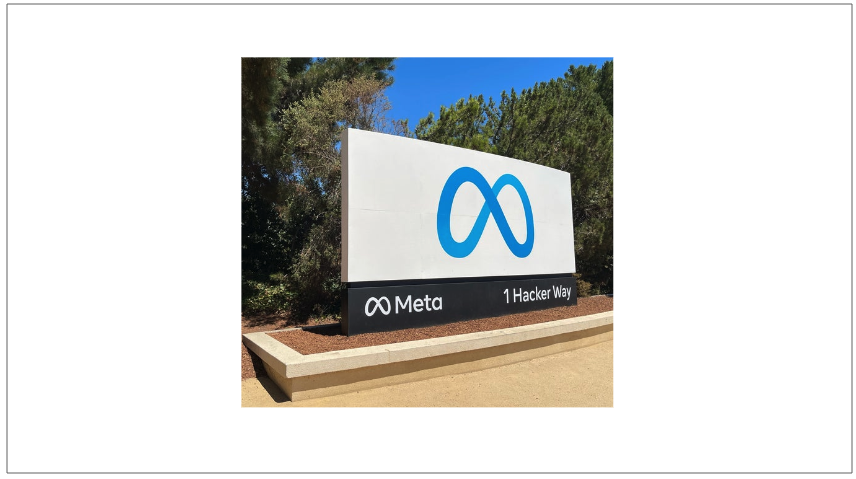

Many people would know what this is.

This is the signboard of Meta at their corp HQ at Menlo Park, California. Many people come over here to get their pictures. But not many would know that this has a peculiar “feature”.


Sun Microsystems (est. 1982) had gone defunct in 2010. Subsequently, Facebook has bought over and remodelled the property as its global headquarters by 2011. And instead of replacing the Sun sign, Facebook just flipped it over and put Facebook’s name (now Meta) on the front(!)

Beyond serving as a homage to Sun Microsystems as a company that had significantly contributed to several key computing technologies, many see this as an intentional ‘reminder‘ to those looking from within the campus.


Many of the logos that you see on the left belong to those brands that had been global leaders in their own right. They had defined standards, influenced culture, and pretty much led to our popular narratives around how societal trends and technologies have a symbiotic relationship given the breathtakingly rapid developments in this space. But today they no longer exist!

At the same time, we also have technologies/digital platforms/ device ecosystems that continue to see strong evolution over the times. For e.g., many would know that 2024 also marked the 40th anniversary of the Apple Macintosh and one can’t over-emphasize its socio cultural influence (that spanned several domains) over the years.


It is to chronicle these very stories in technology and with a stated mission to “decode technology—its computing past, digital present, and future impact on humanity” the Computer History Museum (CHM) at Mountain View California prides itself as the largest repository of computational artifacts under a single roof. The museum presents stories and artifacts of Silicon Valley and the information age, and explores the computing revolution and its impact on society.


I would like to believe that it is not an accident that the CHM’s core belief about the inter generational value of computational technologies has parallels with how UNESCO defines ‘heritage’.

(as a fun aside, I couldn’t help but notice the fact that the Centre for Heritage Management and the Computer History Museum share the same acronym!)


Therefore, the UNESCO’s charter on the “Preservation of the Digital Heritage” proposed in 2009 is a good start to the conversation. But we have a lot more to do.

Given rapid bursts of new technology breakouts coupled with ever shortening generational time spans of these technologies such as AR/VR/AI/Cloud etc, their ever expanding and evolving influence over practically every domain of our existence has a near axiomatic appeal wrt the socio economic political and cultural discourse of our times.


And that leads us to more fundamental questions.

  • What is digital heritage? (a question with an ontological lens)
  • Why study digital technologies in the realm of heritage research? (a question with an axiological lens)
  • What standards inform digital heritage identification? How do these influence how we experience & identify tangible and intangible heritage artifacts? (questions with an epistemological lens)

By virtue of the inquiry along these lines, I would posit that we might soon need to reconsider broader perspectives to help us answer even the central ontological question in our domainWhat is heritage?


And that’s why I would argue that Digital Technologies have even more foundational role to play wrt the philosophical aspects of heritage management. 


We spoke about the Kondratieff Waves a few minutes ago. Another way to look at these waves, especially in the context of Heritage Management is as follows:

  • What a generation calls as ‘legacy’ could be that which it perceives as the vehicle or the marker of its ‘progress’.
  • While the first few (known) millennia of the chronicled human history saw progress around the vectors of “transforming material”, the next set of waves – characterized by a dramatically reduced scale (of centuries) – could be seen as a commentary on our progress around the vectors of “transforming energy”
  • And today, our progress (and thereby what we’d perhaps call as the legacy of our times) can probably be characterized as that pertaining to “transforming information”
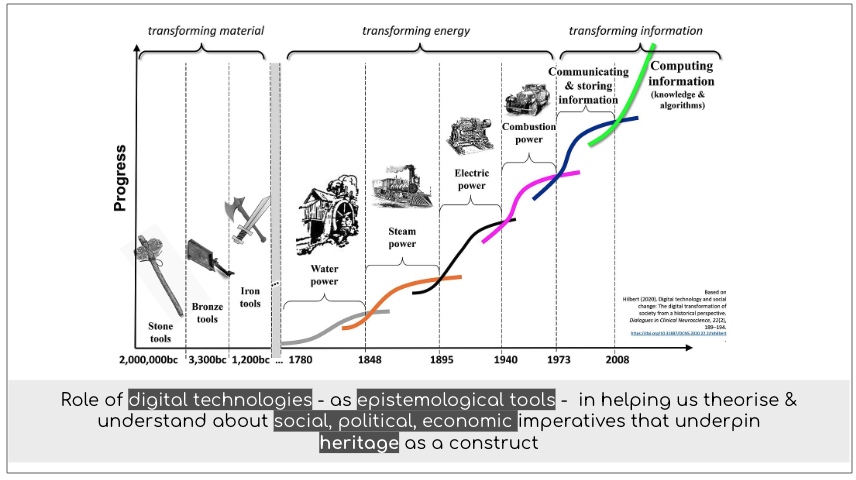
And that leads to the question about: the role of digital technologies – as epistemological tools –  in helping us theorize about and understand the social, political, economic imperatives that underpin not just ‘digital heritage’ but also the construct of ‘heritage’ as a whole.


And therefore just as the Drosophila melanogaster (fruit fly) ended up becoming the “model organism” that revolutionized the research in evolutionary genetics, just as the hard disk drives helped serve as the “fruit flies” for research on innovation management, my premise I submit for your consideration – phrased as a question- is as follows…
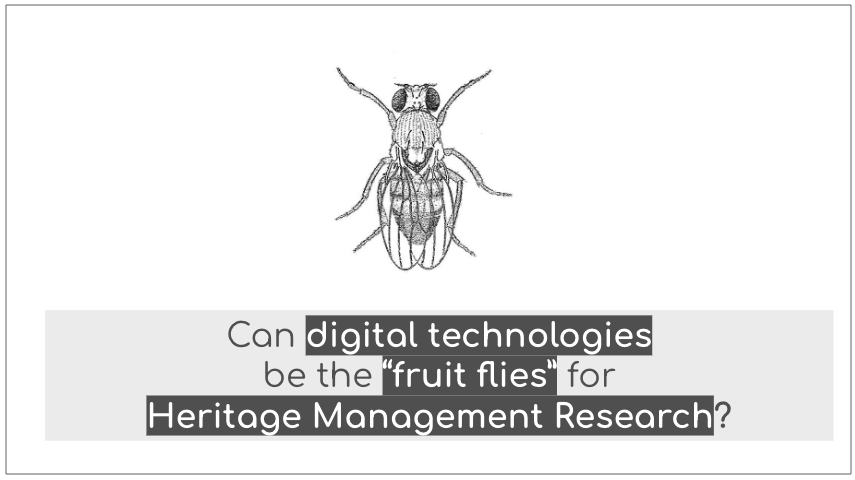

Can digital technologies be the ‘fruit flies’ for research in Heritage Management?

Thank you once again for the opportunity and I wish The 5th International Conference on Heritage Management Education and Practice at the Centre for Heritage Management, Ahmedabad University a grand success!

Narrative Violations and Narrative Primitives

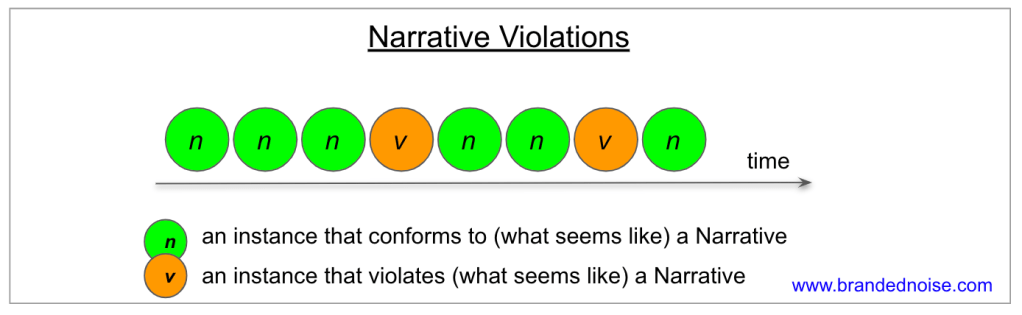
Quick Read: Sometimes narratives could have ‘violations’. And sometimes, what might at first appear to be a ‘violation’ could prove to be intrinsic to its narrative. Knowing the former from the latter could help unlock great value – across verticals or contexts.

Making sense of John Coltrane’s “Giant Steps” is said to be difficult.

It is considered by many to be one of the most revered and feared compositions in Jazz history. In fact generations of Jazz musicians are known to approach ‘Giant Steps’ as the pinnacle in Jazz improvisation.

Why? This video could provide a delightful crash course of an answer.

Or take Afrobubblegum – the new film genre redefining on screen representation of Africa.

It refers to fun, fierce and frivolous African art that has joy and hope at the centre of it. The pioneer of this style, Wanuri Kahiu a TED fellow and a Kenyan filmmaker says “We’re so used to narratives out of Africa being about war, poverty and devastation. We believe that Africa is joyful and full of pride and respect and hope,” and continues to champion the need for such art that captures the full range of human experiences to tell vibrant stories of Africa.

And tell she did!

In 2018, Wanuri Kahiu’s story of young lesbian love, Rafiki, made international headlines for being the first Kenyan film programmed at the Cannes Film Festival in 71 years of French Riviera cinema history.

What is common between Wanuri Kahiu’s ‘Afrobubblegum’ and John Coltrane’s ‘Giant Steps’?

The genre of Afrobubblegum or the Jazz track ‘Giant Steps’ standout because they ‘violate’ the popular narratives around their respective art forms or subjects. They are examples of what venture capitalists call Narrative Violations.

Narrative Violations

While the term could seem like a fancy jargon to reference the essential characteristic of what makes something a ‘contrarian bet’ to a VC, I should admit that it serves its semantic purpose of helping us put a label on something specific through descriptive and non ambiguous terminology.

Perhaps it is this pull that made Geoff Lewis and Eric Stromberg – the founders of Bedrock Capital – write a manifesto for their firm titled ‘In Search of Narrative Violations‘ stating the following..

Some recent ‘Narrative Violations’ listed on Bedrock Capital’s manifesto letter

The letter in its entirety is eloquent and makes for a great read and ends on an inspiring note saying..

“..As our keystrokes hunt for the next narrative high, thousands of possibilities that will never be remain trapped beneath our fingertips. When we allow popular narrative to dictate who, where, and what is worthy of our time or capital, breakthroughs that could transcend remain overlooked, underestimated, or simply fade away.

Against all odds, a few brave entrepreneurs violating the narrative today will come to define profound new truths tomorrow. We’re on a mission to find them

To be clear, the concept of ‘Narrative Violations’ has also had its fair share of critiques for being too reductive. It was even declared 2019’s ‘VC Bingo’ buzzword of the year.

Nonetheless, I find the concept to be a clarifying filter that helps me process or question most things with a healthy dose of scepticism and encourages me to seek out edge cases in popular rhetoric, including say even that around the concept of ‘Narrative Violation’ itself.

Why?

Consider this question.

What if, sometimes, narrative violations are part of the narrative?

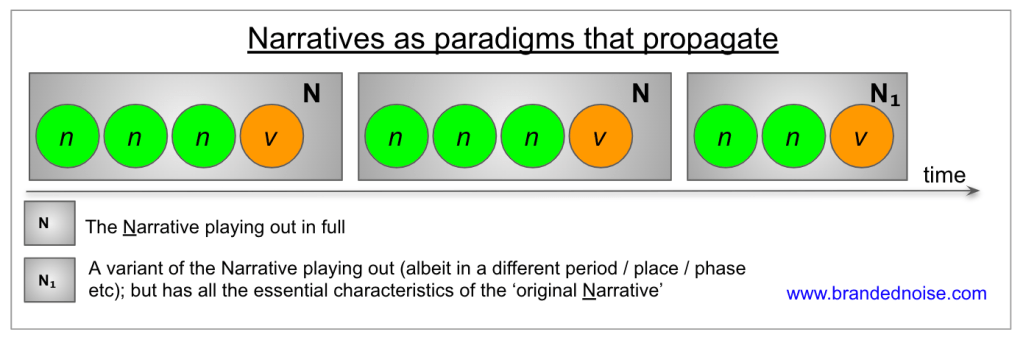
i.e., what if a ‘violation’ is actually an inherent part of a larger pattern that constitutes the narrative itself? Like say, a recurring motif that becomes apparent if only one were to step back and consider the big picture. Being able to see if and when that is the case could help us identify emerging paradigms and recognise how such paradigms propagate.

For e.g., after the dotcom bubble burst in 2000, Carlota Perez published her seminal book Technological Revolutions and Financial Capital arguing that the ‘burst’ was completely normal and qualified it by drawing patterns from four similar epochal periods over the last two centuries: the industrial revolution, steel and railways, electricity and heavy engineering, the automobiles and mass production.

Across each of these periods, she pattern matched its associated moments of ‘crash’ (the equivalent of the dotcom bubble burst from 2000) and recognised such instances as inalienable parts of larger cycles that play out over several decades (as opposed to say some inexplicable violations to the popular narratives of their times).

Source: Carlota Perez, Technological Revolutions and Financial Capital,2002

The master stroke of her framework is that it inherently provisions for moments of ‘big bangs’, ‘bubbles’, ‘crashes’ and then again necessary ‘recompositions’ as part of a single unified narrative that cohesively explains the interplay between financial capital and technological revolutions. And then continues to shine a spotlight on how this narrative seemed to have repeated itself across ages almost inviolably.

(Bonus reads: Two of my favourite thinkers, Alex Danco and Ben Thomspon have recently used Carlota Perez’s framework to write about Debt Financing and Paradigm Shifts in tech. Highly recommended reads indeed.)

To reiterate, a key takeaway for me here is the idea of the narrative as a paradigm that propagates.

Such a narrative construct that propagates needs to be essentially indivisible, should have a full self contained arc of a structure to serve as a standalone story if need be and be able to play out as a cohesive whole even with trivial variations in contexts or actors.

Matthew Ball has a term for this – The Narrative Primitive.

In one of the most intellectually stimulating podcasts I have listened to in the recent past, Matthew Ball joins Patrick O’Shaughnessy to discuss movies, the Metaverse and more and refers to the concept of ‘Narrative Primitive’ to explain why the worlds of the Marvel Cinematic Universe or the Star Wars stand out as expansive and immersive. The following lines from the podcast’s transcript shine light further.

… “how would you have told the story 80 years ago if you had all the tools available? How are those stories going to change in the next 10 years?” And in some instances that is unlocking what you might call a narrative primitive, that’s perhaps some of the reasons why the Marvel Cinematic Universe or the tales of Star Wars are so expansive today, so immersive.

Now, when I consider these two concepts – Narrative Violation and Narrative Primitive – together, I am tempted to posit the following.

The essential insight that rock star traders, venture capitalists and story tellers possess is this – they know a good narrative when they see one. And more importantly they have an eye for a narrative violation. Because they think in narrative primitives.


Noteworthy ingredients – that may or may not have gone into the making of this blog post:

[Featured Image: Pendulums on freepik]

Expressions and Insights

Quick Read: No matter what we do, we tend to express ourselves. And these expressions can lend themselves to interesting insights. 

A very popular class of Kenneth Goldsmith at the University of Pennsylvania is called “Uncreative Writing”.  As part of this course, students are forced to plagiarize, appropriate, and steal texts. In fact, they are said to be penalized for originality, sincerity, and creativity.

What does the course do?

As Kenneth elaborates ..

What they’ve been surreptitiously doing throughout their academic career—patchwriting, cutting-and-pasting, lifting—must now be done in the open, where they are accountable for their decisions.

Suddenly, new questions arise: What is it that I’m lifting? And why? What do my choices about what to appropriate tell me about myself? My emotions? My history? My biases and passions? The critiques turn toward formal improvement: Could I have swiped better material? Could my methods in constructing these texts have been better?

Not surprisingly, they thrive. What I’ve learned from these years in the classroom is that no matter what we do, we can’t help but express ourselves.

No matter what we do, he says (and I repeat), we cannot help but express ourselves. And this forms of expression if interpreted and analyzed could lend themselves for some valuable insights.

Let us take a few examples from the most unlikeliest of the sources of expression.

The link between crime and ink

People choose to draw stuff on their bodies because of what that specific tattoo means to them. With one of the hotbeds of tattooing being the American prisons, The Economist set about to investigate what inferences it could possibly draw about a life of crime from different types of tattoos.

mob
Source:  Robert Gumpert 


Their question: If people’s ethnicity and sex determines their tattoos, can the same be said of their types of crime?

Using data from the Florida Department of Corrections (FDOC) – a downloadable database featuring records for all the 100,000 inmates currently incarcerated in the Florida state prison system –  The Economist built a series of statistical models to predict the likelihood  of criminals committing specific crimes based on their demographic traits and choices of tattoos. (see table below)

crime-ink
Source: The Economist

For example, their  analysis had found that inmates convicted of property crimes and weapons-possession offences have the most tattoos, while sex offenders, particularly those convicted of paedophilia, tend to have the fewest. For a full commentary on this revealing analysis read the full article here.

One big insight based on this analysis is that tattoos tend to be supremely effective in predicting recidivism – the tendency of an ex convict to relapse into criminal behavior. (Of the inmates who have been re-incarcerated, 75% percent had tattoos!)

So non profits like Homeboy Industries – one of America’s largest gang rehabs – have free tattoo removal services. For, the act of removing tattoos reflects a genuine investment in ones change and thereby almost guarantees a step change in how you see yourself.

Bespoke fashion: an investment in self expression

Getting a pair of bespoke shoes is considered an epitome in luxury grooming for men.

One, because of its obscene cost. And two because it requires a considerable investment of time—typically, you fly off to Europe to get your feet measured and place the order (or the shoemaker flies in to your city), there may be two-three more visits for fittings, and then you wait anything from 9-12 months for the final shoe.

These connotations of luxury don’t still capture the essence of the bespoke fashion movement, until one begins to see it as an investment in self expression.

Bespoke, thereby, is a journey where you typically start with shirts, move to suits, and then some men take the logical next step to shoes as a final expression of their overall style and look. So next time you see someone with a bespoke suit you know where they are in their journey of self expression.

berluti-shoes
Source: Berluti, Mastery of Form

Now, given that there’s greater variety in women’s body shapes than men’s, one would expect a greater choice for women’s bespoke fashion. Interestingly it’s the other way round.

Cost is one challenge – more curves mean more measurements, more places a garment might need to be adjusted and more time getting the fit just right, making the whole process more expensive.

But the key challenge could be in being able to support for the underlying vocabulary of self expression dormant in women’s custom clothing. After all, bespoke fashion for women is an ocean of choice for personal expression that goes beyond just body fit, spanning attributes like apparel, color, fabric, style, occasion and perhaps even mood.

Now that’s one heavily under served segment in the super lucrative world of bespoke fashion –  if only one could demystify the method to the madness of the infinite variations of expressions that constitute women’s custom clothing.

Anyone that’s sartorially linguistic?

(Featured Image: Bespoke Shoes by Gieves and Hawkes)

Time Travel Democratised

Quick Read: Time travel, branding and public sentiment indices could have a lot in common. To know more, just ask Zlaty Bazant (the Slovak beer) for a test drive to the 1970s. 

Here’s an exercise. Think of any science fiction story. Anything.

Now take a few seconds and reflect on its theme.

Chances are that its theme might not be the future. You would notice that the genre uses the future only as a canvas on which to imprint its real concerns—the present.

The insight: Counterintuitively, time travel stories are often those tales that are most anchored in the present.

Similarly, stories that transport you to the past do so only to provide the necessary distancing effect for the narrative to be able to metaphorically address the most pressing concerns of the here and now – the present.

This has an interesting corollary for brands.

Na zdravie, Slovensko (“Cheers, Slovakia!”)

Central and eastern European countries faced the scourge of communism for most part of the last century. So it’s only natural to expect that the people in these countries would not want to be reminded of those darker times.

Yet, a curious trend seems to be suggesting the contrary in recent times.

Retro is seriously back with a bang.

  • Polish hipsters are lapping up retro furniture of the Jaruzelski era.
  • Lidl stores (the German supermarket chain) in Czech Republic have sales of imitation communist products in their now popular “Retro Week” promotions
  • Even the communist era beers are getting resurrected across the region

(Retro Products at Lidl. Source)

As The Economist article frames it, communist nostalgia is not new, but it does seem to be having a new wave of resurgence. While this makes some sense in Russia, which ruled the empire, it is puzzling to understand its relevance among the central and eastern Europeans whom the Soviets ground under their boots.

And to frame this irony even more acutely, this affection for the socialist era products seems embodied even in the consumer products that are marketed by Western multinationals!

For example, in May this year a Heineken-owned Slovak brewery, Zlaty Bazant, introduced a premium version of its beer based on a 1973 recipe, priced 20% higher than its standard line up. Even its slogan Na zdravie, Slovensko! (“Cheers, Slovakia!”) vaunts its local roots as opposed to typical beer marketing themes that emphasize Europeanness and modernity.

zlaty-bazant
Zlaty Bazant Ad. Source

Yet, this doesn’t necessarily reflect a desire of these people to return to the pre-1989 era. That’s where it becomes a bit complicated (in terms of their relationship with these brands).

The insight here: As Ivan Klima, a Czech novelist, puts it, “nobody is nostalgic for the communist era, but many people are nostalgic for their youth”.

Why?

Most people in the region are believed to be discouraged about the future.

In fact according to the recent Eurobarometer survey, just 30% of Slovaks and 26% of Czechs have a positive view of the European Union. Poland and Hungary are more pro-European, but have elected governments determined to check the power of Brussels. (source)

And these themes of insecurity and pessimism in the current socio political context manifest among the central and eastern Europeans as an inexplicable longing for brands of the bygone communist era. As if returning to these good old things could bring about a sense of security and stability amidst the slipping sands of the current times.

So if a Serb is seen enjoying a 1973 communist era quaff like the Zlaty Bazant, he is perhaps not so much contemplating nationalizing the auto industry as he is struggling with his attempts to reconcile with his current times.

Almost like the fascination with that time travel story to the past that is fueled by the strifes of the current times.

This could have interesting implications on brand building.

Public sentiment index (or their proxies) can perhaps be a lighthouse for brand builders. If the sentiment is low for a prolonged period of time in a market, brand builders there could perhaps do well to dust the grime off legacy brands and shine a light on them.

And may be even charge a premium for the same, as it is after all time travel, only packaged in a little bottle.

(Featured Image: Zlaty Bazant saying “Merry Christmas, Slovakia!”)

On Points Of View

Quick Read: Some businesses thrive by driving a singular POV regarding their offering amongst their target audience. And there are some that take pride in celebrating multiple POVs regarding theirs. 

Some elite restaurants in Japan are ichigen-san okotowari (first-time customers not allowed), meaning a regular customer has to introduce you before you can make a reservation.

The genius of this system is that it ensures that you buy yourself into a singular and a specific POV about its food, experience and its clientele if you want to be able to get a reservation at the restaurant.

Almost by definition.

And the story continues. One customer at a time.

It works because the ichigen-san okotowari system ensures that a single consistent POV gets bought into, replicated and passed on.

Meanwhile elsewhere..

A recent print campaign by Shutterstock made it to the shortlist of Clio Awards 2015 under the Print category.

As a purveyor of stock photos, Shutterstock.com wanted to celebrate the fact that an image can potentially fire up your imagiation in multiple ways.

So it brought this idea to life through the following executions.

ShutterStock_Shark

ShutterStock_Broken

ShutterStock_Baby

[Click on the images for a larger view]

Agency: Leo Burnett. Images via: Clio Awards. (HT Bhatnaturally)

A truly insighful execution that celebrates the multiple POVs that an image can inspire. As Mr. Bhat says..

The irony is that this is too close to reality. We’ve all seen how art directors search for inspiring images first and then try and retrofit an idea. Also, a visual idea which was rejected or didn’t make the cut for a pitch in one category can be adapted to a totally unrelated category. This campaign actually puts a positive spin on that.

Does your brand – and by extension its strategy and execution –  thrive on driving and sustaining a singular POV or does it celebrate multiple POVs? 

[Bonus Link: Speaking of POVs, you should check out Hardcore – the world’s first action POV film that got premiered in the latest Toronto International Film Festival to critical acclaim.  The entire movie is shot from a single POV and boy is it intense!]

(Featured Image: Shutterstock Print Execution. Source)

Is The Classic Purchase Funnel Flawed?

Quick Read: With most products in any given category tending to have total functional parity, the only way to drive trial could possibly be through a singular route – curioisty.

Often times I am curious why “curiosity” doesn’t even figure in the classic purchase funnel.

In fact I tend to believe that without inciting a threshold level of curiosity in a consumer, awareness and consideration could end up proving to be moot pursuits.

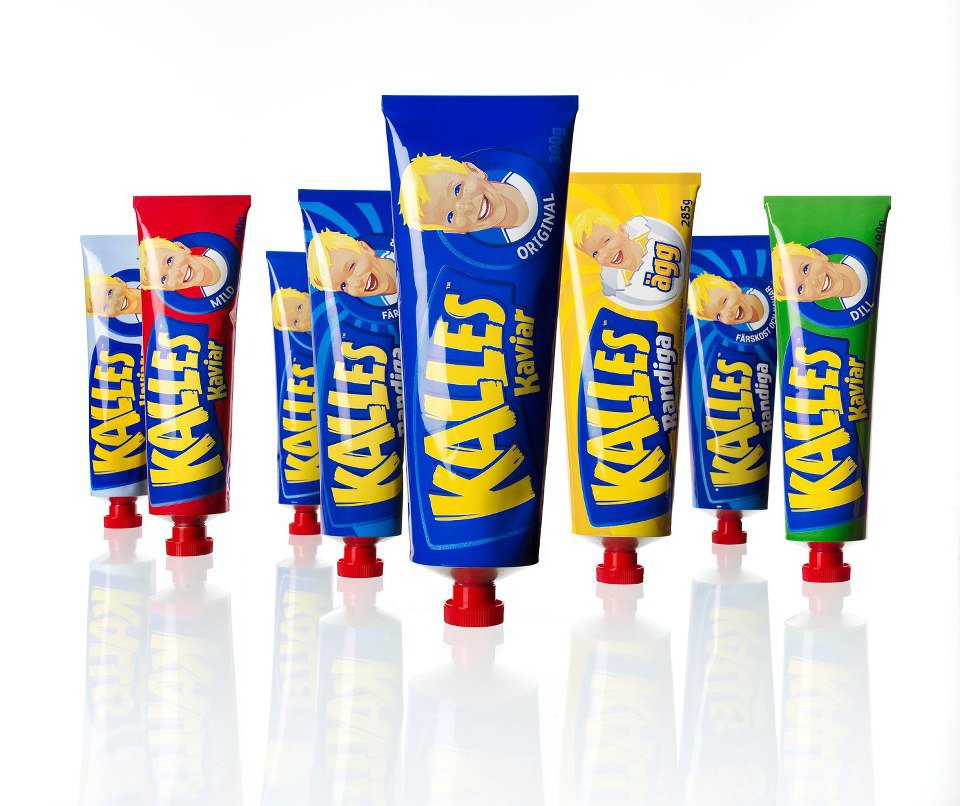
Let’s take Kaviar. (or Smörgåskaviar to be specific)

Kaviar is a Scandinavian spread – a paste consisting mainly of lightly smoked cod roe that has a salty/sweet/fishy taste and a gooey pink/orange colour. Packed full of omega-3 goodness, kaviar can be eaten at anytime and practically spread on anything edible – breads, eggs, meat, cheese etc. (source)

Mills Kaviar

(Source: Mills Kaviar)

No wonder the Scandivaians swear by them, with the category that is sufficiently crowded with brands like MillsStabburet, Kalles, Kavli etc battling out for market share by commanding fierce loyalties.

However kaviar supposedly has one catch – it is an acquired taste and a first timer might find the taste disgusting

Now that’s where the Kalles Campaign proves to be a genius. (Kalles is a Swedish Kaviar brand)

The campaign holds a mirror to other nationalities’ incomprehension and their reaction at having something that tastes – let’s just say – strong and funny.

It starts with Los Angeles where obviously the Californians don’t hold back their feelings upon tasting something weird.

As it moves to Switzerland, the taste test yields more hand and eyebrow gestures than actual verbal responses.

“It tastes … ” a serious looking man in a tie says. “It tastes … ”

“Fantastic?” the Swede asks.

“No,” the Swiss man replies, with a resolute firmness.

In Budapest, the reaction is icier. A woman takes a bite, exchanges cold glances and upon being asked if she likes it, she smiles, and says “yes,” with a look that clearly says no.

The Costa Ricans laugh and gesticulate.

And the Japanese are very polite even as they appear to be gagging at the taste.

 The Kalles commercials began in 2012 and were made by the Swedish ad firm Forsman & Bodenfors.

As this NYTimes article says, if nothing else these ads are a whimsical cultural excursion into manners.

Now, can anyone get me a Kalles Kaviar please?

I want to try my own gag reflex.

I am really curious!

Now, where am I in the purchase funnel?

(Featured Image Source: My Guilty Pleasures)

Straddle Categories, Redefine Competition

Quick Read: Straddling categories can sometimes help redefine competition and build a unique position in the market place. 

“If I should have a daughter, instead of Mom, she’s gonna call me Point B … “

began Sarah Kay, in a talk that inspired two standing ovations at TED2011.

Sarah Kay is called a genius. She has invented a new medium, a new way of sharing an idea. It’s called Spoken Word Poetry. Arguably others have done spoken word poetry before, but not like this.

Mixing in the magic of her poetry, presence, and exuberant energy her art form straddles two categories – poetry and theatre. This unique combination has helped her redefine her ‘comparison set’ – not poets and not theatre artistes, but someone at the intersection of both to become a truly unique voice to reckon with.

Today she is the founder and co-director of Project V.O.I.C.E., founded in 2004, a group dedicated to using spoken word as an educational and inspirational tool. Her TED talk has been loved so much that Seth Godin has published her poem ‘B’ by himself.

Why Do We Love Some Comic Strips More Than Others?

Most of us have our favorite four paneled comic strips that we enjoy and share on a regular basis. Why do we love them so much? Is it because they resonate with us at a deeper level? Is it because they have that spark of insight – a blinding flash of the obvious? Or is it because they remind each one of us that we are not alone?

calvin-and-hobbes-relativism(Source: Calvin and Hobbes)

Seth is a cartoonist, illustrator and book designer based in Guelph, Ontario. Based  on his research on Charles Schulz’s Peanuts, his insight is that most of the best known four paneled comic strips have one thing in commonthey straddle the art forms of graphic design and poetry and occupy a truly unique space of artistic expression. He calls such comic strips Visual Haiku and elaborates.. 

It seemed so clear that his four-panel setup was just like reading a haiku; it had a specific rhythm to how he set up the panels and the dialogue.Three beats:doot doot doot— followed by an infinitesimal pause, and then the final beat:doot. Anyone can recognize this when reading a Peanuts strip.These strips have that sameness of rhythm that haikus have — the haikus mostly ending with a nature reference separated off in the final line. (source)

Peanuts - pe_c140414.tif(Source: Peanuts)

What Sets Brita Filters Apart?

Ever heard of Brita Filters? A leading company in portable household water filtration, its products are distributed in more than 60 countries world wide. But what sets it apart is how it straddles categories and redefines competition. As per this HBR article..

Brita filters compete against other filters when they are placed in the kitchen appliances section at big-box stores, for instance. But Brita changes both its comparison set and the economics of the consumer decision when the filters are placed in the bottled-water aisle at supermarkets. Here Brita filters have a competitive cost advantage, delivering several more gallons of clean water per dollar than bottled water. Of course, not all buyers of bottled water are buying solely for the criterion of cost (some are buying for portability, for example), but for those who are, Brita is an attractive choice.

Brita Filter Jugs

As the article goes on to say, in choosing how to position products, there’s a tendency to pay attention to the size and growth of the market and overlook the intensity and identity of the competition. Such times, all it might take is to challenge our playing field (the category) and see new niches emerge for tapping into a new consumer base.

Opportunity – it seems – could sometimes be rife at the intersections.  

For artistic forms of expressions or water filters.

(Featured image: Calvin and Hobbes by Bill Watterson May 05, 2014)

3D Printing, Value Chain and Lawyers

Quick Read: 3D Printing as a technology can can have revolutionary implications on all the 3 key stages of a value chain –  Manufacturing, Distribution and Retail. And not to forget lawyers!

Let’s Start With Manufacturing

Today Lego finds itself going to war with the 3D Printing technology. Why?

Because, what has happened over the last decade to music, newsprint, film and photography now seems to be threatining the world of shapes and objects. As this Washinton Post says..

Soon hobbyists…. will be able to craft their own (lego) bricks, thanks to 3D printers that make fabricating those plastic parts as convenient as going to Toys R Us. With such technology, entire structures can now be reverse-engineered, reduced into a pile of components and snapped together in minutes. 

Lego’s sophisticated molding process that currently enables it to produce 55 billion Lego pieces a year is probably not under an immediate threat from the 3D printers. But once the technical challenges like being able to meet the established tolerance levels for finish, texture and fit of various materials and being able to operate at scale are solved, which –  many experts believe is just a matter of time – Lego might be at a major  risk.

lego_ironman(Lego Ironman, Source)

So the recent remarks from Lego’s CFO John Goodwin who said “3-D printing is a fascinating development and certainly opens up a lot of new avenues” gain significance as a first ever major acknowledgment by Lego about the impending storm.

This has even led to some analysts predicting that the future for Lego could be as an Intellectual Property publisher of the digital models of their blocks, not unlike the modern record company which doesn’t actually create physical tracks anymore but just owns the IP rights of their music.

Moving Over To Distribution

Distribution (and inventory management) are known to be Amazon‘s expertise. But faster shipping can come at a price. For e.g, in Q1 2013, Amazon’s shipping costs were 4.7 percent of revenue (source). So it has reportedly been testing the grounds for newer, cheaper and faster delivery methods like drones.

But here is – what could potentially be – the billion dollar question. 

What if the whole value chain starting from maintaining inventories of raw materials, industrial scale manufacturing, packaging, palletising, shipping, bulk breaking, transporting, warehousing to distributing were to become redundant? What if we manufacture goods just in time near the final destination?  

As this article says, that’s where 3D printing comes in –  by producing goods in exactly the ordered configuration precisely when they’re needed, 3D printing is ideal for filling gaps in the supply chain (which reduces uncertainty), keeping inventory low more generally (which saves companies money on shelving) and reducing waste (which occurs when the goods aren’t sold).

Called as Just In Time manufacturing, UPS has already started to venture into this business model in a small but significant way. And the initial results are reported to be more than encouraging.

3D Printer UPS Store(3D Printer at a UPS Store, Source)

So when the largest shipment/logistics company in the world begins such seemingly ‘odd’ experiment around On demand 3D printing, it can only indicate one thing.

Even the distribution behemoths are swearing by the mantra – if you can’t beat them join them. 

And Finally Speaking Of Retail

This year’s SXSW – the annual music, film, and interactive festival being held in Austin as we speak now (from March 7 – 11) has been generating a good amount of buzz.

Oreo‘s Trending Vending Machine is an example.

Envisaged by Mondelez as a fun experiment with Twitter, the concept is a mash up between the vending machine experience and social media based real time marketing. Named, Trending Vending Machine, it has been offering the SXSW attendees Oreos with 3D printed flavours picked from trending tweets and delivered to the attendees in 2 minutes (source). This marketing effort includes the hashtag #eatthetweet.

While this certainly makes for a pretty good engagement driving initiative by Mondelez where the world of social media hashtags meets cookie cutter biscuits – literally, the underlying story here could be that of the emergent possibilities of 3D printing in the retail sector where:

  • Inventories for the retailer are non-existent and limitless at the same time!
  • Shopper engagement becomes the norm, in fact the key enabler for the whole set up
  • And finally personalisation becomes a category code, and not just a fancy differentiation strategy

In fact, going by this logic, 3 D printers could even upend the very concept of retail sector as we know it today!

After all, why would anyone even bother to walk down an aisle when all they need to do is perhaps just download a design, chose a nearest 3D printer and click PRINT?

Or shall we call it MAKE?

Some food for thought on a related note: Thanks to 3D Printing, professions like Intellectual Property and Law can be in good demand for a long long time to come!

(Featured Image: 3D Printed edible Lollies at CES 2014, Source)

The Allure Of Being Limited: Part 2/2

Quick Read: Value as a concept to a consumer has 2 key dimensions: perceived benefit and perceived cost of a product. But the moment a third dimension called ‘availability’ is introduced, the equation becomes intriguing and interesting, especially when the former is limited – in reach or time.

Imagine someone unboxing a case of 20 blind boxes – each box contains a sealed wrapper that holds a mystery toy within.

For each foil he unwraps and realises the actual toy within – a miniature character –  he lets out an exclamatory ‘aah’. The look and feel of this miniature character makes him marvel at the detail and the exquisite craftsmanship that must have gone into its make, while he also makes a mental note to himself regarding its probable name and where it fits in the larger family of its ‘toy clan’.

And this goes on for each of the 20 blind boxes containing a mystery miniature character within.

Box after box.

And did I tell you that he is an adult in his 30s?

Difficult to imagine, right?

No worries.  For there are thousands of videos here showing this very story unfold. Box after box.

This video here is a good representative version. (strongly recommended dose of some infotainment before you read further)

What did we just see?

Adults –  acting like kids on a christmas morning, unable to contain their excitement as they hold their breath while they unwrap a foil to discover a pretty little toy character within.

Welcome to the world of Urban Vinyl and Designer Toys – a world where toys become prized possessions and collectibles because of two reasons: 

  1. They are works of art designed by prominent international pop culture and graffiti artists.
  2. They are produced in limited quantities  – some as few as 10 to a maximum of 2000 – thereby becoming some of the rarest toys of that kind to be ever made.

Qee series produced in Hong Kong by Toy2R,  Be@rbrick from Japan and the Dunny series produced by Kidrobot are some of the most prominent examples of Designer Toys and Urban Vinyl.

Let’s take Kidrobot – known to be the Mecca of Designer Toys enthusiasts – founded in the US in 2002 by Paul Budnitz. It calls its limited edition Designer Toys as an innovative cross between sculpture and conceptual art, offering not only a powerful medium for today’s international fashion designers, illustrators and graffiti artists, but also the creative canvas for emerging street trends and pop art.

And due to these toys being ‘limited edition’ in design and make they retail anywhere from $5 to $25,000, and many appreciate in value over time. (source)

Kidrobot Dunny(At the intersection of Art and Cult –  The Kidrobot Dunny, Source)

A few more fascinating details regarding Kidrobot and its Dunny Series Designer Toys:

  • Packaging: Each Dunny Designer Toy comes in a foil wrapped inside a blind box. These blind boxes are identical in every way to any other box in a given set so nobody knows which toy is inside. A foil is used to wrap the toy so nobody can open the box and peek inside. (also shown in the unboxing video above)
  • Product Assortment: While the outer case would have some indication of what characters to expect inside, not all of them can be expected to be contained within. Each toy character would have an odds ratio indicating its probability of occurrence within a set. Interestingly there are some characters called ‘chases’ with unknown odds called out as ‘?/??’, while a few are shown mysteriously only in silhouettes. Occasionally, they also include ‘super mystery figures’ that aren’t even indicated on the box, which tend to be some of the rarest ever made of the kind!

Kidrobot Official Dunny Series 2012 Checklist & Ratios(The odds ratios as printed on the cases of Dunny Series 2012, Source) 

  • Kidrobot’s approach to marketing is anything but ordinary: Read here a short interview with Paul Budnitz where he reveals how he has taken a marketing approach opposite to that of most companies.
  • How Kidrobot manages its creative capital: Kidrobot’s approach to distribution of decision making power within the company, its open source design strategy, and how it regularly commissions rock star designers rather than in house artists in order to let a sort of ‘fluidity’ permeate the entire company makes for a fascinating read.
  • Tie ups and Partnerships: Given the cult level popularity and the artistic appeal of Kidrobot’s limited edition toys, it naturally makes for a very coveted partner. For e.g., in Jan 2014 CES, Samsung Galaxy partnered with Kidrobot to land the message about the brand being a new touch point in artistic expression.

samsung_kidrobot_0235wtmk-1280x878(Samsung partners with Kidrobot in CES 2014, Pic source: Slash Gear)

And so it goes on – a fascinating story of how a bunch of unassuming tiny vinyl toys have grown to become icons of pop culture that regularly pull in rabid fans and ardent collectors, who neither mind queuing up for hours outside its stores nor forking out hundreds or even thousands of dollars to buy these designer toys while making its company a multi million dollar brand that it is today.

And when one reads this, sometimes all one can manage to say could be …

…while perhaps even wondering on a wishful note to oneself  damn! where can I get one myself!!”

(Featured Image: Set of Huck Gee’s Night & Day Raku 8” Dunny released in 2011.These were a limited edition of just 500 sets.source)

The Allure Of Being Limited: Part 1/2

Quick Read: Value as a concept to a consumer has 2 key dimensions: perceived benefit and perceived cost (of a product). But the moment a third dimension called ‘availability’ is introduced, the equation becomes intriguing and interesting, especially when the former is limited – in reach or time.

Value is an interesting concept. It can be defined as  the consumer’s perceived benefit derived from a product in relation to its perceived cost, and can be represented by the equation:

Value = Benefit / Cost 

What generates value? Dial up the benefit and/or dial down the cost of your product for the consumer. Simple. Isn’t it? But that is conventional.

Let’s take the concept of Limited Availability. When something becomes limited in availability, the concept of value can become a bit unconventional and even compelling – almost as intriguing and compelling as the concept of turbulence is for physicists.

Don’t believe me? Let’s take 3 examples.

What if the sun were to become limited edition?

Difficult to imagine, right? But for the 3,300 odd people living in the small Norwegian town of Rjukan they don’t have to. Because sunlight for them is literally limited – to just 6 months in an year. The towering peaks that surround the town rise to almost 2,000 meters above sea level and block out the sunlight for 6 months, meaning Rjukan residents live in a permanent shadow from September to March. Every year.

So in October 2013, the town of Rjukan created history by getting sunlight to shine on the town.

And the day that happened, the town square was reportedly abuzz with cheering families, delighted children, sun loungers doning shades and drinking cocktails while waving Norwegian flags as TV cameras flocked from around the world. It was almost like a spectacle, an epochal moment for the town.

How did they do it? 

NORWAY/(Giant mirrors reflecting sun light into the Town Square of Rjukan. Source)

Giant mirrors.

At a  cost of 5 million Norwegian kroner, they installed giant mirrors on a mountainside to reflect the sun into the town. Using computer controlled technology, these mirrors, called heliostats are powered to shift every 10 seconds to track the movements of the sun and reflect sunlight into the town square throughout the day.

Regardless of the cost involved per capita for Rjukan, this unique solar project stands out as a sculpture, an installation that makes us think about the value that we attribute to something as fundamental as sun especially when it becomes limited. Limited in reach and time. 

An insanely irritating game with bad graphics = a viral hit?

Flappy Bird is a 2013 game developed by Dong Nguyen – a Vietnam based developer. For the uninitiated, the following lines from this Verge article can give you a quick sneak view into the ‘Flappy Bird Phenomenon’:

..the game goes as follows: you tap the screen to propel a tiny, pixelated bird upwards. If you hit any of the green pipes on your way … the game is over. The goal is simply to accumulate the highest score possible. The catch? You’ll very likely spend an hour even reaching a score of five. The app has been downloaded 50 million times, and has accumulated over 47,000 reviews in the App Store — as many as apps like Evernote and Gmail. Mobile games studios generally spend months coding up deliberately addictive and viral titles, but Nguyen did it by spending a few nights coding when he got home from work.

See the video of the game play here:

But for many gaming industry experts Flappy Bird is an enigma. Huffington Post described it as “insanely irritating, difficult and frustrating game which combines a super-steep difficulty curve with bad, boring graphics and jerky movement”. Despite that by early 2014 it was  one of the top free games on the App Store and Google Play in the US and the UK and was touted as “the new Angry Birds.” And was reportedly earning around $50,000 a day in revenue through its in game advertising. But that’s not the most interesting part.

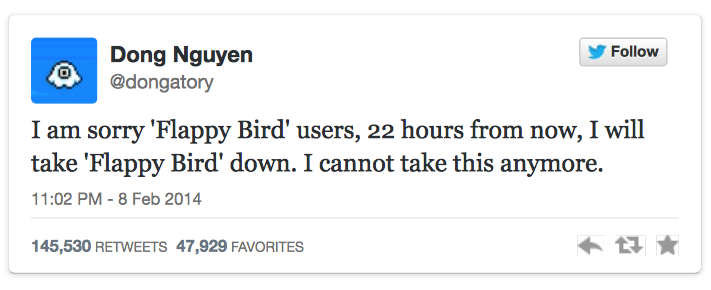
On the 8th of Feb, when Flappy Birds was soaring past stratospheric heights in popularity and cult status, Dong Nguyen tweeted the following.

Flappy Bird

With this single tweet (dutifully reported by the likes of The Wall Street Journal, Guardian, Forbes, Reuters etc. and aided by the existing popularity of his game) Dong was instantly catapulted to a status of cult guru trying to pull an act of ‘Limited Edition’ to his game.

This promnise of limited availability has unleashed an instant panic in the gamers, fuelled debates among gaming experts globally and even invited suspcisions that this could just be a marketing stunt.

Not surprisingly, the game was taken down on App Store and Google Play within the next day while the whole phenomenon has become a viral hit globally. And spectacularly, following the removal, many media outlets reported that several merchants on eBay were offering phones that had the app pre-installed for US$1499 or more, with some receiving bids of over $90,000!! (source 1,2, 3)

As mind blowing as this might prove to be, the story nevertheless tells us two things:

  1. That Flappy Bird is proof that no one really knows what the audience wants. (Do read this article by the same name)
  2. And that the promise of limited availability can sometimes stretch the definition of the word irrationality or insanity (depending upon who you are)

So that’s two examples so far on how compelling the perception of value can turn out to be when driven by a promise of limited availability.

The third example is my personal favorite and deserves a seperate blog post.

To be continued..