Steve Jobs – The FIRST FAN of all things Apple

You must have no doubt read so many write ups about Steve Jobs in the wake of his resignation from the Apple of the world. No exception here, as each day I get to read so many interesting articles and a number of ‘post mortems’ of his role as the CEO, the salesman, the evangelist of most (if not all) products that ever came out from Apple’.  I was reading this artcile on Steve Jobs at Fast Co.Design and have found it very insightful.  A few snippets:

  • If you listen to Steve Jobs’s presentations over the years, he comes across not as the creator of a product so much as its very first fan—the first person to digest its possibilities.
  • A reporter who asked Jobs about the market research that went into the iPad was famously told, “None. It’s not the consumers’ job to know what they want.”
  • He is a focus group of one, the ideal Apple customer, two years out.
  • It’s almost certain that Jobs has killed far more great ideas than he ever let live—there are 313 patents under his name covering everything from packaging to user interfaces.
  • He has taught his entire organization to play in the span of product generations rather than just product introductions: Apple designers say that now, each design they create has to be presented alongside a mock-up of how that design might evolve in the second or third generation.

On the flip side:

  • When Steve Jobs has fancied himself the chief creator, disastrous failures often ensued (eg: Apple Cube)
  • He was also openly disdainful of the Internet in the late 1990s.

Catch the full article here.

How GroupOn can create or obliterate your Brand

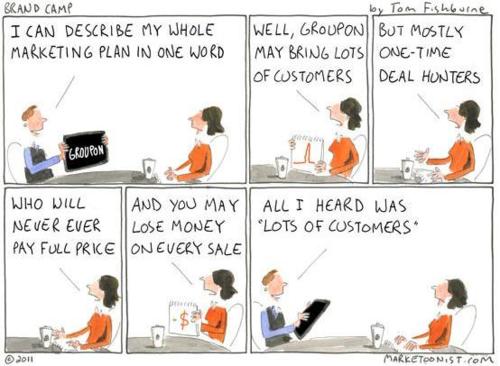
My previous post was about Groupon, and I couldn’t help but notice not one but two cartoons by the very insightful marketing cartoonist: Tom Fishburne. Click on any of his cartoons and you would get a write up with insights coupled with humour, with a generous dash of reality and seductive topping of realistic sarcasm.

After having received relentless mails everyday on some or the other offer and after reading so many write ups on the business model of GroupOn I couldn’t help but confess my realization of 2 trends that seem to be playing out vis-a-visa GroupOne:

1. Democracy is now online and is becoming an unassailable online force at that.  Marketers better take note!

2. “Marketers.. please don’t pander to the lure of volumes by sacrificing value. Be selective and selective and yes selective while pandering to this ‘democracy’. “

As Tom says:

“While 50-90% discounts are right for certain brands and business models, the daily deal mindset doesn’t drive loyalty. It trains customers to buy your brand on deal.”

The key words? Value Sales, Volume Sales, Brand Equity and yes good old Loyalty.

1 year from now it would be interesting to see:

1. How many new brands would owe their presence to GroupOn (I see so many merchant establishments in Singapore that have begun to scream “notice-me” sailing on the wave of GroupOn)

2. How many establishments would owe their soon-to-come-absence to GroupOn (a related story)

Of Business Models and Lost Opportunities

It’s always like an “OMG I didn’t quite see it that way” moment, when we begin to discover what some business models actually are. For eg, a number of years ago I remember the first time when someone told me that McDonald’s is actually NOT in Burgers business but in real estate business. (There is actually a How Stuff Works page that explains how the back bone of its business model is real estate!). I felt awed at the parallel and suddenly became aware of all those unseen opportunities that become the back bone of business models themselves.

Similarly, last year, it dawned upon me (again from an insightful article) that twitter is actually in water cooler business! Hang on , not in the literal sense of the word, but yes in the metaphorical sense. Water cooler is a place where people bump into each other and exchange ‘Hi’s, ‘Hello’s, How do you do’s and occasionally  exchange tidbits and updates. If I come to think about it, isn’t that what Twitter is doing?

Anyway, the point is, that I have read this blog by Joshua Gans and he makes a case that GroupOn is actually in Memory business. Hmm„ may be you could argue, may be not. But what stuck me as insightful was the fact that GroupOn seems to be missing some obvious opportunities at hand. For eg: If I were to buy a coupon as a gift to my near and dear, can’t GroupOn capture that and leverage it as a potential opportunity to sell more similar coupons to me in the future? By tracking user specific purchase trends, can’t it bargain for more relevant discount coupons and do a gmail-like user interest based coupon delivery system? Groupon already has the database of every single user and can easily track the trends of the individual subscribers (atleast in a significant number of cases where the usage and buy in rate is higher than average).

That way, I don’t receive a coupons that are completely irrelevant to me. That way I am willing to sit up and take notice. That way I am eager to act, as the offer in question pertains to my interest.

Speaking of which, I am reminded of this great book store that has a presence in Singapore, Hong Kong, Thailand, China and Taiwan (phew! last time I knew they had presence only in Singapore, Hong Kong and Taiwan). I somehow I so loved their interior, decor, ambience and over all feel (and better still has a store near to where I live) – that I ended up taking their My One Card (a loyalty card that rewards me with 5-10% discount on each book that you buy).

Each time I buy a book, they just need to be shown the card and you get a discount. Now that’s bad. Why?

  • The card effectively is transferable, meaning my friends can just borrow the card and leverage the discount.
  • They don’t do any entry of what book was bought against which card. Had they done that they would have an invaluable database of who has bought what books and at what times

I actually needed to buy the card as it is not free and had to fill in all my details to get the card. Hence the very fact that a customer holds a card means that he/she  is willing to be loyal to the store and has shared very valuable info about themselves. And most importantly each time they make a purchase they show to PageOne cashier what their interests are (after all your book needs to be scanned to charge you.. right?).

Pity that PageOne doesn’t even capture that in their database. A lost opportunity – of not being able to sell what is more relevant to me, of not being able to keep me hooked to the store, of not trying to cross sell me titles that fall under my area of interest.. all despite the fact that it has all the means to collect all the required info about me.

Do you see any such lost opportunities around?

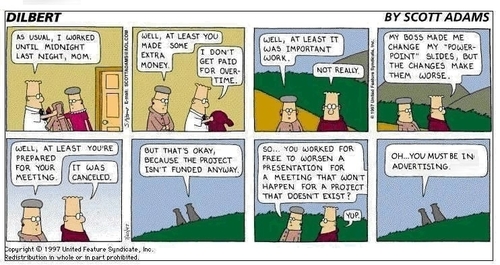
You must be in Advertising

Just came across this Dilbert Strip. Couldn’t resist from posting it 🙂

Answer is the Problem itself

Though the following blog post speaks about a specific product, I think the underlying insight has potential implications for marketers in a broader context.

Q: As a B2B business if you want to sell a product that is a more efficient work place management system,  how do you do it? 

Ans 1: By making a great presentation on how MORE efficient it is as opposed to other players?

Ans 2: By trying to convince that a client needs a work place management system (WPMS) by showing some case studies from past clients?

Arguably these might work in the case of those clients that already deploy a WPMS and as a marketer you could come across a a better vendor if you explain them what efficiencies you could bring in and what more costs you could help save and what better value you might help deliver.

But wait, what if this client is someone really big and who has never used any WPMS in the past? And worse still, what if your product is the new kid on the block? A challenge right? Everyone in this equation – you, your product and your customer are new and everything depends on how you would try to frame it, contextualize it, relate it and in summary position it in a more compelling and relevant way.

Though this sounds so obvious, just think about this paradox for a moment.

 ”a lot of people aren’t willing to embrace that they have a problem unless they also believe that there’s a solution… so part of selling a problem is hinting that there’s a solution that others are using, or is right around the corner.”

I think  it’s an amazing insight – an insight on the basis of which roomtag operates as we speak.

“Imagine, for example, getting the data and publishing a list of the top 50 firms, ranked by efficiency of space use. All of a sudden, the bottom half of the list realizes that yes, in fact, they have something that they need to work on. If you knew that your firm was paying twice as much per associate as the competition, you’d realize that there’s a problem.”

Read this post by Seth Godin for further details.

For me this was a great insight about marketing a B2B and also B2C product. Now having read the above and having checked out Seth Godin’s post, what do you have to say about the recent $80 Million Office 2010 Ad Campaign?

Redesign of the “Champagne of Beers”

I always wondered why I haven’t come across many (or any for that matter) beer brands that bottle their beer in clear bottles as opposed to brown or green tinted ones. I know there are some practical issues involved in this – like the beer loosing its freshness and character (if I may call it so) if it is directly exposed to sun. But I have always felt that this could be a great opportunity for any brand to capitalize upon as they can potentially use it as a strong differentiating point in terms of packaging –  if they can somehow succeed a workaround for the physics and the chemistry of the beer formulation and come up with clutter breaking clear bottled packaging.

Finally today I stumble upon what looks like a solution to this (sub-conscious) quests of mine. I learnt about Millers High Life Beer and have learnt why it is called as the “Champagne of the beers”. I learnt that it’s packaging has been redesigned. (By Landor) And better still, it comes in clear bottle packaging 🙂

Read the article here.

I read the above article in conjunction with the following extract from wikipedia and that helped me connect some dots.

“Miller High Life—This beer was put on the market in 1903 and is Miller Brewing’s oldest brand. High Life is grouped under the pilsner category of beers and is 4.7% ABV. The prevailing slogan on current packaging is “The Champagne of Beers”, an adaptation of its long standing slogan “The Champagne of Bottle Beers”. Accordingly, this beer is noted for its high level of carbonation, making it a very bubble-filled beverage, like champagne. It was originally available in miniature champagne bottles and was one of the premier high-end beers in the country for many years. Except for a brief period in the 1990s, High Life bottles have always been quite distinctive, as they have a bright gold label and are made of a clear glass that has a tapered neck like a champagne bottle. High Life has brought back its “Girl in the Moon” logo, which features by today’s standards a modestly dressed young lady that, by legend, is company founder Frederick Miller’s granddaughter. The “Girl in the Moon” logo was originally painted in the early 1900’s by an unknown artist and has since been re-painted by Nebraskan artist Mike Hagel, who added his own unique touch to it. High Life beat out 17 other contestants to take home the gold medal in “American-style Lagers” category at the 2002 World Beer Cup. High Life has enjoyed a resurgence recently, using its humorous “Take Back the High Life” campaign—which features a common sense-wielding deliveryman removing beer from non-High Life locations—to position the brand as “a good honest beer at a tasty price.”“

Some snippets of the  design:

The New Consumer Sweet Spot

Last month I was back from a very hectic set of trips to China and India. After the business leg of the trip I had a chance to extend it to a small vacation. Though the ‘vacation’ didn’t exactly turn out to be a pleasure trip, it has given me an opportunity to travel from the North to the South and to the East of India – by flight and also by trian. These travels have given me an opportunity to notice a few interesting things. Let me share one of them.

India, I see has slowly but certainly taken to reading – in a big way I mean. And there are no two ways about it. And I see a set of factors that seem to be responsible for this trend. I mean, a set of facts have just about managed to hit the consumer sweetspot on reading. Let me explain this from a marketer’s point of view.

First, the Product: We are speaking about Chetan Bhagat’s books. Some common characterictics of his books:

  • They are set against the backdrop of very contemporary Indian themes
  • Have characters which could almost be any other middle class Indian with dreams and aspirations despite the very Indian compulsions and constraints
  • Realistically reflect the paradox apparent in the new Indian milieu – politics, education, cricket, career, relationships etc

His books are almost like catching up with your childhood buddy after say 5-7 years and sitting over a few drinks as you exchange your stories about love, life, work and dreams ever since you have met last.

Price (INR 95): Everytime I come across a pirated books’ stall or vendor, I get to see all sorts of pirated editions. But there is one thing in common across all these cases – You would always find the ‘original’ edition of Chetan Bhagat’s books. This is because you can’t pirate his books with any more degree of sustainability. All his books are already priced at a comfortable low of Rs. 95, and it is as low as you can go down. In fact, if you shop online, chances are that you can get his books for an even lower price.

Anyway the point here is that though Chetan Bhagat might not necessarily smile his way to the bank with the price point he has chosen with Rupa & Co, it is for sure a very well thought out price point.

Place: By which I mean the distribution channels. Well you do have the typical channels like the books stores of different sizes and formats in metros, cities and big and small towns. But there is a particular channel of distribution that I want to focus on here – one that has lent itself to be a very relevant channel in this case. These are the small book stalls and vendors that you find throughout the length and breadth of India on its Railway Platforms.

They are very relevant in this case because of the following reasons:

  • Let’s consider the case of a serious reader. She casts her own aspersions at the idea of buying a novel on the railway platforms. She knows that they are priced higher than even in the swankiest malls in her town/city. So unless she is very tempted to buy one she doesn’t usually feel comfortable to buy novels from the vendor on the platform. In most cases she might just settle for a magazine (as they are priced as the price tag on them says). But if she knows that there is some novel that is a quick read for her, doesn’t tax either her mind or her purse much she has no qualms to fish out that 100Rs note and get a Chetan Bhagat book along with the 5Rs change.
  • Now let’s consider the case of a not so serious reader. She knows that she is not the ‘reader types’. Hence she doesn’t even consider a novel from the vendor at a railway platform. Novels for her are some ‘geeky stuff’ meant for those who have the right amount of patience and inclination. Nevertheless, she sometimes does crave for an ‘interesting’ time pass to while away her time on the train. So she prefers a very light reading material (even magazines can sometimes be seruios reading for her). Add to this the price, so unless she finds some book that is more conversational in tone, very Indian in theme (so that she can relate to it) with the right amount of masala and action and love and drama available at price that doesn’t make her feel guilty, she doesn’t even consider a novel at the vendor on the platform.

So you got it the main elements of the mix working right for Chetan Bhagat books. And lo behold! When I get down the train to check out the collection of books at the vendors on the platforms, I came across atleast one customer quickly handing over a note of 100Rs and asking for one of his books – at almost every decent sized station. Seriously! And yes the vendor clearly stacks all the books of Chetan Bhagat (all 4 of them) in every case. And inevitably, as I walk down the aisle in the compartment, I catch quite a number of people engrosssed in a Chetan Bhagat book. Please note that this is not a one off scenario! My journeys took me across different states through various stations and this scenario repeated time and again and yes even on a domestic flight that I took from Delhi to Hyderabad! A passenger sitting right next to me was engrossed in 2 States.

It was then that I realsied that something quite interesting has started to happen. More Indians are apparently taking to reading. It’s just that every elemenst of the mix has worked so well that they have hit bang on the consumer sweet spot! See for yourself. Travel and just keep your eyes open around you. You are bound to notice it. This silent ‘revolution’ could in fact overwhelm you (in a way) as it did me.

Of Great News, Apple and Splotches

It has been a crazy week at work and it has robbed me off any available time to ideate and write. In fact there are quite a few topics in the pipeline about which I was planning to pen (rather ‘key’) about. But before that there is a very heartening update that I had wanted to share this week.

My blog post on The Best Touch Points in India for marketing Fabric Conditioners, has been referred to the Category Innovation Head of the Indian arm of my company! One of my manager’s at work has seen this post and has found it to be very interesting and has forwarded to the people concerned for the evaluation of the idea.

I do not know if this idea would be a reality (as the ground realities, legal and govt. technicalities involved could be challenging for a smooth implementation of this idea). But I felt extremely humbled when I discovered that some bytes of my ‘noise’ have actually become worthy of ‘that’ level of attention.

Though my blog has been a very recent endeavor, almost every post of mine has been commented/discussed by many learned people around – some in the company that I work for, some very famous bloggers, some FMCG enthusiasts, some marketing evangelists, some friends and some well wishers. I feel inspired at every such occasion and it makes me take my learning even more seriously and my ignorance even more seriously.

Thank you everyone. This reminds of a very famous live by Steve Jobs.

“Stay Hungry Stay Foolish”

And this reminds me of another super interesting thing – Apple and Jan 27th:

Never before has an Apple event been as anticipated, as debated and discussed about and as hyped as this one is. As David Colker of The Log Angeles Times says, With anticipation of the new Apple Inc. tablet computer — or whatever it is — at a fever pitch, every tiny thing the company does is noted, analyzed and discussed with an intensity the CIA might envy.

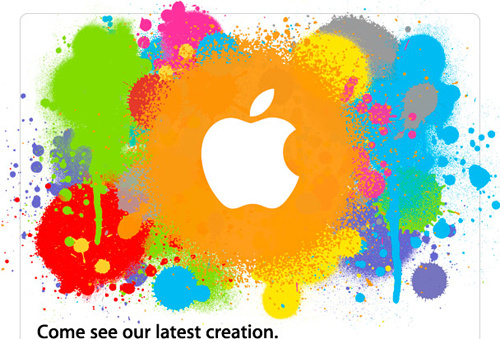
For example the following was the invite that was sent by Apple about the event to be held on January 27 at 10am PST.

There are literally thousands of posts and view points what each color/design element/message/splotch in this picture could mean about Apple’s next launch. I would not add to any of these. (just Google ‘Apple’ and you would literally see yourself lost marveling at a Global Marketing Case Study unfold live in front your eyes). As a sample, see an incisive analysis of this invite from Apple:

“In reference to the new invite, notice that some of the paint splotches were created while the “canvas” was laying flat while some of them are dripping as if to indicate an upright orientation during that part of creating the image, the last orange splotch is flat again.

A graphical device with orientation awareness. What could it possibly be?”

Let’s see what it would be on the 27th.

Indian Entertainment. Redefined

I guess it was some two years ago that I came across this one in some blog. It showed how some of even the best brands of the Indian media industry, sometimes fail to exercise even a minimal sense of prudence in the way they dish out news. Check this out:

Though there must have been some arcane and remote rationale behind presenting this particular news in the ‘entertainment’ section of this news paper, common sense dictates otherwise. Absolute common sense.

Anyway, that is about the Indian Media and News industry – one that has become a butt of jokes than a power to reckon with like CNN or BBC. Even NDTV, the channel that was considered to be a little more professional and worthy of even being considered as a challenger brand in this category has pandered to mass sensationalism in the resent past. Barkha Dutt’s minute by minute coverage of the Mumbai bombing episode would be remembered as one of the most misguided and ill conceived acts of journalism in the history of Indian News Industry.

It is in this context that I am saddened to find that even google can be a source of such slips. Google – a company that has assumed massive proportions of global muscle (it shall be remembered as the only entity till now that has succeeded at fluttering China’s feathers with economic and geo political implications), has come to assume the status of the Digital Big Brother of the world – like the one in George Orwell’s 1984, with it’s sphere of influence ranging from search, mails, social networking, real time news aggregation, blogs to maps and GPS systems that can potentially track you anywhere and everyhere.

Given this level of reach and influence that it wields over us, it is, but expected that it undertake every endeavor to safeguard its moral high ground with responsibility and integrity. But the recent slips from the part of Google News – a real time news aggregation platform have compelled me to cast aspersions over the laxity in the logic behind its world altering algorithms.

News categorization and presentation, it seems is a very low priority in Google News algorithm. I normally go to Google News India portal to get a pulse of just about everything for the moment from Political, Economic, Business, Health, Sports and Entertainment news about India. But the other day I was a little surprised and even a little amused to find news about the resignation of AP ministers over the Telangana issue under the entertainment section. Check this out:

Ofcourse, given my sense of mistrust and disrespect of Indian politics (of which I am not proud about), it really amused me to find this news in this section. On a lighter vein, I even wondered if the Google News algorithm has in fact did this on a deliberate note, given the large spread sentiment about the Telangana issue (that has literally become a parody of Indian politics).

But today (17 Jan 2010), when I went to http://news.google.co.in/, for my dose of Indian news, I was aghast to find this in the Entertainment Section of the portal:

OK, I am not a fan of any politician in India and worse still those of West Bengal. But I was really surprised to see the news of Jyoti Basu’s sinking health under the Entertainment section of Google News.

When the bottle itself becomes the hope

For those who missed the first part of this discussion, please read here. The question was, as a brand that is serious about its intentions, what can it do to break the vicious circle of ‘commoditising’ the entire men’s deo category in India?

Thank you everyone for taking time to post your views for my post. Especially the discussions that I had with my digital planner friend, and my FMCG passionate buddy brought about a clearer definition of the idea that I already had in mind. The idea that got crystallized was basically this – If I am the brand that has originally created a break through positioning and did everything to own it in the first place,  why should I now even tweak my proposition and thereby vacate the place to competition just because there are so many ‘me-too’ brands in the category?

So now the focus goes to the remaining P’s in the mix (believe me, as simplistic as it may sound but it’s always about getting the mix right in marketing. Always). So where would you now focus? Mind you this is in no way a breakthrough idea that I am proposing. All this could do is to give a better pedestal for the brand to further differentiate itself from the multitude of the me-too brands and reach out to the consumer in a way that is still consistent with its present positioning.

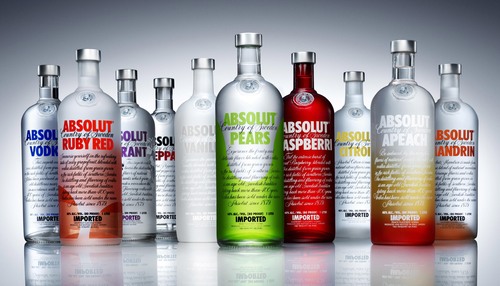
Now let me park this here while we try and ideate to come up with an idea for this challenge. If I were to think ‘out of this category’ and try to see if there is any other category with which I can draw parallels to this case, I find that there is one that has very successfully survived this sort of me-too syndrome of lower priced but similarly positioned competition. It is Vodka.

There was a time when every other middle to premium priced vodka spoke about very similar things – exotic places that were purportedly the sources of a vodka’s key ingredients (grain, rye, wheat, potatoes, or sugar beet molasses),  imagery of fun and frolic (sometimes in a very adulterous way) etc. While they really sounded exotic and sometimes even evoked the imagery associated with a place, most of them couldn’t reach a critical mass in terms of marketing effectiveness. So what did they do? Some tweaked around with prices, thereby decoupling themselves from their supposedly premium positioning and lost out. Some over priced themselves without an demonstrated claim to superiority. Some sought to differentiate themselves by line extending their core offering and started rolling out various flavours of vodka and so on. While some of these strategic moves could have worked for a few, most of them have only succeeded at further diluting the consistency of their identity and positioning.

So what did some of the most iconic vodka brands that we know today have resorted to? They acted upon an insight that was in fact very obvious (insights, by very definition are obvious but unnoticed or ‘not acted upon’ spaces in the landscape of consumer behavior). Vodka is an alcoholic drink that is unlike other alcoholic drinks in many ways. While they arguably have a masculine appeal about them, they have an imagery of strength and resilience associated with them. A vodka is a very common additive in many cocktails and is also enjoyed on the rocks. So in many instances, a bottle of vodka finds itself with pretty much time and space as it becomes a part of the gathering for the occasion. So what should it ideally do? Simple. It should itself be a statement just like the people who drink it are. This was the insight that went into those brands that sought to differentiate themselves on the basis of their Packaging. That’s how Absolut and many other brands were born.

It was an incredibly simple insight. But the result – phenomenal. Absolut now has books written over just the shape of the bottle. The shape in itself is a brand so much so that it is the shape of the bottle that is the fundamental identity of the brand. It is then that it becomes almost a non-transferable and non-copyable identity of the brand. Even if someone tries to ape it today, the consumer becomes absolutely sure that has to be a rip-off as they know that if it has that shape it ought to be absolut.

So now you know the answer. You have a very powerful positioning in the men’s deo’s category. You try to bring in the imagery of an irresistible masculinity, fatal attraction, power (of a magnetic odor), confidence and charm of an uber sexy male. You work hard to own this space in your TG’s mind. But alas! You see a bunch of me-too’s jumping into your wagon (taking the short way out) to appeal to the similar class that you are trying to target. So what do you do?

Think of an even smarter way to reach out to your TG by subtly tweaking your core positioning? If so, aren’t you vacating your hard earned space. Why not stay put and try to reinforce your very own positioning in an albeit very tangible way? Just as an example, consider the design of Samurai vodka bottle: (This is a design by a Moscow based designer Arthur Schreiber)

Got my point? Why not explore the possibility of making your pack speak by itself? Why not break out of the very similar looking pumps and dispensers? I know this could eat into your Gross Margin as the packaging cost becomes a little more expensive. But doesn’t it give you a better reason to price yourself a little more? Your competitors are in fact doing you a favor by moving their prices south. So now you have a more premium space for yourself, the same positioning albeit reinforced in a stronger way and your TG who, given the increasing need of distinctiveness would only be willing to shell out a little more.

  • It does have a very loud pick me up factor from the shelves. In fact, just come to think of yourself walking along the aisles to pick up a brand of deo. You are sure to at least consider this, at least once
  • Now another threat of the Indian deo category – the rip-offs business of fakes and counterfeits would have an even difficult time catching up with you
  • It now becomes a very glamorous thing to be proudly exhibited on your dressing table – the best possible ad for a brand

Last but not the least, the packaging of the deo would then assume a life of it’s own. For eg., there is this forum that was discussing the implications of the design of the Samurai Vodka design above. A guy loved it so much that he couldn’t resist to associate a story to the bottle:

“THE BOTTLE WAS THROWN INTO THE AIR AND SLICED MID-AIR, THEN THE SCENE FROZE AND THATS WHY IT LOOKS LIKE IT DOES!!!”

(Disclaimer: I have no business interests in the marketing of deodorants. All this post seeks to do is to speak about a need to infuse some fresh thinking to seek some innovative yet simple ways to ‘decommoditise’ the deodorants category in India. The views expressed here are solely mine and in no way relate to the company that I work for.)