Fruit Flies, Technology and Heritage

Context: I was recently invited by Ahmedabad University Centre for Heritage Management to deliver a “curtain raiser keynote” (had to look up what that meant) at their annual research conference – The 5th International Conference on Heritage Management Education and Practice. Organized between March 15 – 17 2024, the theme of this year’s conference was “Intersections of Heritage Economics and Digital Technologies”.

When I had first received the invite, I was pretty certain that there must have been some mistake, for I had/have no authority to speak on the subject. But long story short, I took up the challenge and delivered my keynote at the Ahmedabad University CHM research conference. And to my absolute surprise, the presentation ended up receiving very positive (and very kind) feedback from the attendees. So I thought I would put it out here on brandednoise to solicit further ideas/ inputs.

So here goes my presentation. This is the direct ‘slide by slide’ rundown along with my speaker notes. Barring extremely minor tweaks (that I have incorporated to aid readability of the content as a blog post), this is my keynote – as is, in full.


Esteemed leaders – current & soon to be – from academia, research, policy and the practitioner community. It is such a privilege to be here amidst you all, precisely because I belong to none of these groups wrt the domain of “Heritage Management Education and Practice”! At best, I may call myself an observer as I seek to soak in, participate and contribute to the topic of the conference today “Intersections of Heritage Economics and Digital Technologies“.


When I thought about the rapidly growing role of Digital Technologies in Heritage Management, I naturally thought about how the technologies of AR/VR, Artificial Intelligence & advances in Cloud Computing are transforming how we interface with Heritage & Art. 

I thought I’d talk about Google’s platform where all this comes to the forefront – Google Arts & Culture. And how it uses technology to elicit user participation, engagement and drive co-creation of experiences wrt art & heritage.

But here’s the thing – that would be my “comfort zone”. 

And I thought, this is a research conference – and one of its kind at that! And what is a research conference if we don’t step beyond our comfort zone – a slight bit. That zone where we do a bit of philosophising, theorising and some crystal ball gazing, if you will? 

And that’s what I am going to do over the next few mins here. So indulge me here 🙂


My argument (or more precisely a premise) in a nutshell is as follows… 

It is clear as daylight that digital technologies have incredible value wrt heritage management & practice. 

But I’d be doing a disservice if I focus on just this aspect of technology – which is just the “tip of the iceberg” , For, if we do that we’d perhaps end up focusing on just a small subset of possibilities: i.e., digital technologies as just “techniques” to be used.


I am going to take a few more steps further and argue that Digital Technologies have an even more foundational role to play wrt the domain of heritage management. For, if you view Digital Technologies for what they truly are or what they truly can be, you could perhaps even see them as enablers of new ontological, epistemological and axiological perspectives of the domain.

So I’d say that Digital Technologies can have a lot to contribute to (even) the core philosophical foundations of heritage as a construct.

Let’s unpack that.
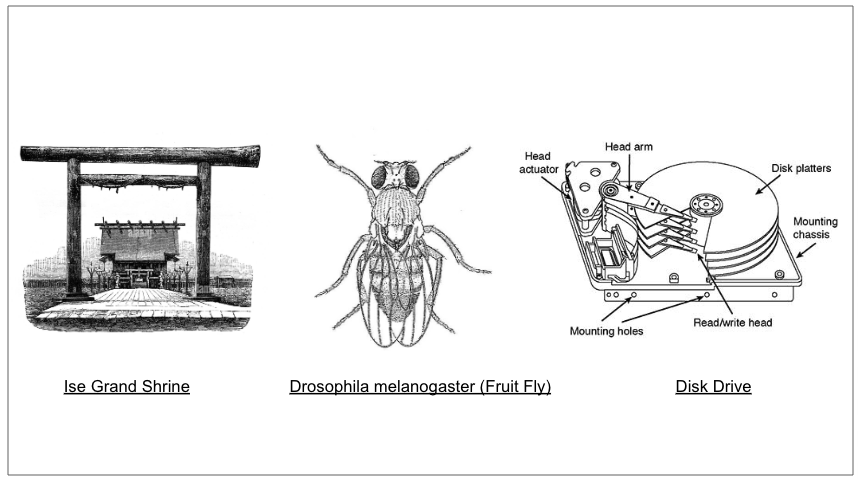

I’d like to start by asking a question. What is common amongst these three.

  1. A 2000 year old Japanese Shinto Shrine 
  2. The Drosophila melanogaster a.k.a the “fruit fly” 
  3. The hard disk drive

Have a think.


Let’s start with the Ise Grand Shrine – a.k.a .Ise Jingu

What can this 2000 year old Shinto shrine have to do with Heritage Management and Digital Technologies?

The Ise Grand Shrine – a Shinto Shrine – in Ise, Mie prefecture in Japan has been preserved exactly like it was around 2,000 years ago. Despite such a rich legacy, it doesn’t figure in the UNESCO world heritage list.

Why?

This is because the shrine is not built of a ‘permanent structure’. The Ise Grand Shrine is built of wood and hence it gradually loses its structural integrity over years. 

So the Shinto priests have a solution;  every 20 years they tear down the structure and rebuild another – in an adjacent plot –  in exactly the same specifications as the original using the wood from the same forest that the original structure was built from. 

Result: the shrine is forever new, ancient and original! 


The Shrine is currently in its 62nd reconstruction, the next reconstruction will be in 2033.

Despite not being on the UNESCO’s World Heritage list, the Ise Jingu Shrine is one of the highest visited Shinto shrines in the world! Now that’s saying something about Heritage Economics 🙂  

What can a 2000 year old Shinto shrine have in common with Digital Technologies?

It goes by the name “version control” / “generational cycle management”. 


The definition of Heritage is anchored around the core concept of “generations” 

  • What qualifies to be called as ‘legacy’ by a generation?
  • How does one generation view the legacies of an older generation? 
  • And what are the socio political cultural & economic imperatives that influence how a generation preserves its ‘legacy’ for its future generations?

And we can’t speak about generations without speaking about the Strauss Howe Generational TheoryWhat it essentially states is that history repeats itself and the sooner we understand the socio – political – cultural and economic contours of the same, we will be better served.

First a few building blocks of the theory:

  • Let’s take the average human life span as approx. 80-90 years. This is called a Saeculum and consists of four periods of approximately 20-22 years each. Which are (1) Childhood (2) Young Adult (3) Midlife and (4) Elder hood.
  • A generation – as we know – could be thought of as an aggregate of people born approximately every 20-22 years.
  • Each generation experiences “four turnings” every 80-90 years. They are (1) High (2) Awakening (3) Unravelling and (4) Crisis.

In essence, the cyclical nature of these “four turnings” could be stated as follows:

  • “Strong people” create “good times” (in general)
  • “Good times” create “weak people”
  • “Weak people” create “hard times”
  • “Hard times” create “strong people”
  • “Strong people” create “good times”
  • and it goes on…

Throwing all these elements into one chart gives us a view like this one about American generational cohorts – where you can see this cyclicity emerge across generations punctuated by the four turnings. And at any given point in time we have multiple generations co-inhabiting the time space. And the interplay between these generations is what leads to the socio political and economic imperatives that we grapple with as a society.

And the world around us – here and now – is this ‘laboratory’ where one can study this theory play out across generational cohorts.
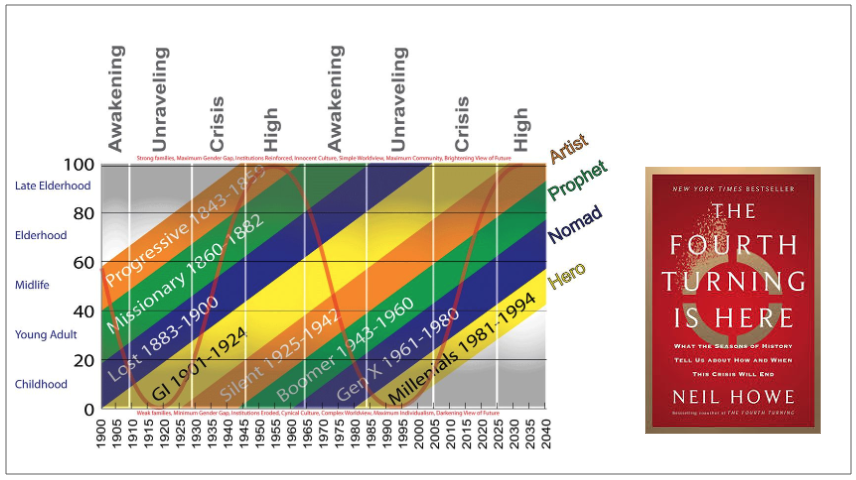

In fact in their book “The Fourth Turning is here” the authors of this theory argue that we are collectively living through the “Fourth Turning” now. The book has been called prophetic given how it seems to have ‘predicted’ way back in 1997, many of the socio political economic cultural and technological realities that we have seen ourselves grapple with over the last two decades in this millennium.

Now let’s conduct this thought experiment.

What if we were to set up a lab where we can observe these inter generational forces at play along with their fall outs? Only this time, the generational intervals are much shorter, thereby allowing us this rare opportunity to get a sweeping view across multiple generations during one single life time.

Wouldn’t we then be able to identify hypotheses, build models, test theories and perhaps even build grounded simulations around how the notions of heritage emerge, propagate and evolve over generations?


Studying species with short generational intervals is not a novel concept. Today, scientists study evolution in species with short generational intervals. This allows for direct observation of changes over many generations, which wasn’t possible in Darwin’s time.

This is Prof Thomas Hunt Morgan who was awarded the Nobel prize in medicine in 1933. His genius lies in establishing the Drosophila melanogaster as the model organism in the study of evolutionary genetics. Why? Because, the whole life cycle of the fruit fly is relatively rapid and takes only 10-12 days

Over the last century, this discovery has led to an exponential rise in research productivity across a diverse range of topics including genetics, embryonic development, learning, aging, behavior and more.


This is Prof. Clayton Christensen who has developed the theory of “Disruptive Innovation”. Reportedly..

Someone told him that disk drives were the “fruit flies” of technology: they were ideal subjects for studying innovation, because a generation in disk-drive technology was incredibly short. He saw that the companies that made fourteen-inch drives for mainframe computers had been driven out of business by companies that made eight-inch drives for mini computers, and then the companies that made the eight-inch drives were driven out of business by companies that made 5.25-inch drives for PCs. 

What was puzzling about this was that the eight-inch drives weren’t as good as the fourteen-inch drives—they had a lower capacity, and a higher cost per megabyte—and the 5.25-inch drives were inferior to the eight-inch drives. So why hadn’t the fourteen-inch-drive companies simply started producing eight-inch drives? It didn’t make sense.
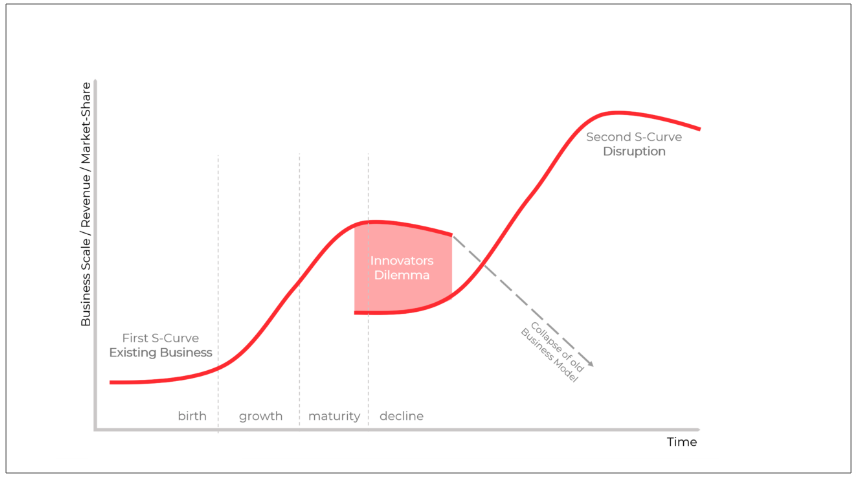

The genius of Prof. Christensen lies in studying innovations in products/categories which have incredibly short generational intervals and rapid evolutionary cycles in order to identify the organizational, economic (and sometimes even political) imperatives that could lead to an incumbent getting ‘disrupted’ by a new entrant in an industry.


In many ways, this – exercising our focus on digital technologies as our canvas – could be inevitable as they pretty much characterise the times that we live in. Students of economics would know the Kondratiev Wave which pretty much says the same thing.

This shows the pattern in the societal waves of advancement since the industrialization era. A few things that you can immediately observe, (1) every k-wave (which is characterized by the dominant technologies of its time) is shorter than its previous wave. (2) We are today living through the 6th K-wave, which could have an even shorter interval span, and finally (3) this wave (loosely estimated to be the one between 2010-2050) could probably be the one around “intelligent technologies”.

Central theme here: Technology’s shorter generational cycles and how that creates a second or a third order influence over the corresponding socio, economic, political and cultural forces at large. It’s pretty much the story of our times.

Let’s take a few examples.
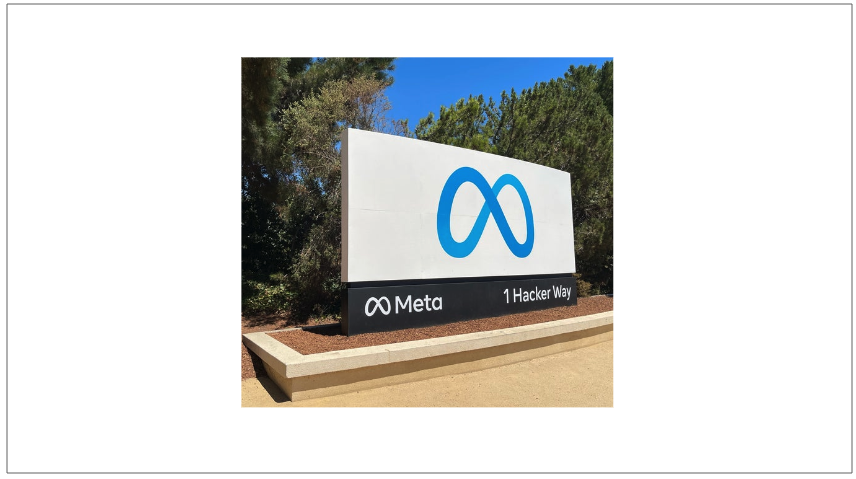

Many people would know what this is.

This is the signboard of Meta at their corp HQ at Menlo Park, California. Many people come over here to get their pictures. But not many would know that this has a peculiar “feature”.


Sun Microsystems (est. 1982) had gone defunct in 2010. Subsequently, Facebook has bought over and remodelled the property as its global headquarters by 2011. And instead of replacing the Sun sign, Facebook just flipped it over and put Facebook’s name (now Meta) on the front(!)

Beyond serving as a homage to Sun Microsystems as a company that had significantly contributed to several key computing technologies, many see this as an intentional ‘reminder‘ to those looking from within the campus.


Many of the logos that you see on the left belong to those brands that had been global leaders in their own right. They had defined standards, influenced culture, and pretty much led to our popular narratives around how societal trends and technologies have a symbiotic relationship given the breathtakingly rapid developments in this space. But today they no longer exist!

At the same time, we also have technologies/digital platforms/ device ecosystems that continue to see strong evolution over the times. For e.g., many would know that 2024 also marked the 40th anniversary of the Apple Macintosh and one can’t over-emphasize its socio cultural influence (that spanned several domains) over the years.


It is to chronicle these very stories in technology and with a stated mission to “decode technology—its computing past, digital present, and future impact on humanity” the Computer History Museum (CHM) at Mountain View California prides itself as the largest repository of computational artifacts under a single roof. The museum presents stories and artifacts of Silicon Valley and the information age, and explores the computing revolution and its impact on society.


I would like to believe that it is not an accident that the CHM’s core belief about the inter generational value of computational technologies has parallels with how UNESCO defines ‘heritage’.

(as a fun aside, I couldn’t help but notice the fact that the Centre for Heritage Management and the Computer History Museum share the same acronym!)
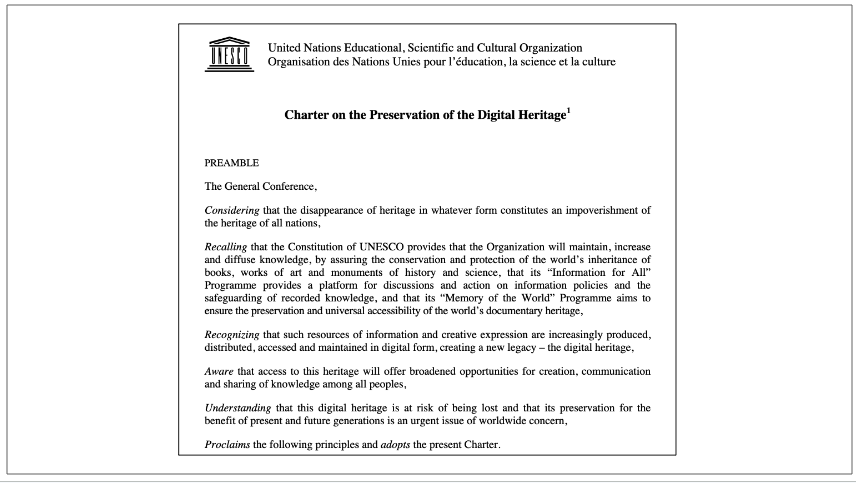

Therefore, the UNESCO’s charter on the “Preservation of the Digital Heritage” proposed in 2009 is a good start to the conversation. But we have a lot more to do.

Given rapid bursts of new technology breakouts coupled with ever shortening generational time spans of these technologies such as AR/VR/AI/Cloud etc, their ever expanding and evolving influence over practically every domain of our existence has a near axiomatic appeal wrt the socio economic political and cultural discourse of our times.


And that leads us to more fundamental questions.

  • What is digital heritage? (a question with an ontological lens)
  • Why study digital technologies in the realm of heritage research? (a question with an axiological lens)
  • What standards inform digital heritage identification? How do these influence how we experience & identify tangible and intangible heritage artifacts? (questions with an epistemological lens)

By virtue of the inquiry along these lines, I would posit that we might soon need to reconsider broader perspectives to help us answer even the central ontological question in our domainWhat is heritage?


And that’s why I would argue that Digital Technologies have even more foundational role to play wrt the philosophical aspects of heritage management. 


We spoke about the Kondratieff Waves a few minutes ago. Another way to look at these waves, especially in the context of Heritage Management is as follows:

  • What a generation calls as ‘legacy’ could be that which it perceives as the vehicle or the marker of its ‘progress’.
  • While the first few (known) millennia of the chronicled human history saw progress around the vectors of “transforming material”, the next set of waves – characterized by a dramatically reduced scale (of centuries) – could be seen as a commentary on our progress around the vectors of “transforming energy”
  • And today, our progress (and thereby what we’d perhaps call as the legacy of our times) can probably be characterized as that pertaining to “transforming information”
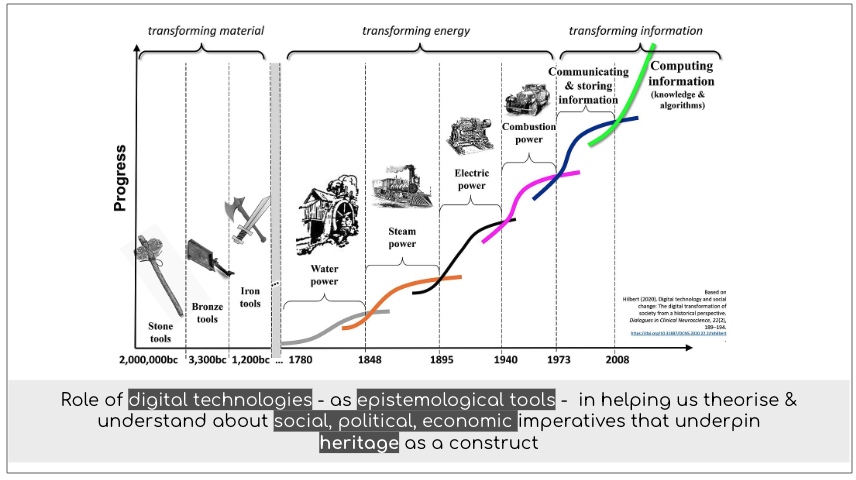
And that leads to the question about: the role of digital technologies – as epistemological tools –  in helping us theorize about and understand the social, political, economic imperatives that underpin not just ‘digital heritage’ but also the construct of ‘heritage’ as a whole.


And therefore just as the Drosophila melanogaster (fruit fly) ended up becoming the “model organism” that revolutionized the research in evolutionary genetics, just as the hard disk drives helped serve as the “fruit flies” for research on innovation management, my premise I submit for your consideration – phrased as a question- is as follows…
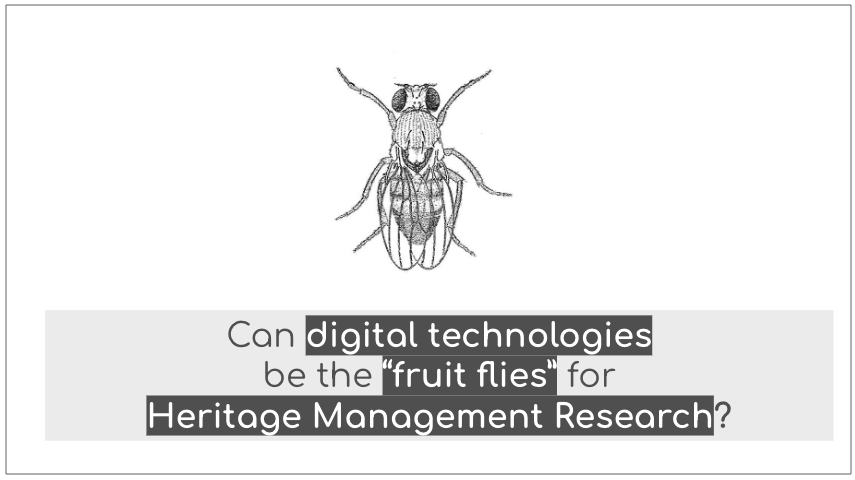

Can digital technologies be the ‘fruit flies’ for research in Heritage Management?

Thank you once again for the opportunity and I wish The 5th International Conference on Heritage Management Education and Practice at the Centre for Heritage Management, Ahmedabad University a grand success!
The Drone View Advantage

Quick read: Drone shots of the Swiss Panoramic Express could remind us about the need to sometimes take the larger ‘meta view’ vs the ‘window view’. And that could perhaps be a good reminder across contexts – from our investment theses, our career choices to even getting a better handle on how we frame our life stories.

Now don’t get me wrong.I LOVED the ride!

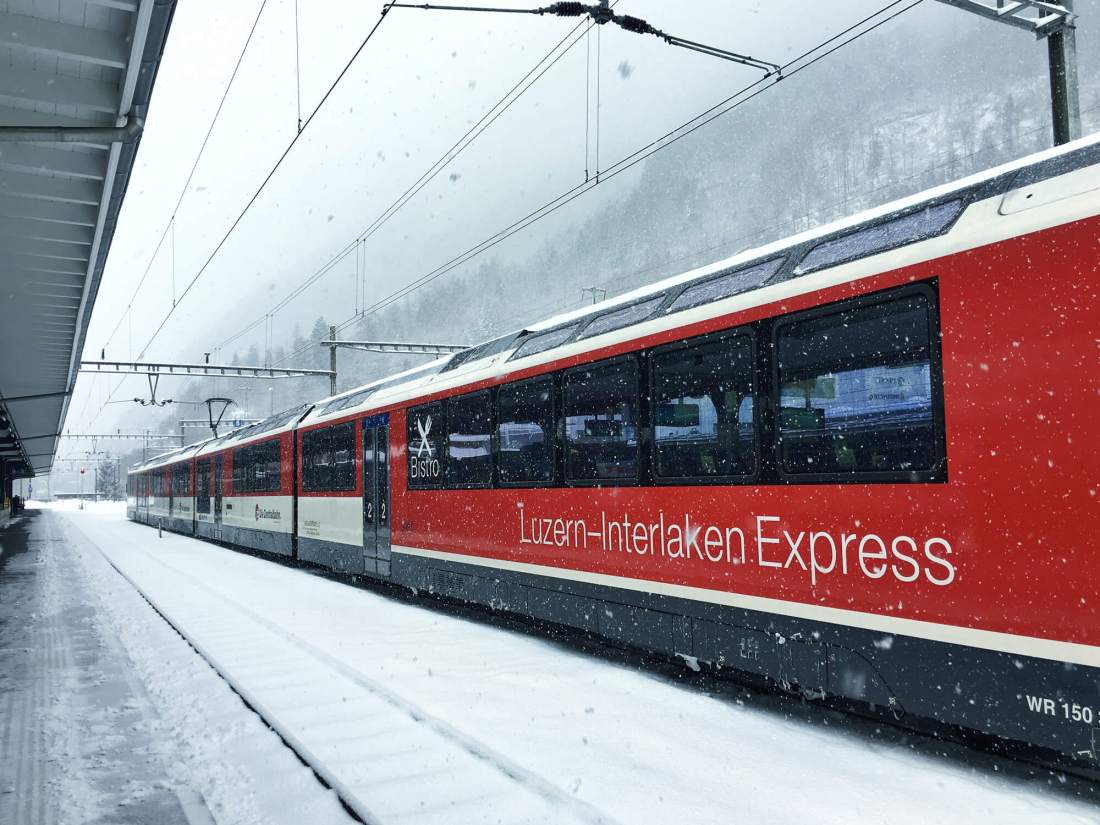
Especially as someone who had found every single nook and cranny of Switzerland picture post card perfect. So, what’s not to like about the truly awesome Lucern – Interlaken Express route? In fact, for once I was happy that a journey would take longer than I had expected – 1hr 55mins to be precise.

Image source

Why should I be the only one that enjoys such magnificent views? (I know! How magnanimous of me, right?) So, I sent a few of such pictures to my friend, who then dutifully responded with a few of such (👍 and ❤️) emojis.

Basking in the sunny snowy views from my train seat, I then turned to the Internet to see what’s the “official word” about this beautiful train ride. The Swiss tourism website said thus

During a train ride of roughly two hours, passengers marvel at five crystal clear mountain lakes that gather the waters from various rivers and waterfalls. At the lakeshore, steep rock faces of surrounding mountains rise up protectively and provide unique photo motifs.

Shortly before starting its steep, winding ascent to Brünig Pass, the train changes to cogwheel drivetrain technology in order to conquer the gradient. With good reason, the Luzern–Interlaken Express is part of the scenic GoldenPass Line leading to Interlaken and on to Montreux. 

Source

Just as I was trying to situate this romance within my 2-dimensional window view, something caught my eye. And soon enough I discovered I was unable to peel my eyes off these spectacular images from my phone screen.

Image source: MySwitzerland

I now sent my friend the above image and texted him saying that’s the route I am actually on.

Now as if by magic, this stubbornly laconic friend of my mine started on a paragraph of expletive ridden love letter to the stunning beauty of the Swiss landscapes. And I must confess, I found these ‘drone’ shots much more appealing than those that my rectangular windows framed for me along the route.

In order for me to get a more first person / visceral perspective of such a view, I wish I had the equivalent of the “tail camera airshow view” – that one occasionally finds on aircraft – in the train.

What just happened?

I was enjoying the view. But I was sure, the “view of the view” (call it a meta view, if you will, but let me call it the “drone view”) would perhaps be a more spectacular one. And I could bet, that drone view would have trumped my window framed 2D view in story telling too!

That’s why most of the airlines ads we see (print / video / OOH) have more footage/shots like this ..

Image source: Turkish Airlines

.. than those like this.

Image source. Photo by Babaroga / Shuttersrock

The “drone view” vs the “2D window view”.

Taking the view of the view vs well, the view.

If you think about it, that’s what financial advisors never tire of telling us.

The Ayodhya Stock Exchange

No, I didn’t make up that click-baity phrase. A popular news portal had this headline: “‘Ayodhya Stock Exchange’: 10 stock ideas to play the Ram Temple theme”.

Another one said “Ayodhya Ram Mandir becomes new investing theme: 6 stocks in focus”, and another “Ram Temple inauguration: Here are 12 shares that may benefit from Ayodhya tourism boom” and the list goes on.

But if you hear the other voices, they would tell you to stick to fundamentals and take the broader view. In other words, they caution us against mixing this “2D window view” with what should have ideally been a “drone view” that frames the larger journey for us.

And come to think about it- in many other aspects in life: from our considerations that drive career pivots and choices, to relationships, to many other things big and small – wouldn’t this be sage advice?

Of reminding ourselves of the need for taking the “view of the view” vs well, the view?

[Featured Image: Source]

Narrative Violations and Narrative Primitives

Quick Read: Sometimes narratives could have ‘violations’. And sometimes, what might at first appear to be a ‘violation’ could prove to be intrinsic to its narrative. Knowing the former from the latter could help unlock great value – across verticals or contexts.

Making sense of John Coltrane’s “Giant Steps” is said to be difficult.

It is considered by many to be one of the most revered and feared compositions in Jazz history. In fact generations of Jazz musicians are known to approach ‘Giant Steps’ as the pinnacle in Jazz improvisation.

Why? This video could provide a delightful crash course of an answer.

Or take Afrobubblegum – the new film genre redefining on screen representation of Africa.

It refers to fun, fierce and frivolous African art that has joy and hope at the centre of it. The pioneer of this style, Wanuri Kahiu a TED fellow and a Kenyan filmmaker says “We’re so used to narratives out of Africa being about war, poverty and devastation. We believe that Africa is joyful and full of pride and respect and hope,” and continues to champion the need for such art that captures the full range of human experiences to tell vibrant stories of Africa.

And tell she did!

In 2018, Wanuri Kahiu’s story of young lesbian love, Rafiki, made international headlines for being the first Kenyan film programmed at the Cannes Film Festival in 71 years of French Riviera cinema history.

What is common between Wanuri Kahiu’s ‘Afrobubblegum’ and John Coltrane’s ‘Giant Steps’?

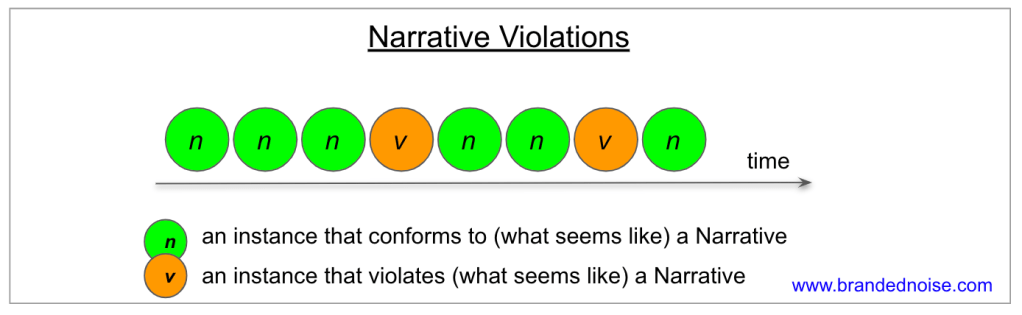
The genre of Afrobubblegum or the Jazz track ‘Giant Steps’ standout because they ‘violate’ the popular narratives around their respective art forms or subjects. They are examples of what venture capitalists call Narrative Violations.

Narrative Violations

While the term could seem like a fancy jargon to reference the essential characteristic of what makes something a ‘contrarian bet’ to a VC, I should admit that it serves its semantic purpose of helping us put a label on something specific through descriptive and non ambiguous terminology.

Perhaps it is this pull that made Geoff Lewis and Eric Stromberg – the founders of Bedrock Capital – write a manifesto for their firm titled ‘In Search of Narrative Violations‘ stating the following..

Some recent ‘Narrative Violations’ listed on Bedrock Capital’s manifesto letter

The letter in its entirety is eloquent and makes for a great read and ends on an inspiring note saying..

“..As our keystrokes hunt for the next narrative high, thousands of possibilities that will never be remain trapped beneath our fingertips. When we allow popular narrative to dictate who, where, and what is worthy of our time or capital, breakthroughs that could transcend remain overlooked, underestimated, or simply fade away.

Against all odds, a few brave entrepreneurs violating the narrative today will come to define profound new truths tomorrow. We’re on a mission to find them

To be clear, the concept of ‘Narrative Violations’ has also had its fair share of critiques for being too reductive. It was even declared 2019’s ‘VC Bingo’ buzzword of the year.

Nonetheless, I find the concept to be a clarifying filter that helps me process or question most things with a healthy dose of scepticism and encourages me to seek out edge cases in popular rhetoric, including say even that around the concept of ‘Narrative Violation’ itself.

Why?

Consider this question.

What if, sometimes, narrative violations are part of the narrative?

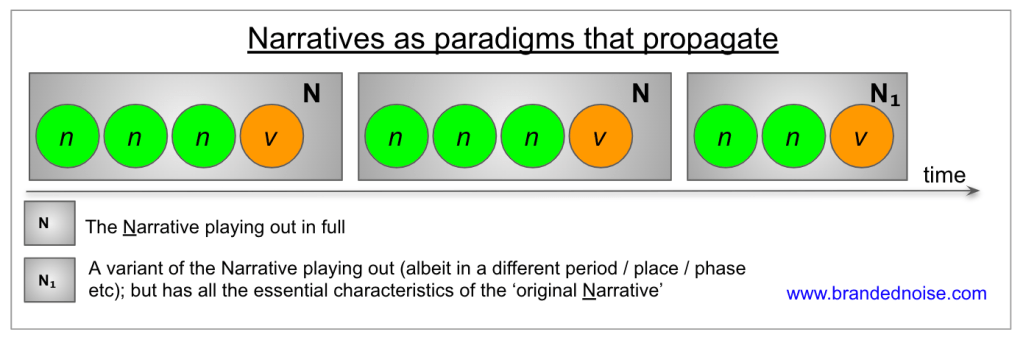
i.e., what if a ‘violation’ is actually an inherent part of a larger pattern that constitutes the narrative itself? Like say, a recurring motif that becomes apparent if only one were to step back and consider the big picture. Being able to see if and when that is the case could help us identify emerging paradigms and recognise how such paradigms propagate.

For e.g., after the dotcom bubble burst in 2000, Carlota Perez published her seminal book Technological Revolutions and Financial Capital arguing that the ‘burst’ was completely normal and qualified it by drawing patterns from four similar epochal periods over the last two centuries: the industrial revolution, steel and railways, electricity and heavy engineering, the automobiles and mass production.

Across each of these periods, she pattern matched its associated moments of ‘crash’ (the equivalent of the dotcom bubble burst from 2000) and recognised such instances as inalienable parts of larger cycles that play out over several decades (as opposed to say some inexplicable violations to the popular narratives of their times).

Source: Carlota Perez, Technological Revolutions and Financial Capital,2002

The master stroke of her framework is that it inherently provisions for moments of ‘big bangs’, ‘bubbles’, ‘crashes’ and then again necessary ‘recompositions’ as part of a single unified narrative that cohesively explains the interplay between financial capital and technological revolutions. And then continues to shine a spotlight on how this narrative seemed to have repeated itself across ages almost inviolably.

(Bonus reads: Two of my favourite thinkers, Alex Danco and Ben Thomspon have recently used Carlota Perez’s framework to write about Debt Financing and Paradigm Shifts in tech. Highly recommended reads indeed.)

To reiterate, a key takeaway for me here is the idea of the narrative as a paradigm that propagates.

Such a narrative construct that propagates needs to be essentially indivisible, should have a full self contained arc of a structure to serve as a standalone story if need be and be able to play out as a cohesive whole even with trivial variations in contexts or actors.

Matthew Ball has a term for this – The Narrative Primitive.

In one of the most intellectually stimulating podcasts I have listened to in the recent past, Matthew Ball joins Patrick O’Shaughnessy to discuss movies, the Metaverse and more and refers to the concept of ‘Narrative Primitive’ to explain why the worlds of the Marvel Cinematic Universe or the Star Wars stand out as expansive and immersive. The following lines from the podcast’s transcript shine light further.

… “how would you have told the story 80 years ago if you had all the tools available? How are those stories going to change in the next 10 years?” And in some instances that is unlocking what you might call a narrative primitive, that’s perhaps some of the reasons why the Marvel Cinematic Universe or the tales of Star Wars are so expansive today, so immersive.

Now, when I consider these two concepts – Narrative Violation and Narrative Primitive – together, I am tempted to posit the following.

The essential insight that rock star traders, venture capitalists and story tellers possess is this – they know a good narrative when they see one. And more importantly they have an eye for a narrative violation. Because they think in narrative primitives.


Noteworthy ingredients – that may or may not have gone into the making of this blog post:

[Featured Image: Pendulums on freepik]

Santa Claus and Peppa Pig

Quick Read: If ‘brand’ is a story and if ‘we’ constitute a culture, interesting things begin to happen when a culture seeks a story or when a story seeks a culture – all in that classic quest for resonance. 

When a Culture Seeks Out a Story

Rovaniemi – is a Christmas lover’s dream. It is a Finnish town that has – over the years – established itself as the home of Santa Claus. This sleepy town of around 60,000 inhabitants manages to attract over 500,000 visitors annually from all over the world all seeking the story of Santa Claus, or in other words the experience of the brand Santa Claus. 

It has the Santa’s office where people queue up for a brief 3 minute meeting with him, Santa’s post office that receives a flood of letters from all around the world addressed to  “Santa Claus, Lapland”, the Santa’s official elves and you get the drift – essentially the entire Christmas package that you could ever ask for. 

screen shot 2019-01-30 at 5.02.42 pm
Santa Claus at Rovaniemi. Source

While this could constitute a fascinating case study in itself about the power of an iconic brand as an enduring story, the last 18 – 24 months have seen an interesting phenomenon emerge. 

Let’s start with the letters. The Santa’s post office is said to have received upwards of 500,000 letters in 2018. Till 2017, most of the letters used to come from the UK. But now China is said to be way ahead. Apparently the Post Office is said to have received more than 100,000 letters from China alone last year. (source)   

Now the visitors. By some accounts in 2017 alone, close to 580,000 visitors flew into Rovaniemi (double the number in 2010) and much of that  growth is said to be driven by visitors from China. In fact as per this article..

Now, just about everywhere in Rovaniemi accepts Alipay, Alibaba Group’s mobile payment system, which is also available on Finnair flights from seven Chinese cities to Helsinki. …At (hotels) you can pay in Alipay and communicate with reception using WeChat, the ubiquitous Chinese social media/messaging service.


santa china
Xi Jinping with Santa. Source

Now this is the interesting thing. 

Christmas is not an official holiday in mainland China, and has in fact increasingly been banned in various cities in recent years. On Dec. 15 2018, security officials in Langfang, a city in Hebei province, issued a notice prohibiting the display of Christmas materials and spreading of “religious propaganda” in public areas including schools and plazas. The notice also warned against selling Christmas products and instructed local workers to ensure a “healthy and orderly environment” during the Christmas period. One city even said it would fine individuals caught selling or making fake snow. (more on that here)

But Chinese visitors and letters addressed to Santa from China constitute the majority. Why?  

Most Chinese children may not be fully aware of Christmas’s religious background nor of China’s complicated relationship to the holiday. But the story of Santa Claus and Christmas –  the universal values of generosity, hope, and gratitude, could be what’s driving them to write to Santa Claus or visit the town of Rovaniemi. 

In many ways this phenomenon could be said to be the classic example of a ‘culture’ seeking out a ‘story’.

Nothing represents this sentiment better than the following lines from a letter written by a 19 year Chinese girl to Santa (as quoted in this article)  

“In China, we don’t have Christmas, and family is more important than gifts,” she wrote in both English and Chinese. ”But you know, one small present can mean so much to a child, and bring so much happiness. Although you don’t really exist, kindness does. In my heart, you represent kindness.”  

When a Story Seeks Out a Culture 

If you are not a parent, let me quickly get you up to speed on Peppa. 

screen_shot_2018_05_01_at_14.40.50.0
Peppa Pig. Source

Peppa Pig is a British preschool animated character that has spawned a multi billion dollar worth empire of TV series, toys, books, films, theme parks, merchandise and even video games. Each day this muddy puddle loving pre-school character has been winning legions of little fans from all over the world.  

In 2018 Peppa’s memes were banned from social media platforms by Beijing. So its chances looked dicey in China.

Well that was till early this month. 

By mid January 2019, Peppa Pig has been experiencing a huge boost to its popularity in China after the runaway success of a trailer released to promote a Peppa Pig film.In fact the trailer’s Mandarin hashtag #WhatisPeppa had been viewed more than 1.45bn times on popular microblogging platform Sina Weibo and the official video had garnered hundreds of millions of views across various streaming platforms. (source)

This short video, co-produced by Canadian media group Entertainment One and China’s Alibaba Pictures story has supposedly found its best resonance with the Chinese audience given the timing of its release –  the Chinese New Year marking the start of the year of the Pig – and for realistically depicting how societal changes such as urbanization and generational culture gaps have had an impact on Chinese families.

Given this, the short video makes for an uplifting story of the potential that could be unlocked when we have a story that successfully seeks cultural resonance. 

Now Try This Exercise

Think of a phenomenon gone viral or a campaign that back fired. And for each such example that comes to your mind: 

  • Identify if the brand or the central theme has a clear story to tell, a positioning that it seeks to carve out in people’s minds with a clear and a consistent narrative. Is it coherent or half baked? Is that rooted/ does it seek to root itself in the zeitgeist of the times or does it look like it is pushing its luck by tapping into a topical trend
  • Now, look at the recipients of the story (or sometimes the seekers of the story). Is there a tenet that unifies them –  a common characteristic, a cultural theme that binds them? Can there be a common story that could appeal to this culture? Or is the underlying cultural theme too fragmented or too nuanced that no single story could have a satisfying chance to resonate with it?  

Chances are that, a successful campaigns/ popular phenomena would always be rooted in strong stories appealing to strong cultural themes or the other way round. Have either one of these stand on weak or flimsy grounds you have a recipe for a backfire. 

[Featured Image: Peppa and Her Family Dress up as Santa Claus for Christmas, Video thumbnail

Of Similarities and Split Screen

Quick Read: There are ads that try and communicate a message of ‘contrast’ and there are those that communicate ‘similarity’. While the former type of ads ride on a diverse set of story telling devices, there seems to be an interesting trend in the story telling devices deployed by the latter set. It’s the ‘Split Screen’.

A lot of advertising is meant to tease out / explain / amplify an element of a brand that is supposedly in contrast w.r.t the competition. Think about it for a moment and think of the core narratives behind most of the ads that you see around.
A lot of advertising narratives tend to fall into this camp, where they try to land a message through a narrative that is designed to communicate a contrast – sometimes in a straightforward manner or sometimes in perhaps a tongue in cheek style.
A few share worthy ads of that kind below.
1. Jeep,  Anti Manifesto
(Agency: Arnold Worldwide. H/T: Bhatnaturally)
And oh, btw just for fun, see this one and it’s hard to not think that the Jeep’s creative team didn’t have this in mind while conceptualizing the above work.
2. Fevicol, Ezee Spray
(Agency: Ogilvy)
3. Eko Kom, Flight Attendants / Garbage Collectors
 
(Agency: Havas, Prague. H/T: Bhatnaturally)
As you can see, ads that have ‘contrast’ as the core message, ride on a diverse set of story telling devices.
Interestingly, this is in contrast with ads where ‘similarity’ is the core message.
When similarity is the core message..
.. there seems to be an interesting trend in the story telling devices that most of them seem to draw upon. Most of such narratives are rooted in a singular story telling device – the split screen.  
Sample the following examples.
1. The Day Before 
(Agency: Leo Burnett Chicago)
2. McDonald’s
(Agency: Agency: Leo Burnett Chicago)
3. John Lewis
(Agency: DDB Worldwide)
4. Coca Cola UK
(Agency: David The Agency, Buenos Aires)
For the record, the split screen as a story telling device has also been used in ads that seek to communicate a contrast.
Like this one from Apple.
In fact this entire campaign for iPhone (in May 2017) had creatives that all used the split screen.
What other story telling devices have caught your eye in the recent past?


Counterfactual Thinking

Quick Read: We have all seen those ads that start with “what if…”? But did you know that behind the facade of their deliberate wacky-ness there is a method to their madness. 

In a world where Rhinoceros are domesticated pets who wins the second world war?

Or sample this..

In a world where a piano is a weapon, not a musical instrument, on what does Scott Joplin play the Maple Leaf Rag?

Counterfactuals. That’s what Amy and Sheldon call them.

First the definition. 

Counterfactual thinking is a concept in psychology that involves the human tendency to create possible alternatives to life events that have already occurred; something that is contrary to what actually happened. (source)

It turns out that counterfactual thinking can have a huge influence over us.

To help us find greater meaning in our lives

In her book, ” The Power of Meaning: Crafting a Life That Matters ,” Emily Esfahani Smith suggests that counterfactual thinking can be a way to find greater meaning in significant past events, be they positive or negative.

The Power of Meaning

In one experiment referenced in the book, researchers had asked participants to think about a turning point event in their lives – be it positive/ negative /or neutral.

Subsequently these participants were segregated into three groups.

  • Group 1 (counter factual thinking): these participants were asked to describe how their life would look if the turning point event had never happened
  • Group 2 (factual thinking): these participants were simply asked to recount the turning point event in detail
  • Group 3 (meaning association): these participants were asked to reflect on why the turning point event was meaningful.

The researchers then asked these participants to respond to two statements about their turning point event: “It made me who I am today” and “It gave meaning to my life.”

Results showed that that participants in group 1 perceived the turning point events as more meaningful than those in group 2 (those primed towards factual thinking) or even those in group 3 (those primed towards meaning association)!

As Esfahani Smith points out in the book, research suggests that counterfactual thinking helps us find meaning in our lives for two reasons:

  1. We’re able to attribute greater benefits to significant past events. Participants in the study mostly imagined that their lives would be worse if the event hadn’t happened.
  2. It helps us tell more coherent stories about our lives – as though everything we have experienced has happened for a reason.

Influence on advertising response

As per (1) and (2) above, if counterfactual thinking indeed makes us better story tellers and helps us become more cognizant and appreciative of our own narratives, could it also have an impact on how we assess and internalize the narratives and stories that we are exposed to on a daily basis a.k.a advertising and marketing?

That’s exactly the hypothesis that these two researchers had set to validate and presented their learnings in the paper titled Counterfactual Thinking and Advertising Responses.

In a nutshell their research proved that invoking counterfactual thinking before an exposure to the advertising message can prime us up to be more receptive to and become more critical of the (key persuasive) message that follows.

No wonder many NGO marketing messages are structured around counterfactuals.

tapproject_print
Agency: Droga5 New York

Or even those ads like the following recent ones from Amtrak that are made with the objective to persuade the viewers and drive a behavioral change.

Can you think of any other advertising examples that ride on counterfactuals?

(Featured Image: What If )

The Stranger Self

Quick Read: Our future selves are strangers to us. For any brand marketer that wants to drive a habit change among people, this could be a million dollar insight.  

What advise would you give your younger self? 

That’s a common question Tim Ferriss asks his interviewees in The Tim Ferriss Show.

The answers are always wise, instructive and helpful. As they ought to be. For the exercise of looking back and reflecting upon one’s journey so far, tends to be a highly visual and (thereby) a pretty straightforward affair in our minds.

Brands like Tine – a Norwegian Dairy brand – have even used it as a construct to tell one of their stories. (more on this in my older blog post)

The idea of looking into a younger version of oneself was also the central theme of a fascinating photography project called Reflections by Tom Hussey.

Each photograph features a person looking into a mirror and seeing a reflection of his/her significantly younger self. Result – a powerful and a poignant means to communicate the story of someone whose mind has gotten stripped of its more recent memories.

Novartis – the pharma giant, used these photographs towards a campaign for their Exelon Patch – a prescription medicine for Alzheimer’s. (more here)

(Photographs by Tom Hussey as part of his Reflections series)

Now let us try flipping the scenario.

Let us try envisioning our future selves.

Think about it for a moment. Is it as easy as envisioning our past selves?

The answer tends to be in the negative. Well, mostly.

Many studies establish our biological truth that one’s future self is a stranger within each of us. For example, Jason Mitchell – Professor of Psychology at Harvard –  has found that when we picture ourselves experiencing something pleasurable a year from now, many of us use the brain areas involved in imagining a stranger.

Biju Dominic’s latest piece is on this very insight and what it could mean for us as a society.

He says that it is this lack of relationship between our present self and our future self that is at the core of many of our behavioural problems — from not saving enough for our retirement to unhealthy lifestyle practices and many more.

This is such a compelling insight that I am tempted to go out on a limb and wager that this lack of a more intuitive relationship between our present and our future selves could actually be the key to solving for classic marketing challenges like low levels of penetration prevalent across several future focussed categories like BFSI (Mutual Funds, Insurance) or Beauty (Anti Ageing) or other FMCG categories (like Oats, Sugar free F&B variants) etc.

The solution to this lies in getting our present self to be more aware of, relate to and empathise with our future self.

Is-that-me-in-the-mirror-1024x682
Pic Source

But that’s the challenge.

It is known that the feeling of empathy between two persons diminishes as the physical and temporal distance between them increases. So how do we get our present selves to build empathy with a self that is 20 or 30 years ahead in future?

Now that could be a great problem worth solving for, with creative possibilities in marketing communications.

Biju Dominic’s article even provides thought starters for possible approaches. He writes..

Hal Hershfield, a social psychologist at UCLA Anderson found that people who spend a few minutes getting acquainted with a computer-generated simulation of what they might look like in the future were motivated to make better decisions about retirement planning.

Now that’s a spring board of an idea – using computer generated simulation to show what one might look like in the future.

Now hold on to that thought and juxtapose that with this famous Dove Sketches execution.

Do you also see the possibilities that I see?

(Featured Image: The Old Man in the Mirror by Vergyl)

Contextual Codes

Quick Read: Think Contextual Codes, not Category Codes. Sometimes it could make a massive difference. 

Fifty years ago, in the fictional world of Mad Men, Don Draper pitched a bold ad campaign to Heinz.

The ads showed close-ups of food that go great with ketchup— a cheeseburger, french fries, a slice of steak—but without any ketchup in sight.

The tagline: “Pass the Heinz.”

But the Heinz clients in the Mad Men episode called it “half an ad”. They wanted to see the bottle.

No wonder Don didn’t get the account.

But now, in March 2017, in a meta union of advertising’s real and fictional worlds, Heinz green lighted the ads.

The best thing: Heinz is slated to run these ads almost exactly as Draper intended, in print and in OOH executions in the New York City. Read more here.

Heinz OOH
Heinz, At 49th and 7th. NYC, Source

Regardless of the fact that these ads are part PR stunt, part on-brand communications, they have something great going for them.

What’s that?

For an insight into that, see any GoPro ad.

And ask the same question.

What do these GoPro Ads have going for them?

GoPro_1GoPro_2

 GoPro_5

My favorite is the following one. (big H/T to Rob Campbell for this one)

GoPro_3

As Rob raves about this ad in his post.

Look at it..Even if you’re not a skier, that photo makes you feel ‘in the action’. Literally in it.

You can feel the snow, the cold, the speed of the World rushing past you.

Then there’s that line, ‘Be A Hero’.

Now compare these GoPro ads to this one from Garmin for the same product category.

Garmin
Garmin, Source

Or this one from Nikon.

Nikon
Nikon, Source

These are all camera brands trying their hand at the “live action category”.

But seeing these, you could say that Garmin and Nikon have failed to understand a crucial distinction between a camera in the ‘live action category’ and that from the photographic category. Sure, they both involve a lens to capture the action, but fundamentally the rules, values and the culture around these categories are very different.

Quoting Rob again from another post,

GoPro’s success is not just because they were one of the first to exploit this market, but because they were part of the culture that created this market.

They understood these people. What they do. What they want. What they feel.

This knowledge influenced everything, from their positioning through to the style of advertising they created.

The fact  that Nikon’s (or Garmin’s) ads show an image that comes from the perspective of watching others do something, highlights how they have failed to understand the audience they are talking to.

So now my question again –  what do  these ads have going for them? 

The New Range Rover Velar’s ad is another case in point. 

(Agency: Spark44 . Directed by Chris Palmer of Gorgeous TV)

From the very first second of the ad you are living it.

Thanks to the brilliant sound design, you feel the jungle cruising by you and the night looming over you.

The car almost becomes your sensory vehicle for this experience.

Now, if you look at them all, don’t these great ads have one thing in common?

The Insight

Don Draper’s ‘Pass the Heinz’ creatives or GoPro’s ads or The New Range Rover Velar’s ad stand out because their executions are not about conforming to any of their respective ‘category codes’ but are about staying true to their respective ‘contextual codes’.

That’s perhaps why you don’t need to show the bottle.

As Don Draper said in his Heinz pitch..

“The greatest thing you have working for you is not the photo you take or the picture you paint. It’s the imagination of a consumer. They have no budget, they have no time limit. And if you can get into that space, your ad can run all day.”

(Featured Image: GoPro Ad)  

Time Travel Democratised

Quick Read: Time travel, branding and public sentiment indices could have a lot in common. To know more, just ask Zlaty Bazant (the Slovak beer) for a test drive to the 1970s. 

Here’s an exercise. Think of any science fiction story. Anything.

Now take a few seconds and reflect on its theme.

Chances are that its theme might not be the future. You would notice that the genre uses the future only as a canvas on which to imprint its real concerns—the present.

The insight: Counterintuitively, time travel stories are often those tales that are most anchored in the present.

Similarly, stories that transport you to the past do so only to provide the necessary distancing effect for the narrative to be able to metaphorically address the most pressing concerns of the here and now – the present.

This has an interesting corollary for brands.

Na zdravie, Slovensko (“Cheers, Slovakia!”)

Central and eastern European countries faced the scourge of communism for most part of the last century. So it’s only natural to expect that the people in these countries would not want to be reminded of those darker times.

Yet, a curious trend seems to be suggesting the contrary in recent times.

Retro is seriously back with a bang.

  • Polish hipsters are lapping up retro furniture of the Jaruzelski era.
  • Lidl stores (the German supermarket chain) in Czech Republic have sales of imitation communist products in their now popular “Retro Week” promotions
  • Even the communist era beers are getting resurrected across the region

(Retro Products at Lidl. Source)

As The Economist article frames it, communist nostalgia is not new, but it does seem to be having a new wave of resurgence. While this makes some sense in Russia, which ruled the empire, it is puzzling to understand its relevance among the central and eastern Europeans whom the Soviets ground under their boots.

And to frame this irony even more acutely, this affection for the socialist era products seems embodied even in the consumer products that are marketed by Western multinationals!

For example, in May this year a Heineken-owned Slovak brewery, Zlaty Bazant, introduced a premium version of its beer based on a 1973 recipe, priced 20% higher than its standard line up. Even its slogan Na zdravie, Slovensko! (“Cheers, Slovakia!”) vaunts its local roots as opposed to typical beer marketing themes that emphasize Europeanness and modernity.

zlaty-bazant
Zlaty Bazant Ad. Source

Yet, this doesn’t necessarily reflect a desire of these people to return to the pre-1989 era. That’s where it becomes a bit complicated (in terms of their relationship with these brands).

The insight here: As Ivan Klima, a Czech novelist, puts it, “nobody is nostalgic for the communist era, but many people are nostalgic for their youth”.

Why?

Most people in the region are believed to be discouraged about the future.

In fact according to the recent Eurobarometer survey, just 30% of Slovaks and 26% of Czechs have a positive view of the European Union. Poland and Hungary are more pro-European, but have elected governments determined to check the power of Brussels. (source)

And these themes of insecurity and pessimism in the current socio political context manifest among the central and eastern Europeans as an inexplicable longing for brands of the bygone communist era. As if returning to these good old things could bring about a sense of security and stability amidst the slipping sands of the current times.

So if a Serb is seen enjoying a 1973 communist era quaff like the Zlaty Bazant, he is perhaps not so much contemplating nationalizing the auto industry as he is struggling with his attempts to reconcile with his current times.

Almost like the fascination with that time travel story to the past that is fueled by the strifes of the current times.

This could have interesting implications on brand building.

Public sentiment index (or their proxies) can perhaps be a lighthouse for brand builders. If the sentiment is low for a prolonged period of time in a market, brand builders there could perhaps do well to dust the grime off legacy brands and shine a light on them.

And may be even charge a premium for the same, as it is after all time travel, only packaged in a little bottle.

(Featured Image: Zlaty Bazant saying “Merry Christmas, Slovakia!”)

Repeat After Me

Quick Read: Some deep seated cultural values that we project on to our children are in need of a massive over haul. Nike and Dove have brilliantly brought this to life in their recent campaigns. 

Handwriting just doesn’t matter.

Or does it?

For a long time it was believed that cursive writing identifies us as much as our physical features do, revealing something unique and distinctive about our inner being.

But over a century, the focus on cursive handwriting in schools actually ended up achieving the opposite. Mastering it was dull, repetitive work, intended to make every student’s handwriting match a pre-defined standard.

In fact in the 19th century America, students were reportedly taught to become “writing machines”, holding their arms and shoulders in awkward poses for hours to get into shape for writing drills.

Or take this Lego ad from 1981. See anything unusual here? 

1981+Lego+Ad

(What it is is beautiful. Source |HT Seth Godin “Stop Stealing Dreams“)

Those were the days when LEGO blocks were sold by the “bucket” with blocks of different sizes and colors thrown in together and labelled “Universal Building Sets”.

This approach celebrated a child’s creativity regardless of what she has created. As the ad copy above goes on to say..

“…how proud it’s made her. It’s a look you’ll see whenever children build something all by themselves. No matter what they’ve created”

Sadly this approach didn’t sell a lot of LEGO blocks presumably because it required too much risk on the part of parents and kids—the risk of making something that wasn’t perfect or expected.

So what did LEGO do?

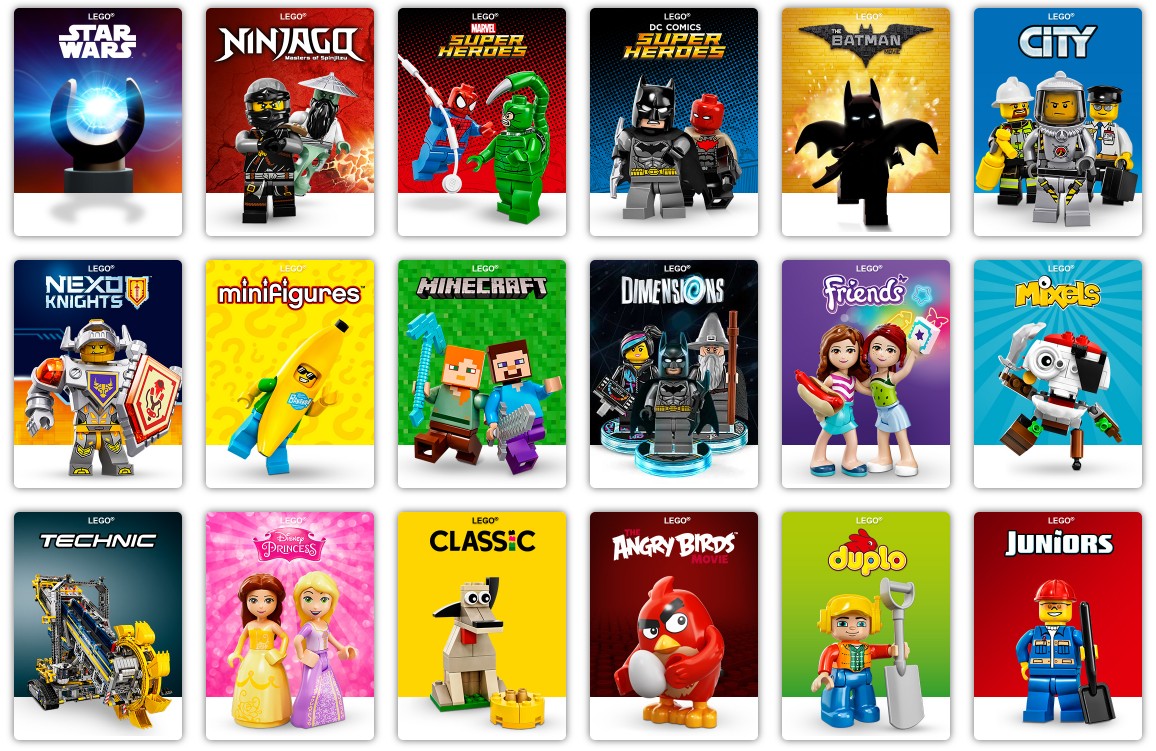
They switched from these all purpose “Universal Building Sets” to a lineup that included more of predefined kits – models that must be assembled precisely one way, or they’re wrong.

Why would these pre-defined kits of LEGO blocks sell so many more copies? As Seth Godin says, it is because they match what parents expect and what kids have been trained to do.

Lego Products Page

(The LEGO products page today, with a disproportionate focus on predefined kits)

These discourses on cursive handwriting or LEGO are metaphors of what’s happening with schools around. 

By the turn of the 19th century, the biggest challenges of our newly minted industrial economy were two fold.

  1. finding enough compliant workers and
  2. finding enough eager customers

The school system – that most of us would have been brought up under – evidently solved both problems.

But the world around has changed into a culture that celebrates ideals like ingenuity, connection, ideas, courage and risk Vs one that only promoted values like conformity, obedience and risk aversion.

Sadly our schooling system has changed little from that originally envisaged for a completely different era. (More in Seth Godin’s must read manifesto ‘Stop Stealing Dreams – What is school for?’)

So a scene with a class full of students repeating ad nauseam after their teacher, rhymes or lessons that only serve the purpose of further perpetuating outdated or worse still outlandish values against today’s realities is certain to provoke anger and perhaps even instigate an active change in our world view. 

Two brands have recently used this very scene, to demonstrate how deeply we have tried to graft our misplaced conceptions of ideas around individualism and beauty in our children.

Nike’s Minohodoshirazu

Earlier this month, Nike Japan  launched a new campaign with a spot that redefines the phrase ‘Minohodoshirazu’, which translates to “Don’t know your place.” While the term is typically used as an insult towards the overly ambitious, the anthem ad tells viewers that not knowing your place can instead be a mindset for athletes to strive for. (source)

Created by W+K Tokyo and directed by Omri Cohen, the ad manages to contrast the values being embedded in children with shots of athletic achievements that run counter to these messages of compliance and obedience. Video here.

https://www.youtube.com/watch?v=WvvpKGVOf0Q

Dove’s Is That You? 

The famous nursery rhyme ‘Chubby Cheeks, Rosy Lips…’ is used as the background score for this video created by Culture Machine (and subsequently pitched to Dove).

The rhyme and the contrasting visuals make you wonder if this is how we have sought to institutionalize a misguided set of beauty ideals in generation after generation of young girls, every single year. Video here.

It is always interesting to see different brands, different agencies from different parts of the world adopt a similar executional approach to land their respective ideas.

(Featured Image: Source)