Fruit Flies, Technology and Heritage

Context: I was recently invited by Ahmedabad University Centre for Heritage Management to deliver a “curtain raiser keynote” (had to look up what that meant) at their annual research conference – The 5th International Conference on Heritage Management Education and Practice. Organized between March 15 – 17 2024, the theme of this year’s conference was “Intersections of Heritage Economics and Digital Technologies”.

When I had first received the invite, I was pretty certain that there must have been some mistake, for I had/have no authority to speak on the subject. But long story short, I took up the challenge and delivered my keynote at the Ahmedabad University CHM research conference. And to my absolute surprise, the presentation ended up receiving very positive (and very kind) feedback from the attendees. So I thought I would put it out here on brandednoise to solicit further ideas/ inputs.

So here goes my presentation. This is the direct ‘slide by slide’ rundown along with my speaker notes. Barring extremely minor tweaks (that I have incorporated to aid readability of the content as a blog post), this is my keynote – as is, in full.


Esteemed leaders – current & soon to be – from academia, research, policy and the practitioner community. It is such a privilege to be here amidst you all, precisely because I belong to none of these groups wrt the domain of “Heritage Management Education and Practice”! At best, I may call myself an observer as I seek to soak in, participate and contribute to the topic of the conference today “Intersections of Heritage Economics and Digital Technologies“.


When I thought about the rapidly growing role of Digital Technologies in Heritage Management, I naturally thought about how the technologies of AR/VR, Artificial Intelligence & advances in Cloud Computing are transforming how we interface with Heritage & Art. 

I thought I’d talk about Google’s platform where all this comes to the forefront – Google Arts & Culture. And how it uses technology to elicit user participation, engagement and drive co-creation of experiences wrt art & heritage.

But here’s the thing – that would be my “comfort zone”. 

And I thought, this is a research conference – and one of its kind at that! And what is a research conference if we don’t step beyond our comfort zone – a slight bit. That zone where we do a bit of philosophising, theorising and some crystal ball gazing, if you will? 

And that’s what I am going to do over the next few mins here. So indulge me here 🙂

My argument (or more precisely a premise) in a nutshell is as follows… 

It is clear as daylight that digital technologies have incredible value wrt heritage management & practice. 

But I’d be doing a disservice if I focus on just this aspect of technology – which is just the “tip of the iceberg” , For, if we do that we’d perhaps end up focusing on just a small subset of possibilities: i.e., digital technologies as just “techniques” to be used.


I am going to take a few more steps further and argue that Digital Technologies have an even more foundational role to play wrt the domain of heritage management. For, if you view Digital Technologies for what they truly are or what they truly can be, you could perhaps even see them as enablers of new ontological, epistemological and axiological perspectives of the domain.

So I’d say that Digital Technologies can have a lot to contribute to (even) the core philosophical foundations of heritage as a construct.

Let’s unpack that.
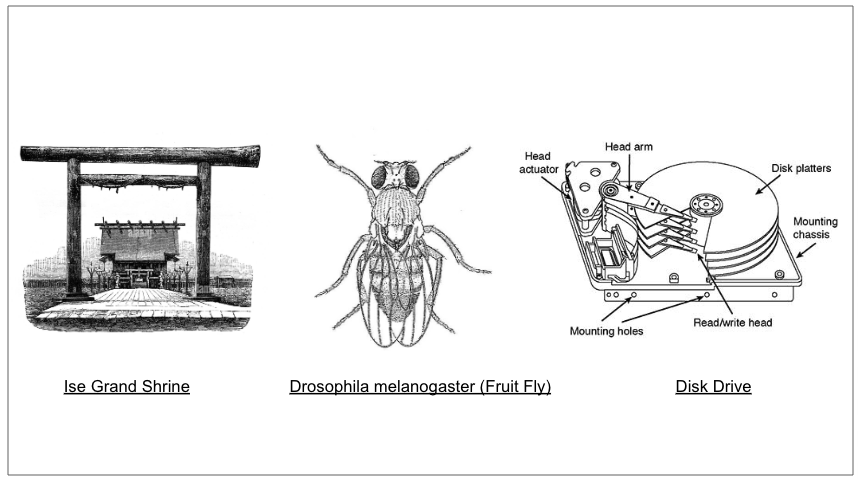

I’d like to start by asking a question. What is common amongst these three.

  1. A 2000 year old Japanese Shinto Shrine 
  2. The Drosophila melanogaster a.k.a the “fruit fly” 
  3. The hard disk drive

Have a think.


Let’s start with the Ise Grand Shrine – a.k.a .Ise Jingu

What can this 2000 year old Shinto shrine have to do with Heritage Management and Digital Technologies?

The Ise Grand Shrine – a Shinto Shrine – in Ise, Mie prefecture in Japan has been preserved exactly like it was around 2,000 years ago. Despite such a rich legacy, it doesn’t figure in the UNESCO world heritage list.

Why?

This is because the shrine is not built of a ‘permanent structure’. The Ise Grand Shrine is built of wood and hence it gradually loses its structural integrity over years. 

So the Shinto priests have a solution;  every 20 years they tear down the structure and rebuild another – in an adjacent plot –  in exactly the same specifications as the original using the wood from the same forest that the original structure was built from. 

Result: the shrine is forever new, ancient and original! 


The Shrine is currently in its 62nd reconstruction, the next reconstruction will be in 2033.

Despite not being on the UNESCO’s World Heritage list, the Ise Jingu Shrine is one of the highest visited Shinto shrines in the world! Now that’s saying something about Heritage Economics 🙂  

What can a 2000 year old Shinto shrine have in common with Digital Technologies?

It goes by the name “version control” / “generational cycle management”. 


The definition of Heritage is anchored around the core concept of “generations” 

  • What qualifies to be called as ‘legacy’ by a generation?
  • How does one generation view the legacies of an older generation? 
  • And what are the socio political cultural & economic imperatives that influence how a generation preserves its ‘legacy’ for its future generations?

And we can’t speak about generations without speaking about the Strauss Howe Generational TheoryWhat it essentially states is that history repeats itself and the sooner we understand the socio – political – cultural and economic contours of the same, we will be better served.

First a few building blocks of the theory:

  • Let’s take the average human life span as approx. 80-90 years. This is called a Saeculum and consists of four periods of approximately 20-22 years each. Which are (1) Childhood (2) Young Adult (3) Midlife and (4) Elder hood.
  • A generation – as we know – could be thought of as an aggregate of people born approximately every 20-22 years.
  • Each generation experiences “four turnings” every 80-90 years. They are (1) High (2) Awakening (3) Unravelling and (4) Crisis.

In essence, the cyclical nature of these “four turnings” could be stated as follows:

  • “Strong people” create “good times” (in general)
  • “Good times” create “weak people”
  • “Weak people” create “hard times”
  • “Hard times” create “strong people”
  • “Strong people” create “good times”
  • and it goes on…

Throwing all these elements into one chart gives us a view like this one about American generational cohorts – where you can see this cyclicity emerge across generations punctuated by the four turnings. And at any given point in time we have multiple generations co-inhabiting the time space. And the interplay between these generations is what leads to the socio political and economic imperatives that we grapple with as a society.

And the world around us – here and now – is this ‘laboratory’ where one can study this theory play out across generational cohorts.
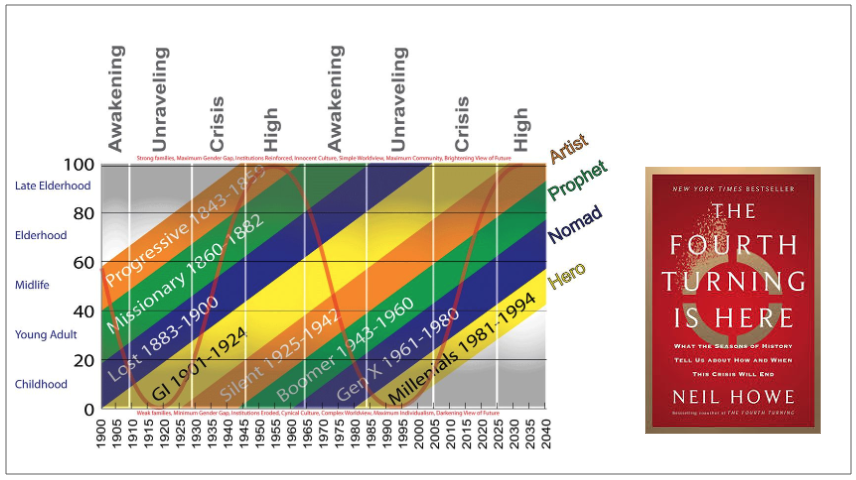

In fact in their book “The Fourth Turning is here” the authors of this theory argue that we are collectively living through the “Fourth Turning” now. The book has been called prophetic given how it seems to have ‘predicted’ way back in 1997, many of the socio political economic cultural and technological realities that we have seen ourselves grapple with over the last two decades in this millennium.

Now let’s conduct this thought experiment.

What if we were to set up a lab where we can observe these inter generational forces at play along with their fall outs? Only this time, the generational intervals are much shorter, thereby allowing us this rare opportunity to get a sweeping view across multiple generations during one single life time.

Wouldn’t we then be able to identify hypotheses, build models, test theories and perhaps even build grounded simulations around how the notions of heritage emerge, propagate and evolve over generations?


Studying species with short generational intervals is not a novel concept. Today, scientists study evolution in species with short generational intervals. This allows for direct observation of changes over many generations, which wasn’t possible in Darwin’s time.

This is Prof Thomas Hunt Morgan who was awarded the Nobel prize in medicine in 1933. His genius lies in establishing the Drosophila melanogaster as the model organism in the study of evolutionary genetics. Why? Because, the whole life cycle of the fruit fly is relatively rapid and takes only 10-12 days

Over the last century, this discovery has led to an exponential rise in research productivity across a diverse range of topics including genetics, embryonic development, learning, aging, behavior and more.


This is Prof. Clayton Christensen who has developed the theory of “Disruptive Innovation”. Reportedly..

Someone told him that disk drives were the “fruit flies” of technology: they were ideal subjects for studying innovation, because a generation in disk-drive technology was incredibly short. He saw that the companies that made fourteen-inch drives for mainframe computers had been driven out of business by companies that made eight-inch drives for mini computers, and then the companies that made the eight-inch drives were driven out of business by companies that made 5.25-inch drives for PCs. 

What was puzzling about this was that the eight-inch drives weren’t as good as the fourteen-inch drives—they had a lower capacity, and a higher cost per megabyte—and the 5.25-inch drives were inferior to the eight-inch drives. So why hadn’t the fourteen-inch-drive companies simply started producing eight-inch drives? It didn’t make sense.
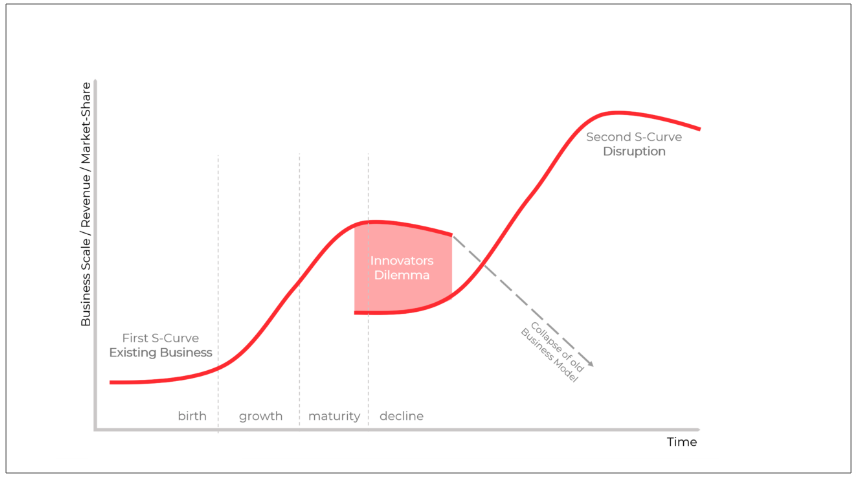

The genius of Prof. Christensen lies in studying innovations in products/categories which have incredibly short generational intervals and rapid evolutionary cycles in order to identify the organizational, economic (and sometimes even political) imperatives that could lead to an incumbent getting ‘disrupted’ by a new entrant in an industry.


In many ways, this – exercising our focus on digital technologies as our canvas – could be inevitable as they pretty much characterise the times that we live in. Students of economics would know the Kondratiev Wave which pretty much says the same thing.

This shows the pattern in the societal waves of advancement since the industrialization era. A few things that you can immediately observe, (1) every k-wave (which is characterized by the dominant technologies of its time) is shorter than its previous wave. (2) We are today living through the 6th K-wave, which could have an even shorter interval span, and finally (3) this wave (loosely estimated to be the one between 2010-2050) could probably be the one around “intelligent technologies”.

Central theme here: Technology’s shorter generational cycles and how that creates a second or a third order influence over the corresponding socio, economic, political and cultural forces at large. It’s pretty much the story of our times.

Let’s take a few examples.

Many people would know what this is.

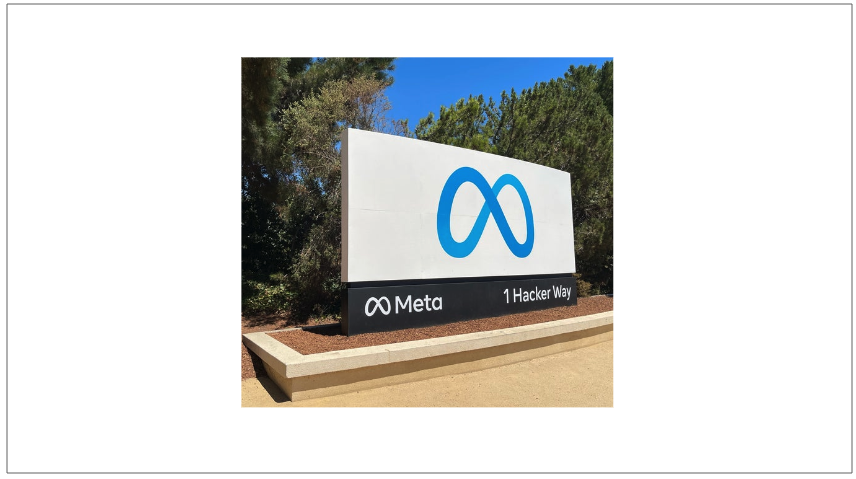
This is the signboard of Meta at their corp HQ at Menlo Park, California. Many people come over here to get their pictures. But not many would know that this has a peculiar “feature”.


Sun Microsystems (est. 1982) had gone defunct in 2010. Subsequently, Facebook has bought over and remodelled the property as its global headquarters by 2011. And instead of replacing the Sun sign, Facebook just flipped it over and put Facebook’s name (now Meta) on the front(!)

Beyond serving as a homage to Sun Microsystems as a company that had significantly contributed to several key computing technologies, many see this as an intentional ‘reminder‘ to those looking from within the campus.


Many of the logos that you see on the left belong to those brands that had been global leaders in their own right. They had defined standards, influenced culture, and pretty much led to our popular narratives around how societal trends and technologies have a symbiotic relationship given the breathtakingly rapid developments in this space. But today they no longer exist!

At the same time, we also have technologies/digital platforms/ device ecosystems that continue to see strong evolution over the times. For e.g., many would know that 2024 also marked the 40th anniversary of the Apple Macintosh and one can’t over-emphasize its socio cultural influence (that spanned several domains) over the years.


It is to chronicle these very stories in technology and with a stated mission to “decode technology—its computing past, digital present, and future impact on humanity” the Computer History Museum (CHM) at Mountain View California prides itself as the largest repository of computational artifacts under a single roof. The museum presents stories and artifacts of Silicon Valley and the information age, and explores the computing revolution and its impact on society.


I would like to believe that it is not an accident that the CHM’s core belief about the inter generational value of computational technologies has parallels with how UNESCO defines ‘heritage’.

(as a fun aside, I couldn’t help but notice the fact that the Centre for Heritage Management and the Computer History Museum share the same acronym!)
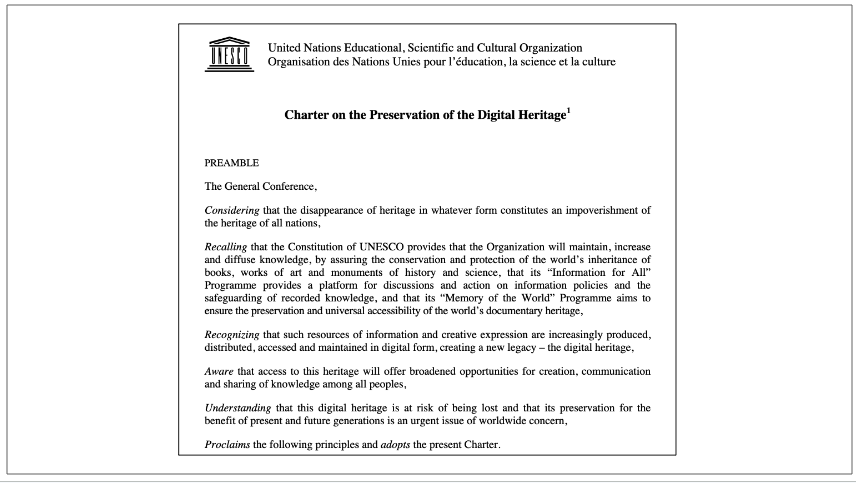

Therefore, the UNESCO’s charter on the “Preservation of the Digital Heritage” proposed in 2009 is a good start to the conversation. But we have a lot more to do.

Given rapid bursts of new technology breakouts coupled with ever shortening generational time spans of these technologies such as AR/VR/AI/Cloud etc, their ever expanding and evolving influence over practically every domain of our existence has a near axiomatic appeal wrt the socio economic political and cultural discourse of our times.


And that leads us to more fundamental questions.

  • What is digital heritage? (a question with an ontological lens)
  • Why study digital technologies in the realm of heritage research? (a question with an axiological lens)
  • What standards inform digital heritage identification? How do these influence how we experience & identify tangible and intangible heritage artifacts? (questions with an epistemological lens)

By virtue of the inquiry along these lines, I would posit that we might soon need to reconsider broader perspectives to help us answer even the central ontological question in our domainWhat is heritage?


And that’s why I would argue that Digital Technologies have even more foundational role to play wrt the philosophical aspects of heritage management. 


We spoke about the Kondratieff Waves a few minutes ago. Another way to look at these waves, especially in the context of Heritage Management is as follows:

  • What a generation calls as ‘legacy’ could be that which it perceives as the vehicle or the marker of its ‘progress’.
  • While the first few (known) millennia of the chronicled human history saw progress around the vectors of “transforming material”, the next set of waves – characterized by a dramatically reduced scale (of centuries) – could be seen as a commentary on our progress around the vectors of “transforming energy”
  • And today, our progress (and thereby what we’d perhaps call as the legacy of our times) can probably be characterized as that pertaining to “transforming information”
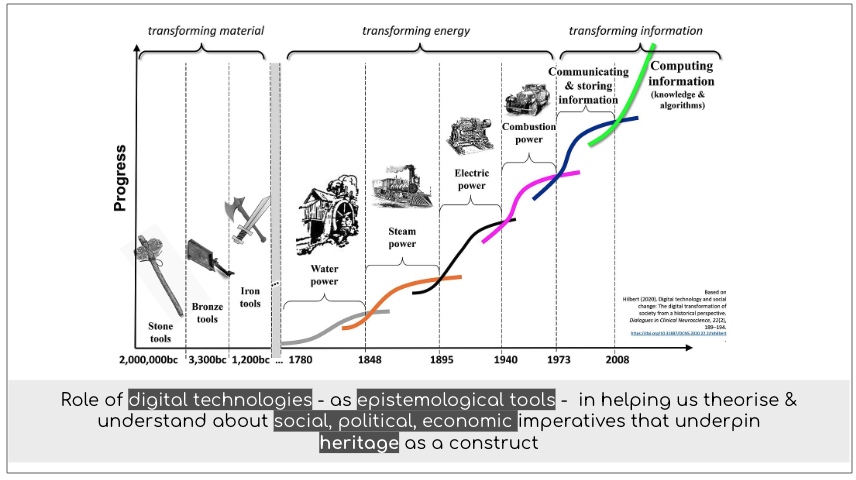
And that leads to the question about: the role of digital technologies – as epistemological tools –  in helping us theorize about and understand the social, political, economic imperatives that underpin not just ‘digital heritage’ but also the construct of ‘heritage’ as a whole.


And therefore just as the Drosophila melanogaster (fruit fly) ended up becoming the “model organism” that revolutionized the research in evolutionary genetics, just as the hard disk drives helped serve as the “fruit flies” for research on innovation management, my premise I submit for your consideration – phrased as a question- is as follows…
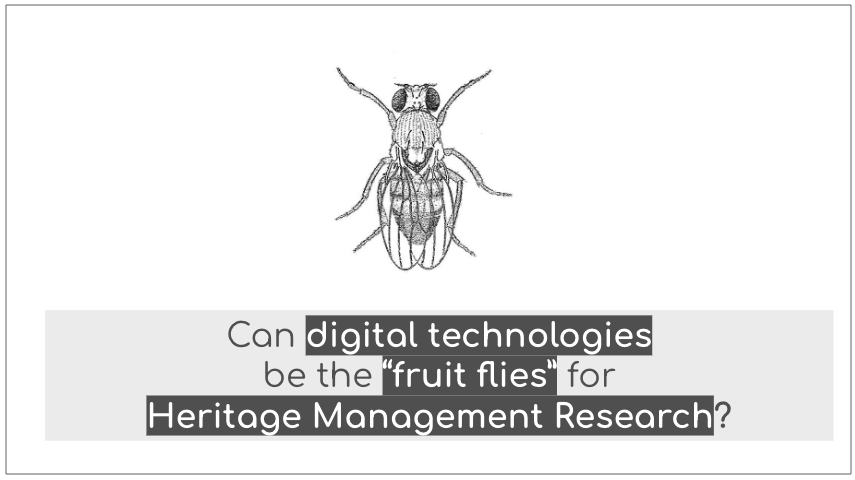

Can digital technologies be the ‘fruit flies’ for research in Heritage Management?

Thank you once again for the opportunity and I wish The 5th International Conference on Heritage Management Education and Practice at the Centre for Heritage Management, Ahmedabad University a grand success!


Of Similarities and Split Screen

Quick Read: There are ads that try and communicate a message of ‘contrast’ and there are those that communicate ‘similarity’. While the former type of ads ride on a diverse set of story telling devices, there seems to be an interesting trend in the story telling devices deployed by the latter set. It’s the ‘Split Screen’.

A lot of advertising is meant to tease out / explain / amplify an element of a brand that is supposedly in contrast w.r.t the competition. Think about it for a moment and think of the core narratives behind most of the ads that you see around.
A lot of advertising narratives tend to fall into this camp, where they try to land a message through a narrative that is designed to communicate a contrast – sometimes in a straightforward manner or sometimes in perhaps a tongue in cheek style.
A few share worthy ads of that kind below.
1. Jeep,  Anti Manifesto
(Agency: Arnold Worldwide. H/T: Bhatnaturally)
And oh, btw just for fun, see this one and it’s hard to not think that the Jeep’s creative team didn’t have this in mind while conceptualizing the above work.
2. Fevicol, Ezee Spray
(Agency: Ogilvy)
3. Eko Kom, Flight Attendants / Garbage Collectors
 
(Agency: Havas, Prague. H/T: Bhatnaturally)
As you can see, ads that have ‘contrast’ as the core message, ride on a diverse set of story telling devices.
Interestingly, this is in contrast with ads where ‘similarity’ is the core message.
When similarity is the core message..
.. there seems to be an interesting trend in the story telling devices that most of them seem to draw upon. Most of such narratives are rooted in a singular story telling device – the split screen.  
Sample the following examples.
1. The Day Before 
(Agency: Leo Burnett Chicago)
2. McDonald’s
(Agency: Agency: Leo Burnett Chicago)
3. John Lewis
(Agency: DDB Worldwide)
4. Coca Cola UK
(Agency: David The Agency, Buenos Aires)
For the record, the split screen as a story telling device has also been used in ads that seek to communicate a contrast.
Like this one from Apple.
In fact this entire campaign for iPhone (in May 2017) had creatives that all used the split screen.
What other story telling devices have caught your eye in the recent past?


Ideas And Their Six Degrees Of Separation

Quick Read: Ideas, like people, could be said to have their own “6 Degrees of Separation” i.e., any idea in the world can potentially be related to another idea in the world with a maximum of 6 connections. And if this hypothesis is right, it can have major implications on marketing. 

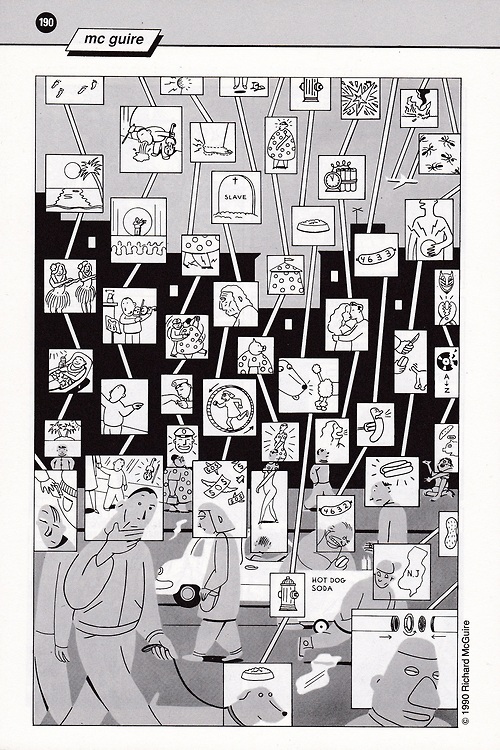
What are you thinking right now? This comic by Richard McGuire appeared in 1990.

Richard McGuire(What Are You Thinking Right Now, Richard McGuire. Source)

While it is a wonderful comic and a fun reflection on how we think, for me it is a brilliant work that manages to encapsulate within the confines of a comic panel – the interconnectedness of our thoughts and ideas.

Speaking of which, just as this theory that any two people in the world can be connected to each other with a maximum of 6 steps, my hypothesis is that:

Any two ideas in the world can be related to each other in less than or equal to 6 degrees of separation. 

In other words, if you think of each idea as a node, I contend that you could potentially connect any two nodes in the “idea universe” with a maximum of 6 connections.

(One way of proving this could be as a corollary of the 6 Degrees of People Separation and mixing it with the notion that ideas make a man. And voila! You can have even a far right capitalist ideology being related to a far left communist ideology within 6 degrees of separation.)

people-exchanging-ideas-26061929(Ideas and connections, stock image)

Why is this fascinating? If the hypothesis is proven right, it can potentially have two major implications on how ideas can be sold.

Implication #1: 

Let’s take Recommendation Engines, the intelligence behind “If you like this, you might also like these” kind of recommendations that you see on Amazon

A good recommendation engine – in search, videos, online shopping, travel etc.,  has far reaching implications in delivering more relevant content to users, thereby driving sales and growing retention within the platform. In fact, as per many accounts, some companies have even gone so far as to realign their business objectives in light of recommender-driven demand, such as Netflix, Amazon, Microsoft, Disney and Apple.

Now, what if we abstract this concept of “six degrees of ideas’ separation” into an iterative, machine learning algorithm that can build up, in real time, a user’s idea map – i.e., a construct that maps out the interconnectedness of user’s ideas?

We can then perhaps use it as the back bone of a more powerful recommendation engine.

So instead of dishing out nearly hard coded, precedent based recommendations – with imperfect results –  what if the smart logic embedded in the recommendation engine can rapidly learn, iterate and replicate my idea map resulting in recommendations that almost feel like – mind reading?

That’s when I might be able to see breathtakingly personalised assortment of search results, advertisements, content and retail options appear in front of me almost at the speed (and diversity) of my thought.

Implication #2: 

Given that any of my existing ideas can potentially be connected to other ideas – and thereby products – out there, having an insight about my idea map can potentially help you sell me a new product/service. How?

By carefully structuring your sales pitch in a way that takes me gently through the different related nodes from my existing ‘idea state’ to a new ‘idea state’ that could probably help me better relate to your product.

Easier said than done, I am sure. But the outcomes here could be as thrilling as they could be scary – a signpost of every major scientific advancement over the last few decades.

On a related note..

If you enjoy the creative process of discovering and connecting disparate ideas into an insightful whole, check out Seenapse.

Seenapse

A creative technology start-up, Seenapse is an ‘inspiration engine’ that assists in your creative process by exposing you to non-obvious idea associations between seemingly disparate concepts. It is currently in a closed beta but you can get an invite by using the code: strandsofgenius. (source)

(Featured image source. H/T Austin Kleon for the riff on Richard McGuire and Faris Yakob on Seenapse)

—————————-

PS: This is my 100th blog post on BrandedNoise which got its 2020th subscriber today! A big thank you to all the readers out there who have been the source of my strength, inspiration and support. Looking forward to many more blog posts to come and a journey fuelled by creativity, curiosity and fun. A big thank you once again!!

Selfies And The Art Of Sky Diving

Quick Read: Selfies as a mode of expression via pictures, videos or 3D shapes is gaining main stream traction. GoPro is a fascinating company that took an unmet ‘selfie need’ and expanded it to encompass newer grounds with great success, while gaining a cult like status.   

It is believed that Robert Cornelius took the first ever selfie in the year 1839. 

Ever since then, over the span of  175 years, the humble selfie has evidently made spectacular inroads into our popular culture. Today we see world leaders, hollywood celebrities, protesters in police vans and even the Pope having all smiles for the selfie. No wonder then, today we have:

In fact – given our recent advancements in 3D printing – it is inevitable that we even have the 3D printed selfie today!

twinkind_window_5126(3D Selfies. Source, TWINKIND)

According to this paper, while selfies have been called different names like  a symptom of social media-driven narcissisma way to control others’ images of usa new way not only of representing ourselves to others, but of communicating with one another through images, or even as the masturbation of self-image, the one that stands out the most for me is the concept of selfie as a device to control others’ images of us. 

This primal urge to control others’ image of us seemed to have proven to be a gold mine for a company that is now on its way to a hotly anticipated IPO. Think Video Selfies. And think about all the exciting activities like surfing, skiing, snowboarding, auto racing, river rafting, sky diving etc. And you get the picture.

Hang on. Did we just say ‘Video Selfie’?

GoPro

2002. On a surfing trip to Australia, Nick Woodman wanted to take a selfie. Albeit with a twist. He wanted to capture quality action photos of his surfing. Having met with limited success, his desire for a camera that could capture him surfing in ‘professional angles’ started to take shape. And thus the name ‘GoPro’ was born for his company that would subsequently go on to sell small, waterproof, wearable cameras that you can use while doing exciting stuff.

GoPro-surfing-longboard-600x400(How to take kickass selfies with GoPro. Source)

Today GoPro makes what it calls ‘smaller, lighter, mightier still’ HD video cameras with a 170-degree angle view under their line up of HERO series to capture and produce high quality content along with an entire ecosystem of mounts, accessories, software and applications.

But what makes GoPro an extremely fascinating brand is the street cred that it earned for itself as an unconventional media company. Sample these..

The GoPro Ad: Instead of advertising, the company aggressively hands out GoPro cameras to extreme athletes asking them to simply shoot and bring back their footage. A small in house team then edits the footage, slaps a hip sound track, throws in the GoPro logo and boom – A stunning free GoPro Ad! (Interestingly – given the versatility of the GoPro camera – a lot of footage that they get from users is so astounding that people are known to insist it had to be fake.)

GoPro on YouTube: GoPro’s YouTube channel ranks among the top 100 with nearly 2 million subscribers and 455 million views of its 1600+ videos posted till date. In fact as per this article, the number of videos with “GoPro” in the title has grown so much—60 percent from 2012 to 2013—that watching 2013’s crop alone would take you 2.8 years. Reportedly GoPro is expected to make about $1.7 million per year from its YouTube channel alone.

The GoPro Channel: In CES 2014, GoPro announced plans to unleash its unique brand of action sport videos on Xbox Live for both the Xbox One and 360. In fact, Virgin America inflight entertainment system already lists this channel that features curated GoPro content where users will also be able to purchase GoPro products directly online.

Expanding cultural footprint of GoPro’s media content: GoPro has strategically carved an outsized cultural footprint for itself by being part of several high points in recent history. Take the recent opening ceremony of the Sochi Olympics, where many athletes were seen filming themselves with GoPros or Felix Baumgartner‘s record-breaking jump from 128,100 feet for the Red Bull Stratos mission. Chances are that you must have seen the footage filmed by one or more of the seven HD GoPro cameras used in the mission.

(GoPro Super Bowl Ad 2014 featuring the Red Bull Stratos mission)

GoPro, Apple and Red Bull: While some observers see GoPro as a company that clearly wants to create a kind of ecosystem, similar to that of Apple, with a devoted fan base addicted to its hardware and software and a thriving core of creators and consumers, there are also those that think, GoPro could make for a new sort of hybrid company, the way Red Bull is both a drink maker and powerful media brand.

Jason Stein, founder of Laundry Service, a digital media agency in New York even says:

“Red Bull has become this media entity, created around the lifestyle of people who drink Red Bull, GoPro is doing the same, but the reason I think they have more potential is that their product is an actual media device.”

Hence analysts expect that GoPro could create revolutionary possibilities in content creation and consumption in the days to come. This article even speaks about a future possibility where the company could sign agreements with sports leagues to place GoPros within the games. So when you tune into your NBA or NFL or IPL, imagine getting a live feed from whichever player you want!

Beyond Hardware

Evidently the GoPro story is no longer about a hardware maker that had captured two-thirds of U.S. sales and 45 percent of the global pie of the pocket digital camcorder segment (source).

It’s about software and experiences. It’s about enabling awesome creative expression and adrenaline packed content production – the non traditional way. It’s about brilliant marketing that is inspired by this unique culture. All borne out of one key human need – to be able to influence other’s image of us by showcasing those fleeting experiences and moments that (we think) could define us.

Like perhaps a selfie.

Block By Block – A Consumption Focused Design Paradigm

It took more than a 100 years for inkjet printers to become commercially viable. The reason?

Severe interdependence of the components and underlying systems. 

For e.g., even with the slightest change in the chemistry of the ink, the composition of the resistors had to be changed, and this potentially impacted the physical layout of the circuits and so on.  The solution for this?  Modularity of design. 

Wikipedia defines modularity as ..

 the degree to which a system’s components may be separated and recombined.

Today most tools, gadgets, processes, systems, structures, designs that we interact with on a daily basis have modularity built from deep within. Right from the nuts and bolts of a system to the way it has possibly been put together on an assembly/production line, modularity is all pervasive.

In fact it is almost accepted wisdom now among designers and manufacturers that the speed at which an innovation can be commercialized is directly proportional to the speed at which the underlying design (of the system) and the process (of the assembly or integration) is standardized and modularized.

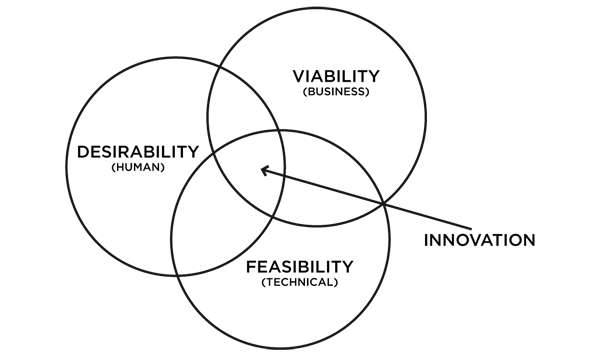
Now consider the above statement in conjunction with the following self explanatory paradigm of Design Thinking evangelized by IDEO, called the Desirability – Viability – Feasibility triad of innovation design. 

IDEO

Based on the above two, my hypothesis is the following:

While modularity in the context of production has almost proven itself to be a pre-requisite for establishing technical feasibility and – in many cases – for driving business viability of a given innovation , modularity in the context of consumption – if done right – can have far reaching implications in seeding the attributes of human desirability for the same.  

Three recent examples that seem to suggest the compelling potential for modularity in the context of consumption as a design paradigm:

(1) Phoneblok: Most of us, by now, would have seen this short video on the idea of building a phone with modular detachable blocks. This  presents the idea of Phonebloks –  hailed as a radical vision of what tech could be. The idea for me, is sheer ingenuity and insight. The possibilities  of such a consumer focused modularity in design seem to be truly empowering and liberating.

(2) NoFlo – A Flow Based Development Environment: The philosophy of Modular Programming is the default standard in most coding systems. But this modularity was mostly – for lack of a better term – limited to the realm of abstraction and ideation, since the corresponding code nevertheless lends itself as ‘strings of spaghetti’ and presents challenges for debugging compilation and logic errors.   With NoFlow as a development environment, modularity can be made more tangible and actionable in order to help inform, structure, design, test, debug and implement a complete software package.  The following is the video put together by the team for their Kickstarter campaign to raise funds (the funding was successful!).

(3) Modularity in content consumption: Unleashing the power of modularity in the domain of content consumption is in fact the name of the emerging game. Platform agnosticism is one of the many ways in which modularity lends itself in the consumption context for services like Amazon, Youtube and now Dropbox.  The latest edition of WIRED in fact features a fantastic story on  Dropbox’s radical plan for a future where “the gadgets are dumb, the features are smart, and data trumps devices.”

Dropbox

So there we have, emerging examples of modularity in the context of consumption (as opposed to only production) and how they promise to pan out in mobile, software design environments and cloud based architectures. Something for the technology powerhouses to sit up and take note? In fact in a recent interview with Forbes Clayton Christensen worries about Apple saying Modularity Always defeats Integration! 

Even in life as usual as we know it, no matter what we do from fixing a meal, concocting a cocktailassembling a piece of furniture, to laying out our Google Newsfeed, there’s always been a sense of joy, an inexplicable sense of desirability that we had for our stuff, for after all, it was our creation.  Step by step. Block by block. Isn’t it?

(Source for the featured image)

Icons – The Visual Metaphors Of Our Culture

Ever wondered what could be the primary cause of our childhood fascination with cartoons? I did. Tons of times in fact. With little success very often.  Thankfully for me Scott McCloud in Understanding Comics gives a clear and a straightforward explanation for that.

Understanding Comics Pg 36

(Scott McCloud, Understanding Comics, Pg 36)

Essentially, he posits,  the mental picture that we we have of ourselves is simple and basic . Therefore, we are able to project ourselves into the ‘simple character’ but not the ‘complex one’.

The obvious lesson here that is applicable to advertising could be – if you want your audience to feel like they are the main character, make sure the character isn’t overly elaborate and detailed.

The classic iPod ads of 2001  have smartly taken this theory a step further by featuring just a set of male and female silhouettes.

iPod

(Image Source)

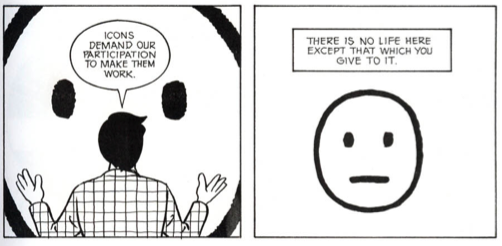
This abstraction of pictures from reality to icons is thus a powerful mode of expression that comics (and comic artists) have deliberately and meaningfully perfected over the years.  For, after all, (visually) quoting Scott..

Understanding Comics Pg 59

(Scott McCloud, Understanding Comics, Pg 59)

“There is no life in an icon except that which you give to it.”

While this insight forms the cornerstone of what constitutes the vocabulary of comics, it lends a very powerful commentary  that is relevant for our practical lives too. Let me explain.

Just like we are said to be exposed to thousands of marketing/ brand impressions per day, I’d wager that we are also exposed to as many (if not more) iconic impressions each day. While a brand’s logo – by definition – could also be called as an ‘icon’, my focus here is more on icons that constitute the typical signage/symbols that we are used to seeing all around us each day – e.g.,  traffic signage, safety signage, industrial signage, traveler signage etc.

dot_pictograms_full

(DOT Pictograms)

Since these signage icons have been around for years, most of us grow up intuitively accepting them as part of our unspoken language. Thereby they practically end up becoming the visual metaphors of our culture.

Armed with this insight – The Accessible Icon Project was born with a goal to  show a more humanized depiction of the differently abled in the International Symbol of Access.

Symbol of Access

I’ll let you read a comprehensive account of the project here, but the highlight of this guerrilla art project was that it succeeded in reorienting the visual focus of the symbol from the chair to the person, while replacing the rigid, static representation with something more dynamic and active.

Result: The idea has been gaining tremendous momentum around globally as we speak, with NYC becoming one of the first cities in the world to formalize and adopt this new symbol with many disability organizations around the world vehemently following suit.

Metaphors are said to have the power of influencing our ideas, challenging assumptions and creating new world views. And if a picture is worth a thousand words, the power of a visual metaphor like this new ‘access icon’ above can be said to be amplified a thousand fold in shaping our collective biases, informing our cultural opinions and influencing our societal attitudes as humanity.

That’s when things get interesting. Symbolically and literally.

‘Method’ to say ‘Hello’ or ‘Help I am Horny’

There have been countless comparisons between how Microsoft ‘speaks’ via design and how Apple does.The best example is this classic  parody on Microsoft designing an iPod packaging.

Obviously neither of this is necessarily an always right/ always wrong approach to designing a pack or a pack  copy: as that depends upon many factors like the brand’s positioning, its design philosophy etc. But the key point here is that whenever any brand comes with a more inclusive/friendly/simple/’or whatever you chose to call it’  kind of positioning and design, it often breaks the ‘category codes’ and thereby creates a distinctive identity and appeal for itself. Sometimes it could even inspire the existing category codes and set new benchmarks (the recent redesign of Microsoft page for its Windows phone is the best example of how dramatically it is shifting away from its ‘past’ towards something that seems to be inspired by the Apple iPhone page)

Examples for this abound – even in categories like OTC Medication, Oral Care and Household Cleaning, where a handful of brands are slowly but certainly inspiring fresh category codes with their new positioning and design philosophy. A quick look at 3 such brands:

Over The Counter Medication:

Stripping away complexities that typical medicinal packaging bombards patients with, help positions itself as a simple medicine for simple health issues based on its “Take Less” philosophy

Take Less

Each package bears a “Help, I…” line of text, such as “Help, I can’t sleep” for a sleep aid, or “Help, I have a headache” for a package of acetaminophen.The simplicity of the packaging matches the promise of the products, which feature no dyes, coatings, and aim to use only the main chemical needed to treat the patient. By the way –  their recent product is called “Help I am Horny” and if you want to use it, you would “need to fill an application to convince them of your sexual superiority”!

Help

Oral Care: 

Imagine:  an army of germs marching  into ‘whatever it is’ only to be attacked by a flood of chemicals leading to a squeaky clean aftermath. Seems familiar? Interestingly, this imagery could be easily applicable to two diametrically opposite categories: Oral Care and (surprise, surprise..) toilet cleansers!

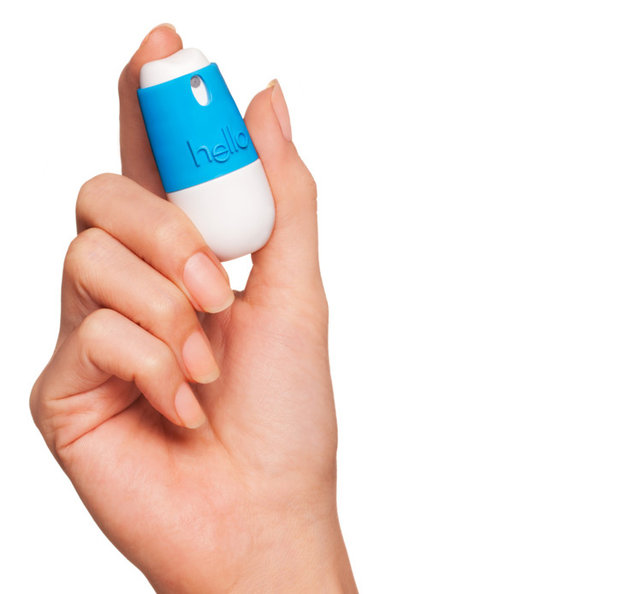
Armed with this insight about the oral care category increasingly assuming the codes of ‘toxic weaponry’ portraying themes of war going on inside your mouth– that need to be eliminated, destroyed & annihilated, Craig Dubitsky created hello– a ‘Seriously Friendly line of Oral Care Products’.

With packaging designed by BMW group’s creative consultancy DesignWorksUSA, hello is an accessible brand for the ‘average consumer’ with the entire mix designed towards one purpose: bring in a fresh breath of friendliness to Oral Care.

HELLO

Household Cleaning

Speak of detergents, dish washing & household cleaning – and it might not always be the  most inspiring conversation and might not always bring a sparkle to the eyes or flushes of joy and excitement.  In 2001, Eric and Adam set out to change this – by creating cleaning products that “people didn’t have to hide under their sinks” and went on to become one of the fastest growing companies in the category. Read their story here.

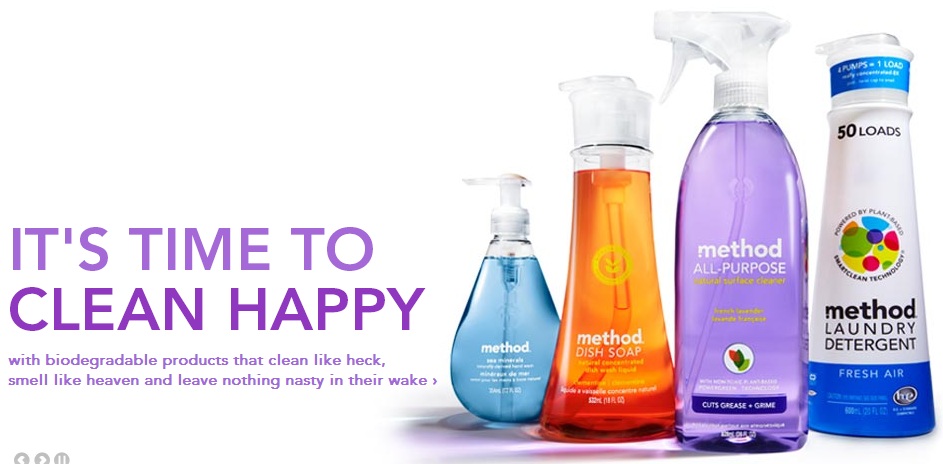
Method

Method with its stylish, eco-friendly products has not only inspired legions of people with its products (did you hear of MethodLust – an independent blog titled as: “one man’s unsupressed lust for all things method”) it has also inspired people to start companies along similar lines (Craig Dubitsky: founder of hello – profiled above – was a board member for Method).

Speak about enlivening some of the most prosaic categories in consumer marketing.

The 12 Most Viewed Posts of 2012

tumblr_inline_mfqegiNdi41qa5woe

The following blog posts received the top 12 pageviews at BrandedNoise in 2012.

1. The Power of Imagination. Unleashed

2. The Best Touch Points for Marketing Fabric Conditioners in India

3. Colors

4. Minimalism and Apple

5. Marmite, Mouthwash and Microsoft

6. 100 Days of Branded White

7. The IKEA Effect

8. Pulling the Triggers on Behavior

9. The Most Iconic Photograph Ever –  On Perspectives

10. The Uninvited Design – Agencies Beware

11. The Job Hunt – Part 1/3

12. Targeted Sampling

Interesting Times Ahead: Of Robots, Supply Chains & Economies

In its upcoming January cover story titled ‘Better than humans’, the Wired magazine provides a compelling sneak peek into the future of our workplace / economy / and our lives where robots or industrial scale automations replace 7 in every 10 of our current jobs.

Robots

Image Source: Wired (Photo: Peter Yang)

One of the most insightful observations in this article is by a MIT professor Rodney Brooks the designer of Baxter – a new class of industrial robots designed to work alongside humans. He says:

Right now we think of manufacturing as happening in China. But as manufacturing costs sink because of robots, the costs of transportation become a far greater factor than the cost of production. Nearby will be cheap. So we’ll get this network of locally franchised factories, where most things will be made within 5 miles of where they are needed.

The first thing that occurs to me is that soon enough Apple Inc., could finally do away with that painful euphemism of “Designed by Apple in California, Assembled in China” for a simple “Made in U.S.A” on its packs. Phew!

But it is only the tip of the ice berg. Some tectonic shifts seem to be underway at industrial scale – literally.

recent story on The Economist about Foxconn: The Taiwanese-Chinese contract manufacturer that notably makes most of the iProducts, Kindles, PlayStations, Wii Consoles and Xbox etc, hints at those very shifts that are rumored to be already underway.

It is well known that besides Product Design, one of Apple’s key strengths is its Supply Chain. In fact with each iteration it does on its product lines (for e.g., the iPhone versions 2,3,3s,4,4s,5..) when there is only so much it can innovate through product design and specs, the obvious place where it would seek recourse would be its processes and supply chain –  cut costs and drive margins. In other words, for every new iterative product version that Apple brings to market there is immense pressure on the company to optimize the basics ofits value chain. Now that’s when things start get interesting.

Tim Cook

Tim Cook at a Foxconn Factory in China (Image Source: HuffingtonPost)

As the largest contract manufacturer in the world, Foxconn gets nearly 45% of its revenue from Apple, so if it has to keep growing and sustaining its lead position, it simply cannot risk alienating its biggest customer. So where do Apple and Foxconn focus their energies upon now? Arguably, one of the biggest innovations that Apple is intently working on is NOT necessarily some uber sexy orgasm inducing tech interface. Rather it is the less glamorous gears and guts of its value chain –  these are innovations in:

  • Manufacturing Costs: Foxconn’s Chairman Terry Guo vowed to build 1 million robots and has hinted that the firm is just a year away from the big breakthrough – robotics that work at scale on commercial lines.
  • Transportation Costs: The article also acknowledges that there have been rumors about Foxconn planning to open a factory in the US.

Just come to think of the impact that these two changes in industrial production and transportation would have on Apple Inc, Foxconn in the short term as also on the economies of US and China in the long term.

Don’t miss the full Economist article (and don’t get misled by its title that seems to focus on Foxconn’s workers’ issues). The big picture is clear. It signals a dramatic yet a silent shift currently underway in the biggest manufacturing hubs around the world. A shift that can soon challenge the conception of developing markets as manufacturing hubs. A shift that can have a dramatic impact on assembly line jobs at the low end of the value chain. A shift that can eventually impact the very nature of economies around the world.

Interesting times. These are indeed.

High time then – the developing economies ought to seek more sustainable ‘business models’. Else let’s just say that things can only get even more interesting.